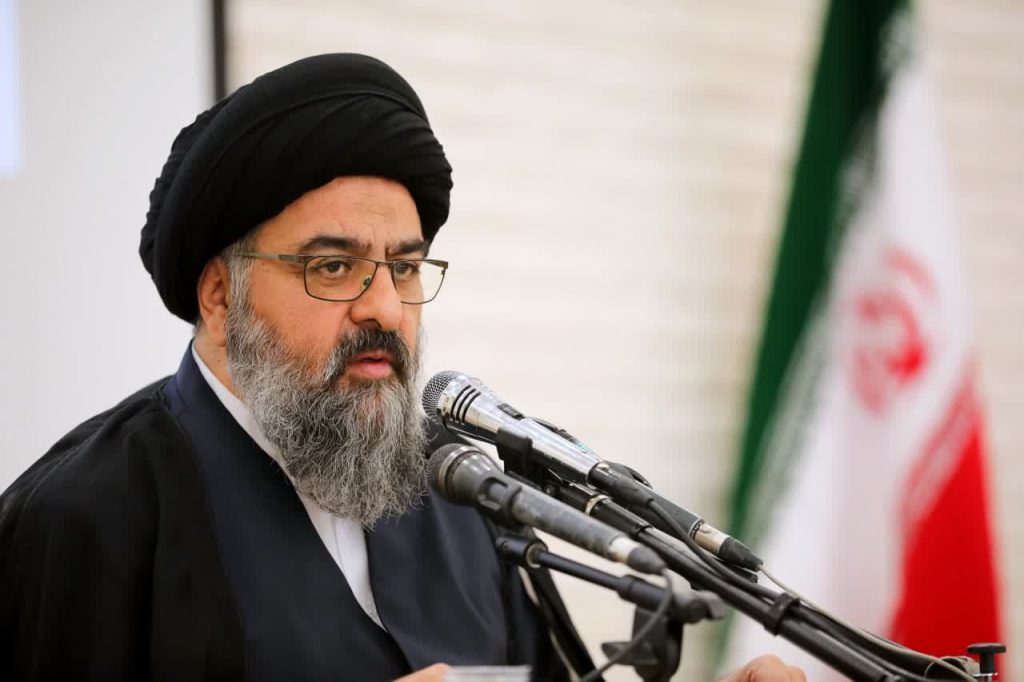
Ayatollah Mesbah Yazdi’s Emphasis on Preventing the Waste of Talent in the Seminary
I will only speak a few words regarding the late Ayatollah Mesbah Yazdi, as I wish to offer a remembrance and reminder. His funeral procession is being held today, so we will dismiss the class earlier. In any case, the demise of a scholar, regardless of their rank, tastes, or thinking, is a loss for the seminary (Hawzah). A scholar, thinker, and someone who has strived and labored in the seminaries is certainly a source of loss when they pass away; there is no doubt about this. Whenever a scholar and thinker departs from the scene of scientific service, a pause in knowledge and science occurs, particularly regarding religious scholars. However, specifically regarding the late Ayatollah Mesbah, I must state:
Perhaps before the Revolution, the first books I read regarding religious and sectarian issues, which were written for teenagers, were books related to the Dar Rah-e Haq Institute. I was perhaps in the first or second year of middle school, and from that time, I would read the books and periodicals that the Dar Rah-e Haq Institute prepared for adolescent and youth audiences, and they were truly impactful. That is to say, the very act of paying attention to the needs of the new generation for religious teachings was highly important. This was perhaps not the case for many individuals, and they did not enter this space much. However, he, along with several other prominent figures such as Ayatollah Kharrazi, Ayatollah Ostadi, and some others, had entered this arena. I exactly remember reading the books prepared with the logo of the Dar Rah-e Haq Institute, and they were indeed excellent books. In any case, they were highly effective and beneficial for elevating the level of our religious awareness in that era. Therefore, since that time, I personally witnessed this service, and it is worthy of appreciation. These labors must be appreciated; fairness dictates that even those who criticize must not step out of the path of fairness in their critique.
After the Revolution, I remember it was the beginning of our seminary studies—perhaps I had been a student (talabeh) for two or three years—when a friend and I went to speak with him and seek his advice. The two of us, as newly entered students, went and got an appointment; he allocated a relatively large amount of time for us, and we spoke with him for about an hour, seeking his advice on our educational programs. The very fact that he placed such great importance on the usefulness and productivity of seminary students was highly valuable to us. He placed great emphasis on the fact that students must study in a certain way, have goals, and be managed so that both they themselves and others derive the maximum benefit. This was a highly important issue that I repeatedly heard from him. Even at that time, he used to say that a number of people enter the seminary and spend years of time and energy, yet they still lack a clear goal and have been unable to set a goal and chart a path for their movement.
Therefore, he placed great emphasis on having a goal in the seminary and making better, optimal, and more effective use of students. He emphasized heavily that much energy is sometimes wasted in the seminary and that we must have a program to prevent this. Right there, I exactly remember that we had a few questions, and indeed criticisms, regarding his institute, his educational method, and its relationship with the seminary. He listened to these with complete warmth and open-mindedness (sa’at-e sadr) and answered us. It was highly interesting to me that he faced us—who were newly arrived students—with such good character, sincerity, and compassion, and guided us. In any case, his efforts over all these years in the seminary and the services he rendered cannot be denied. Both in terms of scientific and missionary activities before the Revolution, and scientific and missionary activities after the Revolution, he truly took effective steps.
When I was studying Nihayat al-Hikmah myself, I observed several professors and did not find any of them to my liking. Consequently, I had to use his recorded audio tapes; at that time, he was not teaching Nihayah live—this was perhaps 35 years ago. In all fairness, in explaining philosophy, he expressed matters in a very smooth and mature manner, and he possessed a critical spirit toward philosophy. From what I perceived—and perhaps before that, I had numerous philosophical questions myself. Usually, at the beginning of entering philosophical discussions, many questions form in a person’s mind, and concepts and propositions are not resolved as they should be. However, he expressed these matters very beautifully and elegantly, and I saw that those very objections and ambiguities that were partly in our minds were addressed by him in his critique of Nihayah. I still possess those writings and the objections that occasionally came to my mind. In philosophy, he was a student of Allamah Tabataba’i and had studied under him for many years; in all fairness, he was excellent in understanding philosophical issues. He would criticize and raise objections, and in this regard, I at least derived this benefit. Of course, I have also benefited from his glosses (ta’liqat) and subsequently his other discussions, both those he presented regarding the human being and the subject of anthropology, as well as his theological (kalami) discussions.
In any case, I deemed it necessary to express these matters, at least because he holds a right over us. This right began in my teenage years, when I was familiar with and utilized the publications of that institute, and continued in the early days of my seminary studies, when I benefited from some of his reminders and points, and throughout the subsequent years, when I benefited greatly from his philosophical and theological discussions. Therefore, I at least deem it necessary for myself to express gratitude for these efforts and to commemorate these services. In any case, the services he rendered to the seminary, the Islamic world, and Islamic thought during these years stand on their own.
Of course, we must know—and everyone must know—that if we do not agree with someone in one area, we have no reason to negate them entirely. We are accustomed to acting this way, and some ignore all aspects of a person. This is not correct; this is contrary to ethics and fairness. May Almighty God grant him His mercy and forgiveness. May He associate him with His saints, and may Almighty God make what he accumulated of these spiritual treasures a source of light for him in the realm of Barzakh (the intermediate realm) and on the Day of Resurrection. I express my condolences to his students, his admirers, his loved ones, the Qom Seminary, the Grand Maraji’ of Taqleed, and the Supreme Leader of the Islamic Revolution, and we hope that this path of scientific endeavors and scientific services always remains open.