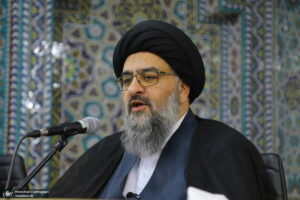
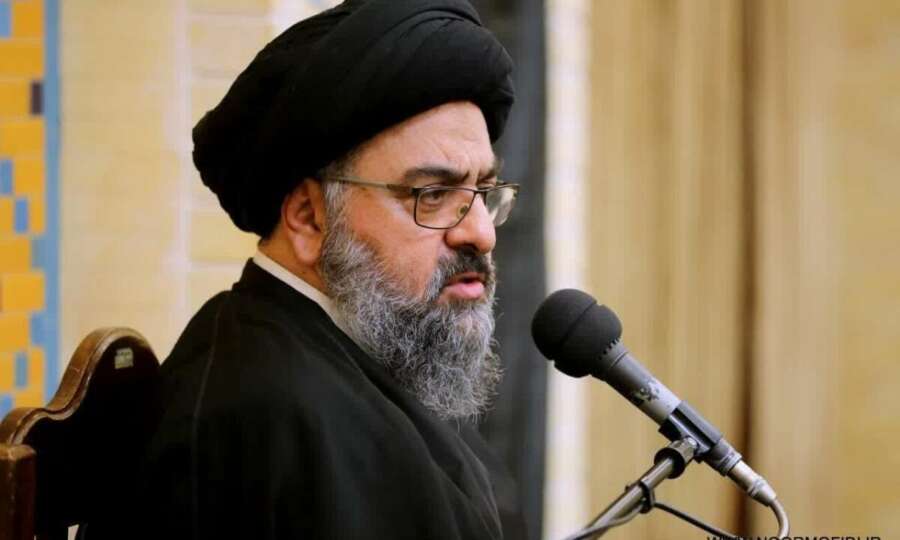
The head of the Contemporary Jurisprudential Research Institute, in an interview with Ijtihad Network:
We cannot call someone a mujtahid if they are narrow-minded.
Reducing contemporary jurisprudence to novel issues is incorrect.
The evaluation of advanced lectures (Kharij) must not become state-run.
The professor of advanced lectures on Fiqh and Usul at the Qom Seminary stated: “We cannot call someone a mujtahid if they are narrow-minded, even if they have mastered the appropriate verses and traditions, have taught for many years, and have written many books and articles.”
Exclusive to Ijtihad Network: Perhaps if several decades ago someone had spoken of contemporary jurisprudence and holding advanced lectures (Kharij) in relation to it, their words would have been taken as a joke. Today, however, dozens of advanced lectures on contemporary jurisprudence are established in Qom and other cities of Iran. These lectures, their professors, and their content certainly have proponents and opponents. Some consider them the foundation for shaping Islamic civilization, while others regard them merely as weak lectures with low-caliber professors and students that simply reduce the scientific standards of the seminary.
In this regard, we interviewed Professor Seyyed Mojtaba Nourmifidi. As a long-standing professor of advanced lectures at the Qom Seminary, he teaches political jurisprudence as one of the branches of contemporary jurisprudence. Furthermore, as the head of the Contemporary Jurisprudential Research Institute, he is thoroughly familiar with the arena of contemporary jurisprudence. We spoke with him regarding the conditions of current advanced lectures in contemporary jurisprudence and the prerequisites of these lectures. Nourmifidi believes that the current lectures are good for initiating this path, though they are far from the ideal.
He also stated: “If the relationships, developments of the era, and the impact of this matter on the subject are not recognized, it will not lead us to the desired and effective fatwa… The contemporary human has changed in the sphere of relationships, beliefs, and needs. We cannot ignore this human and make the human of the past our sole criterion.” The transcript of the Ijtihad interview with the head of the Contemporary Jurisprudential Research Institute follows below:
Ijtihad: What is the meaning of contemporary jurisprudence? Is jurisprudence without the adjective “contemporary” also discussed?
Nourmifidi: Faqahat and ijtihad in accordance with time and space, or contemporary jurisprudence, can be viewed from two angles: sometimes we view contemporaneity as an intrinsic adjective of jurisprudence, and sometimes we consider contemporaneity as an exclusionary and non-intrinsic adjective of jurisprudence.
Martyr Motahari, regarding the intrinsic nature of the adjective of contemporaneity, states: “If ijtihad is not directed at new issues and does not take into account the needs of the time, it is not ijtihad in the precise sense of the word.”
Similarly, Muhammad Javad Mughniyah says that a mujtahid is someone who is innovative and creative within the framework, sources, and sphere of individual and social issues. Therefore, we cannot call someone a mujtahid if they are narrow-minded, even if they have mastered the appropriate verses and traditions, have taught for many years, and have written many books and articles.
Thus, from this perspective, ijtihad cannot be separated from the element of contemporaneity. For instance, the books compiled by Sheikh Tusi were written in accordance with the conditions of his time. This suitability is clearly seen in the book ‘Uddat al-Usul. In his other books as well, he wrote in accordance with the time and requirements of that era. Consequently, he became the founder of a jurisprudential school that cast its shadow over the lecture seats of jurists for many years.
In my view, contemporaneity is the element that makes jurisprudence dynamic and returns it to its original status.
However, if we consider the adjective “contemporary” as exclusionary and limit it to the jurisprudence of novel issues (masa’il mustahdathah), the matter becomes different. Grand Ayatollah Sobhani objected to the term “contemporary jurisprudence” and stated: “Instead of ‘contemporary jurisprudence,’ it should be called ‘the jurisprudence of novel issues’.” However, replacing “contemporary” with “novel issues” seems to reduce jurisprudence to a specific, limited scope.
Another view in explaining contemporary jurisprudence is defining it as a jurisprudence based on new solutions, or presenting old jurisprudential topics with new solutions. Generally, contemporary jurisprudence can encompass all of these; meaning a jurisprudence that addresses the sphere of novel issues, discovers new solutions, and is, of course, based on prerequisites including expansion in foundations, methods, and goals.
Ijtihad: What are the prerequisites of an exemplary advanced lecture (Kharij) in contemporary jurisprudence?
Nourmifidi: The operation of faqahat, considering the intrinsic element of contemporaneity, is based on matters through which we can discover the realization of faqahat in the precise sense of the word. These matters are as follows:
-
Understanding the requirements of the new era and the type of relationships formed in this period is one of the foundations of contemporary jurisprudence. The effects of this understanding are clearly raised in the identification of subject matters (mawdu’shinasi). For instance, Hazrat Imam considers the elements of time and space to be effective in ijtihad in a way that is different from others. He states: “This subject matter may apparently remain unchanged and be the same subject matter of the past, but in light of the developments that have occurred in the world and the relationships created, it has acquired another form.” Therefore, if the relationships, developments of the era, and the impact of this matter on the subject are not recognized, it will not lead us to the desired and effective fatwa.
-
Identification of subject matters (mawdu’shinasi) holds an important position particularly in the sphere of novel issues.
-
Paying attention to the problems of human beings in the contemporary era is another point that requires special attention. The contemporary human has changed in the sphere of relationships, beliefs, and needs. We cannot ignore this human and make the human of the past our sole criterion. This point is clearly seen in the words of some jurists such as Martyr Sadr.
-
A systemic approach to jurisprudence so that macro and micro views can be extracted from it. Unfortunately, jurisprudential systems have not yet been extracted, which of course requires time.
-
Revising goals, methods, and foundations.
-
The social view of jurisprudence, as opposed to the individual view which has cast its shadow over almost all chapters of jurisprudence, must be strengthened. Throughout the history of jurisprudence, the social view of religion and rulings has been restricted, whereas it is necessary for the social view to return to its original position.
-
Comparative jurisprudence (fiqh al-muqaran), comparing the fatwas and jurisprudential opinions of the Shi’a with those of the Sunni schools and their various branches.
-
Interdisciplinary jurisprudence (fiqh-e tatbiqi), in the sense that the necessary issues between the science of jurisprudence and other sciences are clarified, such as jurisprudence and sociology, and jurisprudence and economics.
-
The relationship between jurisprudence and legislation, and the issues surrounding it, must be examined.
-
Awareness of past issues and the solutions that have been presented.
-
Understanding the arguments and critiquing the arguments presented by predecessors, and presenting new solutions with innovation and creativity.
Of course, these points relate to the science of jurisprudence itself, and other points related to the person of the mujtahid must be examined separately.
Ijtihad: How do you evaluate the current advanced lectures (Kharij) of contemporary jurisprudence?
Nourmifidi: If we pay attention to the current contemporary jurisprudence lectures being held, depending on the person of the professor, their capacity, mastery, and command over the discussions and the desired criteria, these lectures are acceptable to some extent. However, if we look at them from the perspective of an exemplary or ideal standard, the current advanced lectures are very far from these criteria, and even my own personal lectures are far from these criteria.
Ijtihad: Do you agree with the evaluation of advanced lectures by a non-governmental and non-state institution based on the opinions of experts and students?
Nourmifidi: The genuine evaluation of advanced lectures has been and is carried out in an imperceptible and informal manner by scholars. This process has existed since the past. Professors who possessed scientific richness and spoke precisely and scholarly have always received attention. The works they presented and the students they trained demonstrated this matter. However, professors who did not possess strong content and lacked sufficient scholarship were set aside.
Therefore, it is not the case that no attention was paid to this issue until today; rather, this process and this evaluation have always existed in the seminaries. Of course, this imperceptible evaluation does not mean rejecting an overt and clear evaluation that distinguishes the genuine from the counterfeit; because in the past, due to space limitations and the small number of lectures and students, this occurred easily and quickly. Today, however, with these expansions and the high number of lectures, the task has become difficult. Therefore, the principle of evaluating advanced lectures is a necessary matter.
Ijtihad: In your opinion, what mechanism must be designed for evaluating contemporary jurisprudence lectures?
Nourmifidi: This evaluation can take place at the beginning, in the middle, and at the end. At the beginning, preliminary steps must be taken: for instance, the history of teaching at the Sath level must be examined, the person’s professors must testify, students and scholars must express their opinions, and scientific works including books, articles, and transcripts of lectures (taqrirat) must be reviewed. Of course, the evaluation in advanced lectures must be scientific, and external considerations, pressures, and other issues must not enter into it.
If an center or institution is to assume this task, in the view of this humble servant, it must be an institution composed of the professors themselves or representatives of the professors, the Management Center, and parallel bodies. Of course, to establish such an institution, we must increase our tolerance and recognize one another, because to shape a civilization-building seminary, we have no other choice