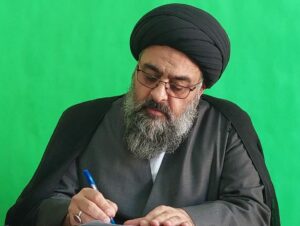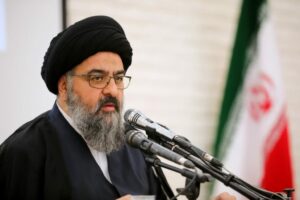
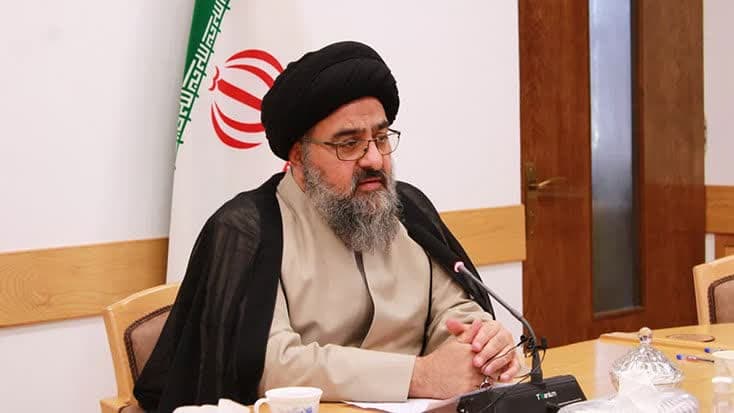
Jamaran News Agency: Ayatullah Sayyid Mujtaba Nur Mufidi, a professor of advanced courses in jurisprudence and principles of jurisprudence at the Qom Seminary, explained the circumstances that led to the event of Ashura and said: “Approximately fifty years elapsed between the passing of the Holy Prophet of Islam and the event of Ashura. During those fifty years, changes occurred in society that ultimately resulted in Muslims perpetrating all those atrocities.”
The full text of Jamaran’s interview with Ayatullah Sayyid Mujtaba Nur Mufidi concerning Muharram and the uprising of the Master of Martyrs (PBUH) follows:
I offer my condolences to you on the arrival of the month of Muharram. A narration has been transmitted from Imam al-Sadiq (PBUH) that has become known as the “Hadith of the Hosts of Intellect and Ignorance.” We would like to know whether this form of analysis can also be applied to the event of Karbala and, from this perspective, which of the two prevailed over the other in Karbala.
I, too, offer my condolences on the arrival of the month of Muharram, the month of mourning for the martyrdom of the Master of Martyrs (PBUH), his Companions and supporters, and his honored Ahl al-Bayt. I hope that these days, while commemorating that bitter and sorrowful confrontation, will always stand before us like a radiant torch and luminous lamp, showing all of us and humanity the correct path in life.
You referred to this hadith, which is regarded as one of the most profound and pivotal hadiths among the teachings of the Ahl al-Bayt (PBUT).
Generally speaking, we sometimes approach narrations and verses of the Qur’an as texts containing scientific, literary, philosophical, and similar dimensions. At other times, we examine hadiths and narrations from the perspective that they guide human beings toward the highest destination and are constructive both for individuals and for society. At the beginning of his book An Exposition of the Hadith on the Hosts of Intellect and Ignorance, Imam Khomeini (RA) drew attention to the point that the principal purpose behind the issuance of these noble hadiths and the exposition of divine knowledge is not merely to explain scientific and philosophical points or historical and literary aspects. Rather, their ultimate purpose is to free souls from the burdens of the dark realm of nature, direct spirits toward the unseen realm, and detach the bird of the spirit from the branches of the tree of this world, which is the root of the evil tree. In his view, this principal objective and pivotal point have been neglected in many writings and statements. In explaining hadiths, some address aspects that provide merely academic benefit and remain far removed from this objective. Therefore, at the beginning of this noble book, Imam Khomeini emphasizes that he is not concerned with those academic aspects; rather, he is primarily concerned with this objective and with ensuring that this hadith and its contents serve as a remedy in themselves, rather than merely as a prescription.
In addition to this point, we may sometimes consider this hadith ethically from an individual perspective, which is itself highly constructive for people. At other times, we may seek to derive from this hadith the roots of social change. I believe that although Imam Khomeini devoted greater attention to the ethical dimension of this hadith from an individual perspective, he noted in the middle of the book that many of the problems afflicting societies arise because they have been inattentive to intellect and its hosts, have allowed ignorance to dominate them, and have permitted the forces of ignorance to drive humanity toward destruction. This book was written in 1363 AH. There, he refers to the Second World War. These are Imam Khomeini’s exact words: “Now, as the author is blackening these pages, the general war between the Allies and Germany is raging, its flames engulfing all the inhabitants of the world. This scorching flame and blazing hell are nothing but the fire of wrath of a man-eating beast and a depraved predator of the age who, in the name of leading Germany, has brought misery and distress upon the world and particularly upon his own unfortunate nation. Where this will end, and when these helpless people will be freed from the grip of a few animals in human form and this misery will come to an end, remains to be seen.” From Imam Khomeini’s perspective, the root of the devastating Second World War was nothing other than the ascendancy of one of the forces of ignorance, which inflicted those calamities upon the people of that era. Therefore, this hadith can be examined from both individual and social perspectives, and attention to it has fundamental effects on human beings’ individual and social lives.
I have presented this introduction to draw attention to the point that, in principle, the conflict between truth and falsehood throughout history has revolved around the struggle between intellect and ignorance. The conflict between the prophets and the unbelievers, polytheists, and deniers of God, the worship of God, and monotheism has revolved around the opposition between the hosts of intellect and the hosts of ignorance. We can therefore interpret the events of Ashura and Karbala within this same framework. The prophets have always been the manifestations and embodiments of intellect, while their opponents have been the manifestations and symbols of ignorance.
What do intellect and ignorance mean in this narration?
The intellect intended here is not the instrumental reason discussed in today’s world and in the Age of Enlightenment; rather, it is the sacred and intrinsic intellect. Instrumental reason means a form of reason that merely evaluates the relationship between tools and means on the one hand and objectives on the other, primarily pursuing interests—particularly material interests. The intellect referred to in this narration, however, is the first emanation and the creature most closely resembling God; that is, the spiritual faculty that is immaterial in its essence, naturally inclined toward goodness and perfection, and a summons to justice and benevolence. In other words, it is the source of all goodness and perfection and calls humanity toward every form of goodness and virtue.
In the lexicon, ‘aql, or intellect, has also been defined as preserving, restraining, and similar meanings. The reason the human intellect is called ‘aql is that it restrains human beings from ignorance and from ugly and improper conduct and actions. According to this narration, based on some transmissions, it has seventy-five ministers and supporters, while according to others, it has seventy-eight soldiers. When one examines the list of the ministers of intellect in this sense, one sees that all of them were manifested at Ashura. By contrast, ignorance is, in reality, an estimative faculty that generally calls human beings toward the world in its reprehensible sense. It, too, has soldiers and hosts, all of which one can see manifested on the plain of Karbala. Ignorance is, in fact, the very reality of Iblis, encompassing all forms of ugliness and vice, whose supporters and ministers are mentioned in this same hadith. Thus, intellect is the creature most closely resembling God, while ignorance is the confluence of all vices. Conflict between these two has always existed throughout history, during the time of all the divine saints and prophets, including in the events of Ashura and Karbala.
Let us return to the event of Ashura and apply the content of this narration to those atrocities. If we wish to explain the roots of the events of Ashura and address them fundamentally, we must say that at Ashura, all moral and human virtues stood arrayed against all vices.
This narration refers to these oppositions, including faith versus unbelief, affirmation of the truth versus denial of the truth, justice and equity versus oppression, and hope versus despair. These are all terms mentioned in the narration itself. They also include contentment versus anger and wrath, gratitude versus ingratitude, trust and reliance upon God versus greed and avarice, tenderheartedness versus hardheartedness, kindness versus spitefulness, awareness versus foolishness, and piety and asceticism versus worldliness. These instances are numerous, but all these virtues were manifested in Karbala and at Ashura in the camp of Imam al-Husayn (PBUH), while all those vices were manifested together in Yazid’s army.
What has distinguished the event of Ashura is that examples of every quality described as belonging to the “hosts of intellect” can be found in the event of Ashura: in the words and conduct of Imam al-Husayn (PBUH); in the words, speech, and conduct of the Ahl al-Bayt and Lady Zaynab al-Kubra (PBUH); and, conversely, in the words, statements, and actions of Yazid and all his aides and supporters. Examples can be found for every one of these qualities, and if the opportunity arises, we will refer to some of them.
How was ignorance able to create this scene in Karbala and in the Karbalas that followed?
Consider the period beginning when the Noble Prophet of Islam (PBUH) was appointed to his prophetic mission. Among all the prophets, he was the perfect manifestation of that sacred and intrinsic intellect, and his movement represented the pinnacle of that intellect’s flourishing. This intellect prevailed, and the forces of ignorance were defeated. Although they outwardly submitted, after the Prophet’s passing, the forces of ignorance reemerged and once again began engaging in deeds commanded by Iblis himself. Approximately fifty years elapsed between the passing of the Holy Prophet of Islam and the event of Ashura. During those fifty years, changes occurred in society that ultimately resulted in Muslims perpetrating all those atrocities.
All of this resulted from the hosts of ignorance prevailing over the hosts of intellect. When the Prophet (PBUH) was appointed to his mission, he emphasized certain qualities, including understanding, wisdom, knowledge, awareness and reflection, piety, God-wariness and patience, forgiveness and forbearance in place of vengeance, kindness, affirmation of the truth, faith, justice, and hope. Through these qualities, the Prophet (PBUH) was able to transform a segment or group within society. However, society at large—and perhaps a substantial portion of its population—still remained distant from these virtues. Following the Prophet’s passing, the same elements that had prevailed during the Age of Ignorance gradually reemerged and began diminishing the virtues that the Prophet (PBUH) had promoted.
What elements gradually brought about those horrifying changes? We must discover them. We must assess and examine these virtues and vices one by one within the context of the society of that time. Gradually, conceit replaced humility, foolishness replaced wisdom, defiance replaced submission, doubt replaced certainty, and vengeance replaced forgiveness and forbearance. The breaking of covenants, for which the people of Kufa became renowned, replaced the Prophet’s firm and unwavering commitment to covenants, even those made with unbelievers and polytheists. Ingratitude and hardheartedness—and all the other qualities referred to in this narration as the hosts of ignorance—were gradually strengthened over those fifty years. Naturally, the hosts of ignorance became so powerful that they brought about the events of the Day of Ashura and perpetrated the most merciless acts against the Prophet’s Ahl al-Bayt. Why? These things did not happen overnight. When hardheartedness replaces tenderheartedness, the heart becomes hardened and cruel and is capable of committing any crime. When worldliness, power, and status become so prominent, people will do anything to obtain them. That is why they committed those acts on the Day of Ashura and perpetrated those crimes against the Prophet’s family.
Therefore, when ignorance—which encompasses all moral vices and impurities—prevailed over intellect and its forces, and when these changes occurred within society, the result was the events recorded in history. Everyone has acknowledged that they truly perpetrated the most merciless acts against the family of the Messenger of God.
In your view, can this narration serve as our guiding principle today and in the future? If so, how?
Certainly. This is a clear path for humanity throughout history. This narration not only can but must serve as our model in every sphere. For example, praise be to God, many gatherings and assemblies are held during Muharram and on Tasu‘a and Ashura: gatherings dedicated to the remembrance of Imam al-Husayn, supplication through him, and elegies and eulogies for Imam al-Husayn and his pure Ahl al-Bayt. Yet through this hadith and the event of Ashura, we possess a criterion by which we must assess both ourselves and society. We must be vigilant, for it is possible that we may display the banner of the Master of Martyrs while our conduct does not follow the way of al-Husayn. This is extremely dangerous. We may raise the banner of Imam al-Husayn’s camp over our gatherings and assemblies while our conduct does not follow the way of al-Husayn.
What I wish to say is that all of us who mourn for the Master of Martyrs (PBUH) should list the seventy-five soldiers that Imam al-Sadiq (PBUH) enumerated for intellect and place that list before ourselves. We should also list the seventy-five hosts and soldiers enumerated for ignorance and determine which of these qualities exist within us and toward which direction our society is truly inclining. This assessment must be conducted continually, lest, God forbid, we suddenly open our eyes and discover that we, too, have undergone these changes. I do not wish to say that this is presently the case, but I emphasize that our society needs to assess its own health. Society, as a living entity, needs to be examined continually by scholars, experts, and those in authority to ensure that, God forbid, it has not become afflicted with illness. Otherwise, as Imam Khomeini said, we may open our eyes and find that nothing remains for us but regret: that our lifetime has been lost, that we did not proceed toward the destination we should have pursued, and that we have instead moved farther away from it.
We must determine how closely we conform to these criteria: how kind we are toward one another, how wise we are, how well we conduct ourselves, how God-wary we are, and how patient we are. Conversely, we must determine how afflicted we are by foolishness, how hasty we are, how vengeful we are, and how readily we break our covenants and pledges. Thus, by means of this criterion, we can assess ourselves and our society and determine how close we are to that truth—the Master of Martyrs (PBUH)—and to that great movement and uprising, which embodied the intrinsic and sacred intellect. Conversely, we can determine how far removed we are from Yazid and his soldiers, who symbolized ignorance and moral vices.
In any event, we must assess ourselves according to this criterion. God willing, by following this criterion, we will be able to lead a life of felicity.