
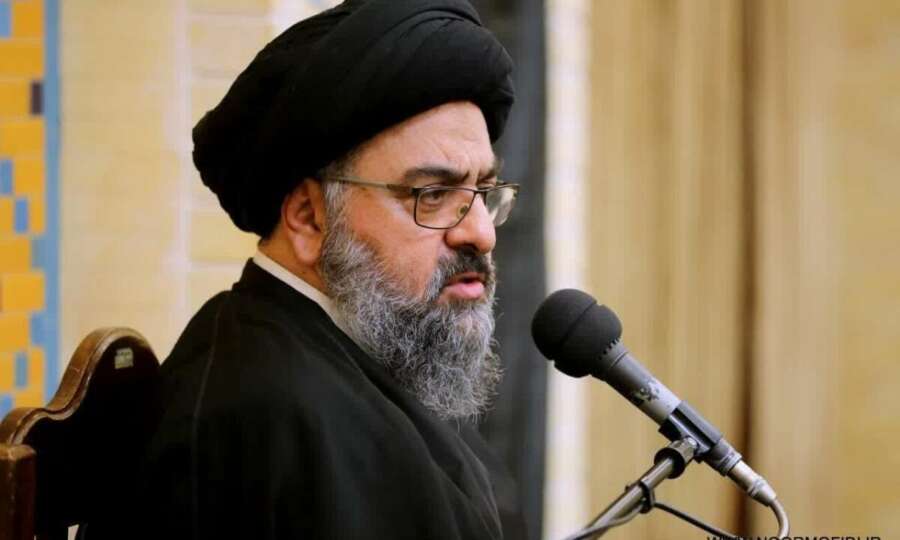
Ayatullah Sayyid Mujtaba Nur Mufidi: One of the most important jurisprudential foundations of citizenship rights is the acceptance of the concept of Haqq al-Nas (Rights of the People) as opposed to Haqq Allah (Rights of Allah). Haqq al-Nas possesses a broad scope encompassing human life, property, and honor. Among the primary discussions of Haqq al-Nas are its conceptualization vis-à-vis Haqq Allah, and its precedence or deference in cases of conflict (Tazahum) with Haqq Allah.
Publisher’s Note: Since citizenship is a modern concept and shares merely a verbal commonality (Ishtirak-e Lafzi) with the concept of citizenship in ancient Greece or ancient Persia, the jurisprudence of citizenship rights likewise falls within the realm of modern affairs. This modern and novel nature allows numerous discussions to be raised around these concepts. Ayatullah Sayyid Mujtaba Nur Mufidi demonstrated his commitment to this emerging branch of jurisprudence by establishing the first research group on the “Jurisprudence of Citizenship Rights and Duties” at the Research Institute of Contemporary Fiqh. We interviewed him regarding the foundations of the jurisprudence of citizenship rights. This Professor of Advanced Jurisprudence and Principles of Fiqh (Kharij Fiqh and Usul) at the Islamic Seminary of Qom believes that prior to entering the discussion on the foundations of the jurisprudence of citizenship rights, the meaning of jurisprudence (Fiqh), rights (Huquq), and citizenship (Shahrvandiyyah) as a modern phenomenon must be clarified. The full transcript of the interview with the President of the Research Institute of Contemporary Fiqh follows.
Question: What is the Jurisprudence of Citizenship Rights, and what are its prerequisites?
Ayatullah Sayyid Mujtaba Nur Mufidi: First and foremost, we must accept the fundamental possibility of such a concept and combination, and subsequently examine what citizenship jurisprudence is, and what the jurisprudence of citizenship rights and responsibilities fundamentally entails.
Generally, regarding the relationship between religion and citizenship rights, four distinct perspectives exist:
-
The First View: Religion, the Sharia, and specifically jurisprudence (Fiqh) do not possess the capacity to articulate or design social laws and institutions, because religious intellect fundamentally lacks the power to enact social laws and establish institutions.
-
The Second View: Religion adopts a stance of rejection toward new and modern concepts—especially those formulated by human beings as opposed to divine law. The issue of citizenship rights is considered one of its instances; following the era of Church dominance in Europe, intellectual rigidity developed, and due to the severity of actions taken, an evasion of religion and God ensued, ultimately placing man at the center as the axis of all things. Accordingly, citizenship rights—recognized as a modern concept—are set aside under this view, which asserts that it is fundamentally incompatible with religious principles and foundations.
Based on these two perspectives, a concept such as “Jurisprudence of Citizenship Rights” would be meaningless.
-
The Third View: Representing an approach of extreme accommodation, this view stands opposed to the second perspective and seeks a hundred percent alignment and compatibility between modern concepts and religion or the Sharia. Under this view, an effort is made to extract all new phenomena comprehensively (Baljumla) from within religion and the Sharia.
-
The Fourth View: This perspective maintains partial alignment and compatibility (Fi’l-Jumla), meaning it neither rejects modern concepts entirely nor accepts them unconditionally. Rather, it evaluates all dimensions against the scale of religion, the Sharia, and jurisprudence, ultimately accepting that portion which aligns with religious rulings and teachings.
We, based on the latter two perspectives, can proceed to define the Jurisprudence of Citizenship Rights; therefore, if we wish to present a definition of the Jurisprudence of Citizenship Rights, we must first adopt one of these two perspectives.
Another point relevant to our discussion is our definition of citizenship rights. Citizenship rights consist of the aggregate of rights that people hold vis-à-vis the sovereignty, the state, and the political system, which the state is obligated to guarantee through legislation, regulations, and necessary mechanisms. This is what is recognized as a “right.”
On the other hand, the state itself is a modern concept that is fundamentally distinct from the historical concept of sovereignty. Meanwhile, some attempt to trace the origin of citizenship rights back to ancient Greece or ancient Persia and figures such as Cyrus, whereas the concepts of “right” and “citizen” during those eras were entirely different from their contemporary meaning.
In summary, the definition and acceptance of the “Jurisprudence of Citizenship Rights” depends on clarifying several points: first, the possibility of the existence of rights for citizens; second, clarifying the meaning of jurisprudence (Fiqh); and third, accepting citizenship rights as a modern concept.
However, if we set aside these preliminary considerations, we can state in brief: The Jurisprudence of Citizenship Rights and Duties consists of articulating humanity’s roadmap regarding its relationship with governance from the stance of jurisprudence. This, naturally, depends on clarifying its various foundations across distinct disciplines, including theology (Kalam). As an example, the issue of human dignity—and whether it is inherent to human beings or acquired—must be clarified.
Question: Is the issue of human dignity as a presupposition for discussions on the Jurisprudence of Citizenship Rights your personal view, or do you consider its acceptance a necessary prerequisite for discussing this branch of jurisprudence in general?
Ayatullah Sayyid Mujtaba Nur Mufidi: It is both my personal view and something I maintain must be refined and clarified in order to enter that domain.
Question: When you affirm inherent human dignity, for instance, do you set aside the legal distinctions (Ahkam) between disbelievers and Muslims? Do you set them aside?
Ayatullah Sayyid Mujtaba Nur Mufidi: In this specific domain, yes!
Question: In which domain?
Ayatullah Sayyid Mujtaba Nur Mufidi: In the discussion of citizenship rights. Of course, as I noted, we accept citizenship rights as formulated in the West in part (Fi’l-Jumla), not in its entirety (Baljumla). In my view, partial compatibility exists between Islam and Western citizenship rights, but this compatibility is not total or absolute.
Question: It appears that the third and fourth views can only be interpreted based on the theory of minimalist jurisprudence.
Ayatullah Sayyid Mujtaba Nur Mufidi: No, on the contrary, the third and fourth views are grounded on the premise that jurisprudence provides the roadmap for life in all its dimensions—as Imam Khomeini stated: “Jurisprudence constitutes the program for human life from the cradle to the grave.” Therefore, the third and fourth views are not interpretable based on a minimalist approach to religion.
Of course, in my view, the expressions “minimalist jurisprudence” and “maximalist jurisprudence” are imprecise, because jurisprudence itself does not possess a minimum or maximum; rather, it is our understanding of jurisprudence that becomes minimalist or maximalist. Thus, a more accurate phrasing is “a minimalist or maximalist understanding of jurisprudence.”
Question: What are the foundations and presuppositions of the Jurisprudence of Citizenship Rights?
Ayatullah Sayyid Mujtaba Nur Mufidi: The foundations of the Jurisprudence of Citizenship Rights are divided into two categories: theological (Kalami) and jurisprudential (Fiqhi). I outlined the theological foundations in brief during our preceding points.
Regarding the jurisprudential foundations, it must be stated that citizenship rights encompass a diverse array of rights, such as the right to freedom of expression, the right to choose one’s residence, the right to privacy, and similar matters. It can perhaps be said that one of the most vital jurisprudential foundations of citizenship rights is the acceptance of the concept of Haqq al-Nas (Rights of the People) as distinct from Haqq Allah (Rights of Allah). Haqq al-Nas possesses a vast scope encompassing human life, property, and honor.
Among the primary discussions surrounding Haqq al-Nas, one is its conceptualization vis-à-vis Haqq Allah, and another is its precedence or deference when in conflict (Tazahum) with Haqq Allah. In jurisprudential treatises, this matter is referenced across various topics—such as the conflict between the obligatory Hajj for an individual who has attained financial and physical capability (Istita’ah) and the performance of Hajj when one must repay a debt, or the conflict between Jihad and debt repayment, or performing prayer (Salah) and debt repayment.
From the aggregate of juristic rulings (Fatwas) and legal arguments, the precedence of Haqq al-Nas over Haqq Allah can be deduced. However, the discussion regarding Haqq al-Nas—its essence, dimensions, boundaries, the arguments supporting each theory, and related aspects—must be thoroughly examined as one of the foundational bases of the Jurisprudence of Citizenship Rights.
Question: It appears that beyond the importance of discussing Haqq al-Nas, one of the most critical topics in this arena is the discussion of contemporary instances (Masadiq) of Haqq al-Nas, such as the right to happiness or the right to recreation. The acceptance or rejection of these instances leads to significant shifts in legal rulings (Fatwas). For example, preventing a halal music concert from taking place might not seem significant at first glance; however, if hosting a concert is recognized as an instance of halal happiness, and happiness is categorized as a citizenship right, then obstructing a halal music concert constitutes an infringement upon citizens’ rights.
Ayatullah Sayyid Mujtaba Nur Mufidi: Yes, the right to happiness can be articulated as a valid citizenship right. I believe that, for instance, in the next hundred years, newer instances of citizenship rights will emerge regarding which the discipline of jurisprudence must express its judgment.
Another major foundation vital to the Jurisprudence of Citizenship Rights is the concept of justice (‘Adalat). It appears that many citizenship rights that speak of equality among various strata of society are, in reality, specific applications of justice.
Another foundation of the Jurisprudence of Citizenship Rights is servitude and obedience to God (‘Ubudiyyat). From the Islamic perspective, humanity was created to attain ultimate salvation, and this salvation is unachievable except through servitude to Almighty God:
“وَمَا خَلَقْتُ الْجِنَّ وَالْإِنْسَ إِلَّا لِيَعْبُدُونِ”
“I did not create jinn and humans except to worship Me.” [Surah Adh-Dhariyat 51:56]
This issue represents one of the major distinctions between the Islamic perspective and the Western perspective regarding human rights. The relationship between the servant (‘Abd) and the Master (Mawla) was articulated by the late Martyr Sadr within his theory of the “Right to Obedience” (Haqq al-Ta’ah), though this concept was addressed prior to him as well.
Given the existence of this Islamic view regarding humanity, we naturally cannot accept certain rights that are claimed as human rights if they stand in direct conflict with this relationship between the servant and the Master. Of course, this point does not imply that we cannot accept any of the rights articulated by Western thinkers as human rights; rather, each of these rights must be discussed and evaluated individually. Some are acceptable, while others are not.
Question: Can one address the Jurisprudence of Citizenship Rights using the theory of minimalist jurisprudence?
Ayatullah Sayyid Mujtaba Nur Mufidi: As stated previously, if your perception of minimalist jurisprudence is a jurisprudence that believes in the restricted presence of jurisprudence solely within individual matters, it is natural that under such a premise, there remains no scope to enter this domain, and no basis for discussion exists.
Question: In your view, to what extent does jurisprudence’s view of humanity influence shifts in citizenship rights propositions?
Ayatullah Sayyid Mujtaba Nur Mufidi: In my view, instead of the phrase “jurisprudence’s view of humanity,” one should use the expression “the jurist’s view of humanity,” because it is the interpretations, outlooks, and opinions of jurists (Fuqaha) that differ, whereas the framework of jurisprudence itself is singular. For example, the Quran’s view of humanity is a singular and clear perspective, but the interpretations of Quranic commentators (Mufassirin) differ from one another.
If the question is how much the jurist’s perspective on “man” influences the analysis of citizenship rights, it must be said that it has a profound impact. At one time, we view man purely as a duty-bound creature; at another time, alongside being duty-bound, we view man as possessing inherent rights. Naturally, under the first assumption, the discussion of citizenship rights does not even arise.
Even if we consider man as possessing rights, it makes a significant difference whether we view these rights as originating from a non-divine source—such as nature, human essence, or the physical universe—or consider them as bestowed by Almighty God. These two perspectives create a vast difference when a jurist confronts textual evidence (Adillah).
For example, regarding natural rights, Martyr Motahhari maintained that these rights represent man’s entitlement. In his view, man qua man possesses rights such as the right to life. God Himself bestowed this right upon him, yet it simultaneously forms part of citizenship rights.
God created man as the noblest of creations based on the dignity granted to him, created him in the finest form (Ahsan al-Taqwim), made him the object of prostration for angels, and appointed him as His vicegerent (Khalifah) on earth; naturally, He established the ultimate purpose of his creation as attaining eternal salvation. That is, all rights and duties specified for man are designed to achieve this ultimate purpose. If He established duties for man, it was to reach that goal; if He established rights, it was likewise to attain that ultimate objective.
Thus, this perspective on humanity will exert an immense impact on the rights we recognize for human beings.
For example, if Almighty God states that there shall be no compulsion in religion (“La ikraha fi ad-din” [Quran 2:256]), it is because compulsion in religion does not guide man toward that ultimate purpose. Or if He commands that man should be free, that his privacy must be safeguarded, or that he must determine his own destiny—
“إِنَّ اللَّهَ لَا يُغَيِّرُ مَا بِقَوْمٍ حَتَّىٰ يُغَيِّرُوا مَا بِأَنْفُسِهِمْ”
“Indeed, Allah will not change the condition of a people until they change what is in themselves.” [Surah Ar-Ra’d 13:11]
—these are all aimed at attaining that ultimate salvation. Almighty God considers the violation of these rights to be incompatible with eternal salvation. Therefore, the jurist’s perspective on the concept of humanity and the origin of these rights will exert a profound influence on the propositions governing citizenship rights and duties.
Question: It appears that the traditional approach to jurisprudence does not recognize rights for human beings per se; rather, under that view, it is Muslims who possess specific rights, not human beings as such. Given this premise, can citizenship rights be conceptualized under the traditional approach to jurisprudence?
Ayatullah Sayyid Mujtaba Nur Mufidi: I do not accept your premise that traditional jurisprudence recognizes no rights for human beings. Ultimately, even under the most rigid perspectives on jurisprudence, certain rights are conceptualized for human beings, even if those rights are highly restricted and remain at a considerable distance from the citizenship rights advocated by contemporary legal theorists.