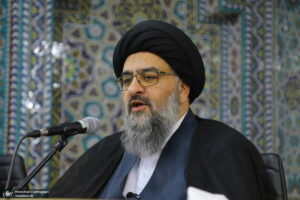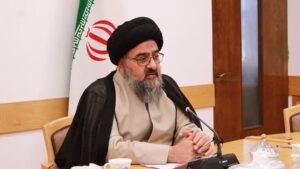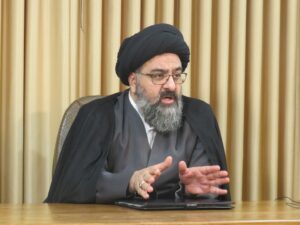
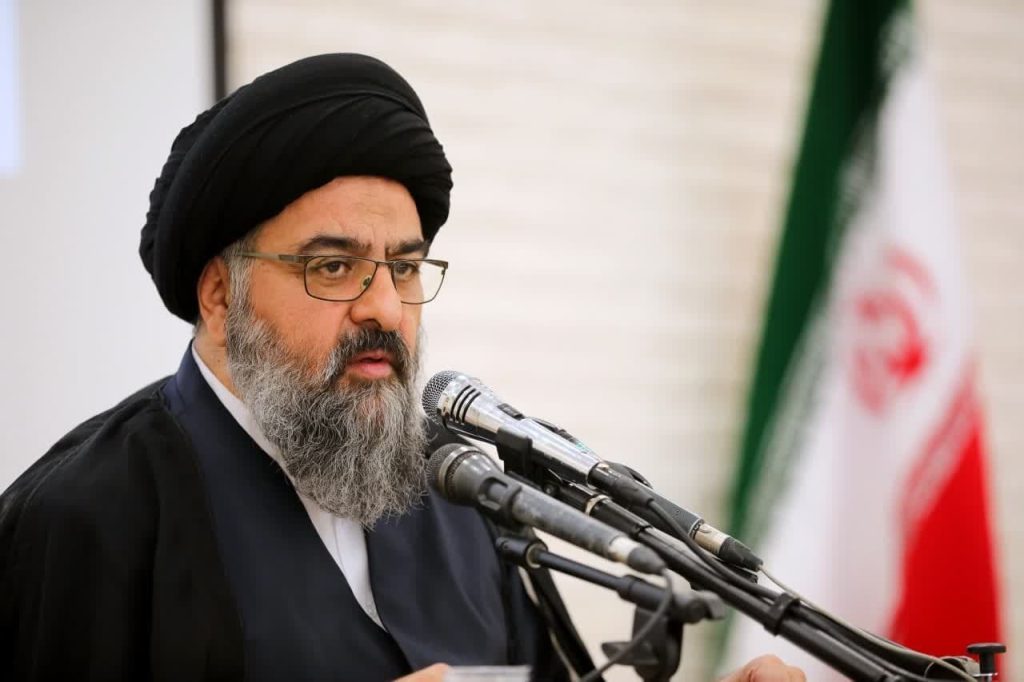
On the occasion of the 40th anniversary of the victory of the Revolution, the lecturer of advanced (Kharij) jurisprudence and principles of the Islamic seminary stated: “The current problems do not diminish the greatness of the Revolution; prior to the Revolution, there was no self-belief; the Revolution increased the population of Shiites in the world.”
Exclusive to Ijtihad Network: On Wednesday, February 6, 2019, on the occasion of the last day of classes before the February 11 (22nd of Bahman) ceremonies, Ayatullah Sayyid Mujtaba Nur Mufidi, a lecturer of advanced (Kharij) jurisprudence and principles at the Islamic Seminary of Qom, expressed important points regarding the Islamic Revolution and the necessity of honoring this invaluable asset. The member of the Scientific Council of the Fiqh Center of A’immah al-Athar in Qom believes that the existing problems and shortcomings in no way diminish the greatness of the Revolution, as these problems also exist in the developed countries of the world. Portions of his remarks are presented before you:
What I wish to express in this brief opportunity is that, indeed, despite all the problems, disorganizations, difficulties, and shortcomings, we cannot ignore the greatness of the Revolution. Truly, far from any prejudice—whether professional or religious—I state that the Islamic Revolution of Iran was a very great achievement and has had immense accomplishments. Of course, this requires a detailed discussion to examine each matter and determine where we achieved success and progress, and where we faced failure.
Perhaps many of you did not experience the conditions prior to the Revolution, and they were not tangible to you; perhaps many of you face certain superficial analyses of the Revolution. Unfortunately, when some wish to analyze the Revolution, they reduce its values and indicators to an ordinary level.
The corruptions and cancerous tumors that existed in the past regime do not exist today. I do not say there are no problems today; today there are many problems indeed. However, prior to the Revolution, self-belief fundamentally had no place in the mindset and culture of Iranian society. This self-belief is a highly critical issue. Whether a nation believes they can reach the lofty peaks of progress and civilization, or a nation assumes it is impossible for them to achieve anything, deeply affects the future of that nation.
Historical reports and memoirs published from those days indicate that the first person of this country, regarding the smallest matters to the crises that arose in this country, always said: “Consult with the Americans and ask their opinion.” Our relationship with America was not a relationship between two equal and parallel countries; they held dominion over the world, the region, and us. This action of the Shah was in truth seeking permission, authorization, and consultation so that their opinion would be implemented.
However, after the Revolution, indeed, Imam Khomeini and, after him, the Supreme Leader made and make decisions by relying on God and the support of the nation. All those who criticize cannot, in the end, deny that the first person of this country is not under anyone’s thumb in this world. The idea of taking orders from, for example, America or any other superpower is fundamentally not in the dictionary of the Revolution. The main officials of this country, despite all the weaknesses, ups, and downs they had, ultimately placed this matter—making decisions themselves and having faith and trust in God and the people—at the forefront of their tasks. This is no small matter; these are the roots of corruptions. For the Shah to say “let’s see what they say so we can do this” is the height of a nation’s misfortune. Although forty years have passed since the Revolution and so many difficulties exist—which have reached their peak today and are observed everywhere—this independence remains unharmed. These are assets that must be preserved. These are values that cannot be ignored.
Another issue is religious governance. I refer to religious governance at its macro level, not that I say there is perfect religious governance today; we are certainly very far from ideal religious governance. Indeed, in many areas, we have even regressed. There is no doubt about this, but religious governance has been among the long-held aspirations of the clergy, the religious, and the believers throughout history. These are important events that took place in the Revolution, and it was a massive transformation created in the thoughts and culture of the people.
All of these are important. Over these years, much work has been done. This independence-seeking and self-belief have had numerous manifestations and expressions. Currently, the capabilities of Iran and Iranian scientists in various fields are praiseworthy. In this very seminary, very great works have been carried out. To accuse the seminary, the clergy, and the students of idleness and laziness is unfair. By the admission of those who have experienced both the past and the present of the seminaries, important works have been carried out. Observe how much production of thought, science, and intellect exists in this seminary, and the extent of the books published. Yes, we did not proceed in step with the transformations of the world; our movement is slow, but this does not mean that work has not been done.
In all fields, indeed, the greatness of the Revolution and the greatness of the work the people did is visible. The effects that the Revolution had in this country, in the region, in the entire world, and for the school of the Ahl al-Bayt are clear. Currently, in all corners of this world, there are individuals and populations under the banner of Shiism and followers of the Ahl al-Bayt, from South Africa to Indonesia, China, and Malaysia. These were all a handful of individuals who embraced Shiism concurrent with the victory of the Revolution and under the influence of Imam Khomeini’s personality, and now they themselves have transformed into significant populations. These are important effects.
Therefore, if anyone assumes that these problems diminish that greatness, they are mistaken. No one should harbor the thought that, for example, because these problems exist, that work was wrong. Expressing regret means that the reality of this subject has fundamentally not been understood. However, alongside these, preserving these assets is also highly important. We must not assume we can continue forever with these assets; if we can preserve these assets, progress will increase day by day, and if we cannot preserve them, we will naturally become weaker day by day.
Great powers in past history, due to inattention to the very same problems they grappled with, fell into decline. Currently, in any case, the conditions are highly sensitive, and we must, far from love and hatred and with absolute compassion, move toward resolving the weaknesses and disorganizations and eliminating the root of the things that cause the people to suffer. Our people have proven that they are capable of enduring problems and difficulties, but on the condition that there is no discrimination, corruption, theft, and embezzlement. The solution to this issue is that we assist as much as we can in establishing the rule of law.
Transparency in affairs is the highest issue. This e-government that is spoken of is no small matter. We must minimize the interventions and areas of intervention of human factors with various motivations so that everything is transparent. Law, collective wisdom, and the system must govern, albeit with a correct perspective. Truly, if someone wishes to be employed, they must look at the competence of individuals, and whoever is more competent, capable, and committed should be employed, rather than incompetent individuals being employed through the recommendations of others while competent individuals are left behind. This nepotism (parti-bazi) causes the people to suffer. I believe that if these matters are corrected, discrimination, nepotism, theft, embezzlement, and these corruptions are reduced, and the people observe everyone in a glass room and under supervision, they are willing to endure all difficulties. Our people understand; our people are truly noble people. However, if alongside these difficulties, those grounds of corruption are not eliminated, it is not certain that cooperation will continue.
At the same time, I hope that this period must be traversed as a transition period. Currently, the sensitivity that has collectively arisen against corruption and aristocracy is encouraging, but these sensitivities must be comprehensive, not selective. These have caused a number of individuals to restrain themselves. In the past, perhaps these were not expressed much, but now, with the aid of virtual networks, these issues are exposed.
I believe that over time, this will be effective and we will pass this stage. Currently, when you look at the developed countries of the world, you see that corruptions are also immense there and many of them are not exposed; additionally, they have passed through these conditions we are currently in. They also had these difficulties for years. The more this public supervision—namely enjoining the good and forbidding the evil (al-amr bi-al-ma’ruf wa al-nahy ‘an al-munkar)—or the press and media are strengthened, the more it helps root out these corruptions.
The final sentence is that today, the clergy and officials bear an exceptionally heavy duty. The solution is for all the people to compassionately and brotherly join hands in affection and reconciliation, and cast away resentments. Let us not seek to eliminate, destroy, and push one another out of the field. If we all join hands together, we still have little time to resolve the problems. Everyone, with integration, unity, and compassion, must move around the axis of leadership. Without this axis, we cannot cross these passes.