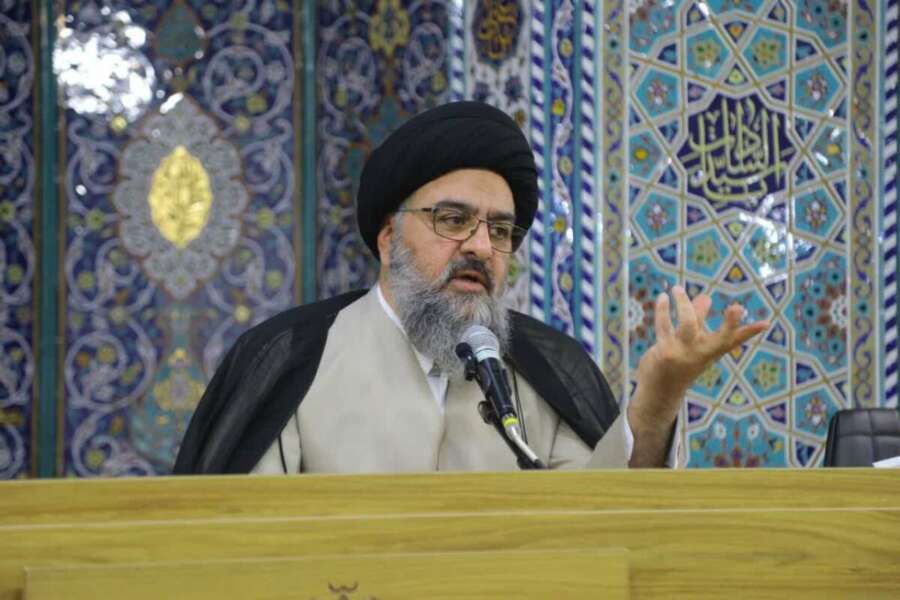
Reminder by Professor Sayyid Mujtaba Nur Mufidi Regarding the Important Statement of the Supreme Leader
The Statement of the Supreme Leader Is the Roadmap of the Revolution
Regarding the statement of the Supreme Leader, which was introduced as the “Second Step of the Revolution,” many discussions and materials have been raised. I do not know whether you have studied this statement or not, but I recommend that you read it. Frankly, the statement—as an account of where we were, where we are, and where we will go—is the treatise of the Revolution’s self-cognition. We have regarding the human being: “May God have mercy on whoever knows from where [he came], in where [he is], and to where [he is going]” (Rahima Allahu man ‘arafa min ayna wa fi ayna wa ila ayn).
This path of self-cognition—of where we were, where we are, and where we will go—is a path that must also be considered for entities that possess a conventional life (hayat-e i’tibari). After all, this Revolution, as a persistent and effective living entity, had a birth; a portion of this Revolution’s life has passed, and it must traverse a path in the future. Naturally, in the past, many successes have been achieved; there were also defects in the past, and currently, in any case, despite all defects, great and undeniable successes have been achieved for the Revolution, the country, and the people. Alongside all shortcomings, the Revolution must pursue a path in the future where those strengths increase and the weaknesses decrease. This statement is the roadmap of the Revolution in the future.
Unfortunately, one of the problems we face in this country is making an uproar without a program and practical action. We are accustomed to making an uproar over things, yet we lack planning and action. If you look at these past years, very often, valuable contents and statements were expressed by prominent figures and the Leadership, and at the very beginning, an uproar, statement, and march took place, yet practically no work was carried out. At most, they organized a conference, but we have rarely seen them operationalized. Unfortunately, this is the case in many matters. Instead of planning this completely with details and integrating it into the current structure—and even if there is a need for structural reform, reforming it so that these are acted upon—we resort to slogans, conferences, praise, and adulation.
Another problem is that everyone interprets the content in accordance with their own taste, rather than the primary needs. We are accustomed, in many affairs, to constructing a caricature of personalities and their statements; meaning, we highlight one aspect while the remaining vital components are neglected and abandoned. Everyone is afflicted with this. Indeed, regarding all affairs—in introducing the Ahl al-Bayt, in presenting role models, in the issues of the Revolution, and in various issues—we must observe these two principles.
First, our actions must not be restricted to superficial and flashy promotions. Promotion is necessary, but more important than promotion is action. Second, we must avoid caricaturing subjects. We must present what exists in its entirety, rather than selecting one part and eliminating another according to our own taste.
Considering these two points, my assertion is that this statement is indeed a precise and valuable statement, written intelligently and hopefully. The topics are numerous, and I do not wish to address merely one part; however, the Leadership directed attention to various matters in this statement. The headings to which he pointed include science and research, spirituality and ethics, economy, justice and the fight against corruption, independence and freedom, national honor, foreign relations, defining boundaries with the enemy, and lifestyle. These are the headings of the important statement known as the “Second Step,” and indeed there is a comprehensiveness in this statement that demands serious attention and the preparation of the grounds for its operationalization.
He has recommendations regarding these headings. That which I mentioned—may God have mercy on whoever recognizes their self, from where they came, in where they are, and to where they go—this progression has been explained regarding the Revolution in this statement; meaning, where we stood in our historical past in this country, what serious problems we faced, what declines we had, what the Revolution did, where we stand currently, and concurrently, what shortcomings and defects exist, and where we must go—whether in the domain of economy, in the domain of science, or in the domain of spirituality, ethics, independence, and freedom.
For example, regarding freedom, he stated that freedom is not a favor (tafaddul) granted by governments to the people, but rather an innate need (fitri) of the human being, and governments must provide the tools for it. Or regarding spirituality and ethics, he states: “Spirituality means highlighting spiritual values such as sincerity, trust in God, and faith in oneself and in society, and ethics means observing virtues such as benevolence, forgiveness, helping the needy, truthfulness, courage, humility, self-confidence, and other good morals. Spirituality and ethics are the directors of all individual and social movements and activities, and represent the primary need of our society.” He introduced spirituality and ethics as the directors of all social movements and activities.
He then continues, stating: “The existence of these virtues makes the living environment a heaven, even with material shortages, and their absence creates a hell, even with material prosperity.” If there is an opportunity, we must speak completely on this matter. This is a general orientation of society and the Revolution in the future. The same applies to the economy, lifestyle, and corruption. That he described corruption as a purulent mass (tudeh-ye charkin) which, if it occurs in the body of governments and systems, is a devastating earthquake that strikes at their legitimacy, is a highly important principle and point.
Regarding the system-building capacity of the Revolution, he states: “This Revolution can perform system-building and civilization-building. It has brought about numerous individual and social transformations, and must bring about even more from now on.” The contents of this statement are highly valuable, and in my view, this statement must be considered both as a basis for examining shortcomings and defects in the existing environment and as a roadmap for the future, and combined with the primary objectives of the Revolution and the ideals of the great, late Imam, become an indicator by which we always evaluate our defects, where we are, and where we must go. God willing, everyone, to the measure of their share, will demonstrate diligence and effort toward the realization of this roadmap.