

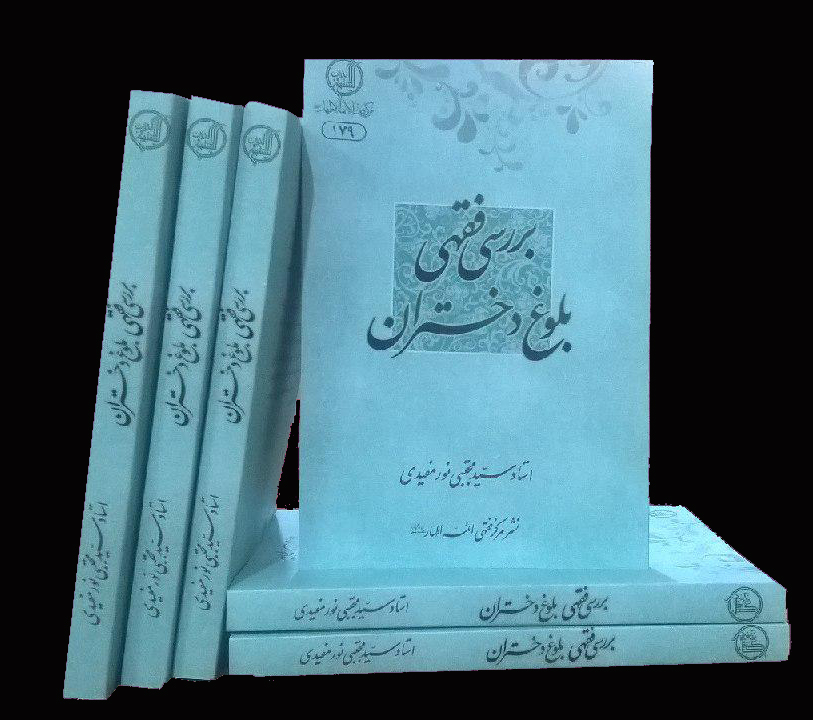
A Jurisprudential Study of the Puberty of Girls
Among the Persian jurisprudential works of the past decades that have specifically addressed the puberty of girls and presented comprehensive, precise, and integrated studies, one can point to the book A Jurisprudential Study of the Puberty of Girls, a valuable work of Professor Sayyid Mujtaba Nur Mufidi, the first edition of which was published by the Fiqh Center of A’immah al-Athar in 1395 SH (2016/2017 AD).
In the preface of this book, the purpose of compiling a work on the puberty of girls is stated as follows: “In the meantime, the discussion of the puberty of girls acquires a double importance from another perspective. This is because today, extensive global efforts have begun under the slogan of eliminating discrimination between men and women, and many groups seek the uniformization of the rights and duties of men and women. Obviously, in the meantime, the widely-held opinion (mashhur) of Shiite jurists has been subjected to objection, and the capacity of girls to accept responsibility and obligation (taklif) at the age of 9 has been questioned.” Therefore, according to the commendable practice of publishing a summary of the results of this research work, it seemed necessary to present this summary. Furthermore, in this book, alongside referring to original Islamic sources, attention has also been paid to the new theories of contemporary scholars, and in this discourse, we refer only to the final results of these investigations.
This book comprises four sections and an epilogue. In the first section, foundational discussions such as the lexical meaning of puberty (bulugh) and its synonyms are discussed. In the second section, the natural signs and indicators of girls’ puberty are examined. The third section contains an extensive discussion surrounding the age of girls’ puberty and the relevant narrations, which are thoroughly investigated. Finally, the fourth section addresses the issue of the conflict of narrations (ta’arud al-riwayat) and examines the opinions and various solutions proposed to resolve this conflict, defending the chosen solution. In the epilogue, several issues and questions related to girls’ puberty are answered.
In the opening chapter of the first section of the book regarding the lexical study of three terms (bulugh, ihtilam, idrak), the author states: “If these terms are attributed to a child (sabi) or a young boy (ghulam), they possess a single meaning, which is emerging from childhood and reaching the stage of men and women, and one of the matters exclusive to men and women is desire and a strong inclination toward the opposite sex.” In the second chapter (Puberty in Convention), he writes: “Based on what has been mentioned so far, it can be concluded that from the perspective of jurists, puberty consists of sexual puberty, as well as reaching a specific age, and in a single sentence, reaching the threshold of obligation (taklif).”
In the third chapter (The Difference between Puberty and Discernment (tamyiz) and Maturity (rushd)), it is stated: “If puberty is defined in the sense of sexual puberty, it is conceptually distinct from these two terms, because sexual puberty is an ontological matter related to the body, whereas discernment and maturity are characteristics related to intellectual capacity. If puberty is defined in the sense of reaching a specific age or reaching the threshold of obligation, the distinction, according to the explanations provided, is even clearer.”
The fourth chapter, which concerns puberty in the Quran, concludes with this point: “The three terms bulugh al-nikah (attaining the marriageable age), hulm (physical maturity), and ashudd (full strength)—which are mentioned in Verse 6 of Surah al-Nisa, Verse 59 of Surah al-Nur, Verse 34 of Surah al-Isra, and other verses respectively—refer only to the meaning of puberty, and the issue of the age of puberty is not raised in these verses.”
Professor Nur Mufidi subsequently presents certain clarifications in the fifth chapter. In the discussion of the jurists’ expressions of puberty, he reaches this conclusion: “It appears possible to place all of these expressions under three general categories: 1) Puberty itself; 2) The sign of puberty; 3) The evidence of prior puberty. The first is the natural capacity of the human being for reproduction; the second consists of matters that detect the human being reaching natural capacity; and the third indicates the realization of the mentioned capacity in a prior time.” At the end of the chapter, he states: “If we harbor doubt regarding the establishment of obligation upon girls at a specific stage, in accordance with the general and absolute implications of the evidences of obligations, the ruling of the establishment of obligation is made.”
Subsequently, the author enters the second section, namely the primary natural signs of puberty. In the introduction, he states: “If we wish to present a list of common signs shared with boys and those exclusive to the puberty of girls mentioned in jurisprudential books, we can refer to the following: 1) The growth of coarse hair on the pubis (anah); 2) Nocturnal emission; 3) Menstruation (haid); 4) Pregnancy (haml).” However, regarding other signs, none have been accepted by the scholars.
In the first chapter of the first section under the title “Evidences of the Threshold of Obligation in Girls through the Growth of Pubic Hair,” his investigations lead to this conclusion: “From the collection of these narrations, it is inferred that the growth of pubic hair is among the natural signs through which obligation is established, and the clarity of its implication on the claim is defensible. In terms of chain of transmission, the weakness of some of these narrations is compensated by popular acceptance, as Al-Muhaqqiq al-Ardabili has explicitly stated.”
This professor of the Islamic seminary, on page 97 of this book, subsequently points to a highly critical note in the methodology of approaching the discussion of girls’ puberty: “Generally, between the widely-held opinion (mashhur) and what we pursue in this position, there is a fundamental difference. The mashhur considers the criterion of puberty in girls to be 9 years of age, and they examine all natural signs from this perspective—whether these signs detect the girl reaching 9 years of age or not. Conversely, in our view, natural signs and the issue of age must be investigated independently, and indeed we have chosen this methodology.” In the final chapter, he places “the growth of pubic hair as evidence of prior puberty rather than its sign” and “rejects the restriction of hair growth to the pubis, considering the growth of underarm and perianal hair also as evidence of prior puberty.”
At the beginning of the second chapter regarding the sign of (nocturnal emission), Professor Nur Mufidi treats this matter as the second sign of puberty, and in the discussion of the relationship between physical maturity (ihtilam) and nocturnal emission in the expressions of narrations and scholars, he states: “It can be concluded that these two are in reality a single fact.”
At the end of the second chapter, he explains the general conclusion of this chapter as follows: “The conclusion of the second chapter is that nocturnal emission is the starting point of obligation in girls, and its evidences do not conflict with the evidences of other matters established as the starting point of obligation in girls; because exclusivity is not inferred from the evidences of nocturnal emission and physical maturity. The only evidence that might conflict with this sign is the narrations concerning age, which we will examine in its proper place.”
The third chapter is written regarding the sign of menstruation (haid). Through exploring the evidences of the threshold of obligation in girls by means of haid, he reaches this conclusion: “Although some of these narrations are open to objection in terms of chain of transmission, and others in terms of implication, as a whole, it can be inferred from these narrations that haid is the starting point of obligation in girls.” In conclusion, to answer this question: is haid a sign of puberty, or is it evidence of the realization of puberty in a prior time? He concludes as follows:
“With respect to the meaning of puberty (not according to the widely-held opinion), it appears that there is no proof of prior puberty; rather, the girl’s capacity for reproduction and her natural perfection begin with haid, and prior to that, this natural perfection is not achieved. Some even say: ‘The occurrence of menstruation is not a complete sign of puberty, and with the first menstruation, the capacity for reproduction is not acquired.’ Under this note, how can haid be evidence of the realization of the mentioned perfection in a past time? Thus, considering the meaning of puberty, haid in itself and setting aside other evidences is the starting point of the establishment of obligation in girls.”
At the end of the second section, other natural signs are examined; among which, “pregnancy” is considered evidence of the realization of puberty in a prior time. The sign of “height” is not accepted as the starting point of obligation, and regarding other signs such as marriage and consummation, they state: “In any case, none of the jurists have issued decrees based on these indications.”
The third section concerns “age,” and at the beginning, Professor Sayyid Mujtaba Nur Mufidi presents three possibilities regarding it: “First possibility: age, like physical maturity and haid, is one of the natural signs of sexual puberty as the starting point of obligation; second possibility: age is a devotional indication (amarah ta’abbudiyyah) of sexual puberty and the mentioned perfection; third possibility: age is fundamentally not an indication of sexual puberty, but is independently the starting point of the establishment of obligation.” In selecting one possibility, they state: “In any case, the third possibility has a general preference over the other two.”
Subsequently, the professor enters the discussion of the age number, and considering that he has previously addressed the discussion of the verses and the non-mention of a specific age in the verses, he proceeds solely to examine the narrations of this chapter to determine whether a specific age has been declared in the Sharia for the establishment of obligations and rights upon girls or not. In response to this question, after a complete investigation among the narrations—both the hesitant (which have declared two age numbers for puberty) and the non-hesitant—he rules on the precedence of the narrations of 9 years of age over other age narrations. In the summary presented on page 246, he states:
“It appears that the narrations of 9 years of age take precedence over the narrations of 13 years of age and 10 years of age because: among the narrations of 9 years of age, there are several authenticated (sahih) traditions, whereas the most important narration of 13 years of age is the narration of Ammar al-Sabbati, which is trustworthy (muwaththaqah); the narration of 10 years of age is also not authenticated in terms of chain of transmission, and in terms of implication, its interpretation as the completion of 9 years and entry into the 10th year is not far-fetched. However, even if we do not accept this, the narrations of 9 years of age have preference because they enjoy both narrative popularity (shuhrat-e riwa’iyyah) and practical popularity (shuhrat-e ‘amaliyyah).”
This section concludes with this very decision, and Professor Nur Mufidi enters the critical section: “The conflict between the narrations of nine years of age (riwayat-e tis’) and the narrations of menstruation and physical maturity,” whose investigation has been repeatedly promised, and about which academic and non-academic circles have spoken extensively in the present era.
In explaining the nature of the conflict, Professor Nur Mufidi begins the section as follows: “On one hand, the narrations of physical maturity and menstruation have mentioned these two matters as the sign of puberty and the establishment of obligation; the meaning of accepting these narrations is the non-intervention of age in puberty and the establishment of obligation. On the other hand, the narrations of nine years of age (riwayat-e tis’) have brought this age as the limit of girls’ puberty and the time of obligation. The meaning of accepting these narrations is the non-intervention of physical maturity and menstruation in this matter.”
Besides his chosen solution, this professor of the seminary presents seven solutions for this conflict, which belong to the following individuals respectively: 1) Fayz Kashani, Mafatih al-Shara’i’, Vol. 2, p. 14; 2) Ayatullah Ma’rifat, Kaweshi dar Fiqh, p. 251; 3) Ayatullah Yusuf Sa’anei, in a pamphlet presented by one of his students; 4) Ayatullah Seyyed Mohammad Bojnourdi, Puberty of Girls, p. 257; 5) Ayatullah Mohammad Ibrahim Jannati, Puberty of Girls, p. 267; 6) Ayatullah Ja’far Sobhani, Al-Bulugh, p. 57, and Sahib al-Jawahir, Jawahir al-Kalam, Vol. 26, p. 44; 7) Professor Mahdi Mehrizi, Puberty of Girls, p. 173. After quoting and examining these seven solutions, he explains his own chosen solution, which is free of the defects of the previous solutions, summarized as follows:
“The age of 9 is established by the Lawgiver as the starting point of puberty and the time of the establishment of obligation, and in our view, it is neither a natural indication of puberty nor a natural sign, but is independently the standard of the establishment of obligation as stated in the narrations. However, according to some other narrations, if a girl is of unknown age (majhool al-sinn)—as the age of individuals was usually unknown in the past—she is ruled as having reached puberty upon the appearance of menstruation and physical maturity. In other words, the Lawgiver has presented two criteria: one for those who are aware of their age, where 9 years is the standard, and another for those of unknown age, where obligation is established upon the realization of natural signs.”
Professor Nur Mufidi answers all eight objections directed at his solution, and concludes the book with the epilogue.