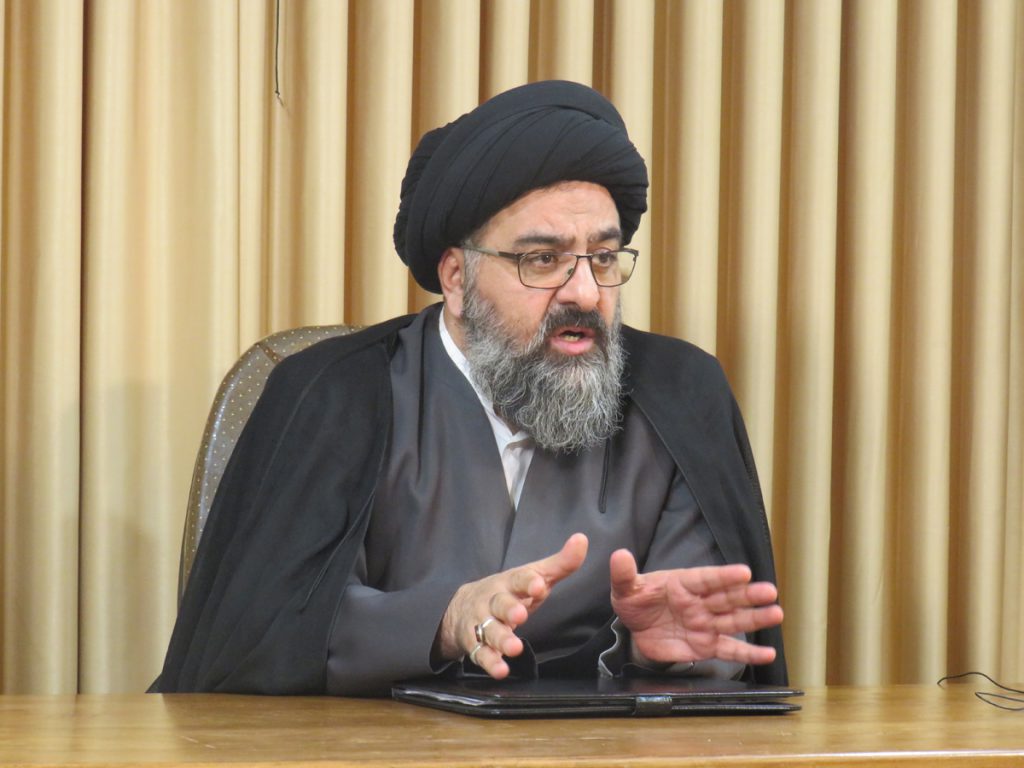
What role do you think the people play in Islamic governance?
These days remind us of bitter and thus unforgettable days. We never imagined in our minds a life without the Imam and an Iran without the Imam, and although many years have passed since that era, I still occasionally review the memory of those moments. Sometimes I see the images broadcast from those days; indeed, the intensity of the grief and sorrow that the people and we ourselves experienced during that period dominates our being once again.
The further we have progressed and the more deeply we have encountered the various opinions and thoughts of the Imam in the fields of jurisprudence, principles, exegesis, and different issues, the more tangible the absence of such a personality has become. God willing, may Almighty God associate and unite him in the Highest Heavens with his pure ancestors, and grant us the success to walk in his path—both in terms of self-building and acquiring spiritual and moral perfections, and in terms of scientific, intellectual, and forward-looking clarity and understanding of the specific conditions and situations in which we live.
Regarding the status of the people in the system of governance, I will explain very briefly. At times, we look at this subject from an ethical perspective, and at other times, from a jurisprudential and legal perspective. From an ethical perspective, the position of the people is extremely high in the eyes of everyone. That is, despite the difference of opinion that exists in the second aspect—namely the legal and jurisprudential aspect regarding the question of who holds the right to self-determination and governance—in this first part, everyone speaks of the people, and even those who do not believe in any right of self-determination for the people actually show them the utmost humility and respect.
Therefore, in my opinion, these two issues must be separated. We wish to discuss the status of the people from a jurisprudential and legal perspective. Serious differences of opinion exist here, but what is derived from the evidence is that the people play a pivotal role in the creation and continuation of the Islamic system. It is not the case that we say the people merely “discover” the Islamic ruler. Rather, alongside certain conditions and criteria, the opinion and vote of the people are considered part of the subject matter.
The collection of proofs that we can cite from verses, narrations, and rational arguments can clearly and strongly establish the involvement of the opinion and vote of the people in the legitimacy (mashru’iyyah) of the Islamic government.
What is the status of the people in the political and governmental thought of Hazrat Imam?
In an interview that the Imam had in Paris, when asked what he meant by the “Islamic Republic,” he stated, “It is the very same republic common in the world.” That is, the very same role that the people play in determining parliamentary representatives and the president. In the messages he sent to officials on various occasions or the letters he wrote, this issue manifested itself so prominently and clearly that it is as if the Imam fundamentally viewed the Islamic government and the Islamic Republic without the people as nothing.
In one place he states: “If a nation does not back a government, this government cannot be established.” (Sahifeh-ye Imam, Vol. 11, p. 456). We might say that because establishing an Islamic government is an obligation, the people, as those who prepare the prerequisite (muqaddamah) for this obligation, must gather to back that government. But fundamentally, it is the people who give substance to the Islamic Republic, and they play an effective role not only in its creation but also in its continuation.
The principle that the majority vote is the criterion, and that it rarely happens that the majority of a society errs, is the view of the Imam. Supposing the majority of a society makes a mistake, this very mistake and the subsequent return from the erroneous path help elevate and grow that society, turning it into a more complete society over time. Just as the mistakes of an individual become an experience for their future, nations are the same.
During the drafting of the Constitution, in his statements and speeches close to the victory of the Revolution, and after the Revolution, the Imam emphasized the issue of the opinion and vote of the people in various places, and this was neither out of emergency nor for mere decoration. The sum of the speeches the Imam delivered during the ten-year period after the Revolution strongly and firmly indicates that he valued the people’s choice.
He states: “We do not intend to impose anything on our nation. And Islam has not permitted us to practice dictatorship. We are followers of the nation’s votes. However our nation votes, we follow them. We do not have the right. Almighty God has not given us the right, and the Prophet of Islam has not given us the right to impose something on our nation.” (Sahifeh-ye Imam, Vol. 11, p. 35).
From the statements of the Imam’s students and the Supreme Leader himself, it appears that the votes of the nation are not a matter of decoration or ceremony, but a matter of genuine efficacy. This very difference of opinion which has become more prominent today also existed during the drafting of the Constitution. Martyr Beheshti, in explaining the theory of Wilayat al-Faqih, clearly states that if we wish to govern, we must refer to the votes of the people, and without this, it is neither religious nor legitimate, nor is it possible.
The opinion of some individuals is that even if participation is not very high, it does not create a problem for legitimacy. Regardless of whether the opinion of the majority of the people plays a role in legitimacy (mashru’iyyah), acceptability (maqbuliyyah), or in other words, in efficiency and power, let us look at what method we should adopt. We must look at the objective effect of these behaviors. If someone says that the people are the source of the system’s power but acts in a way that distances the people from this system, this is a weakening of the source of power. How can a weak system solve problems?! Those who say the people are the source of the system’s efficiency, not its legitimacy—if an arrangement is made such that the people distance themselves and the majority of the people do not provide the necessary support, the result will be an inefficient or weakly efficient system. How can an inefficient system solve problems and interact with the world?! How can it become a model for other countries?!
Any behavior that, God forbid, causes the support of the people to weaken and the people to distance themselves actually damages the source of power, the origin of efficiency, and the acceptability of the system, and this certainly has unpleasant consequences. We must strengthen these bonds, and the strengthening of these bonds cannot be temporary; it must be in a permanent and continuous framework, and this must occur in a real manner.
What is the status of the elements of time and space (conditions) in the thought of the Imam, and what dangers threaten the system if these two elements are ignored?
Over these years, I have occasionally seen writings, speeches, and statements in this regard, and I truly felt regret that some of those who spoke on this subject did not understand the depth of this thought at all and reduced it to matters that many previous jurists had also stated. We must see what the Imam stated here that usefully distinguished him from other jurists. The Imam believed that the conditions of time and space have an impact not merely on the subject matter and the changes that affect it, but even on the criteria of rulings (malakat al-ahkam) and the quality of our derivation (istinbat) of proofs.
That is, a subject that carried a certain ruling in the past, and apparently remains the same subject today, has been transformed by the complex relations created in today’s world, thereby requiring a new ruling. The late Martyr Motahari does not use the expression “time and space,” but refers to this as “novel ijtihad” (ijtehad-e novin). Understanding today’s complex relations has prerequisites which are the very conditions of time and space, and this requires a novel ijtihad to enter the arena.
The danger that the Imam warned against is that if this element is ignored, religion will be accused of inefficiency and the Islamic system will be accused of reaching a dead-end, showing an inability to provide solutions and untie knots, which ultimately leads to a turning away from the Islamic system, jurisprudence, and juristic authority.
What is the most important heritage of Hazrat Imam in our world today, and what must we do to preserve this heritage?
The most important heritage of the Imam is the “Islamic Republic.” The Islamic Republic is composed of two parts. The Islamic Republic is the fruit of the long years of effort of the Imam, the support of the people, and the blood of the martyrs shed for this seedling. To preserve this heritage, its components must be preserved with care and seriousness. The Islamicity of the system and the general path of the system’s movement are important, and alongside it lies the republicanism.
We must not intend a particular, idiosyncratic meaning of republicanism. Republicanism in the words of the Imam is not a term different from the conventional and common meaning in today’s world. The Imam stated “the Islamic Republic,” and our meaning of the republic is the very same republics that exist in the world, wherein the will of the majority of the people rules and materializes through the established channels of governance. We must preserve this.
Possible though it is that someone might assume that if a small damage is inflicted for the sake of certain more important expediencies, it is not important; but we must think of 50 years from now. If, God forbid, either of these two pillars is damaged and deviates from the heritage, what will be the ultimate outcome after many years?