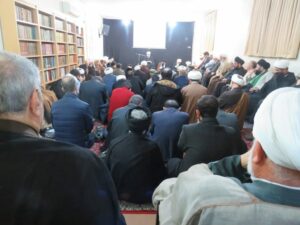


Ayatullah Sayyid Mujtaba Nur Mufidi, President of the Research Institute for Contemporary Jurisprudence
An Unmatched Threshold of Tolerance Is the Outstanding Trait of Imam al-Kadhim (PBUH); an Exemplar That His Followers Must Apply in All Spheres of Life, from Family to Politics.
All the Imams (peace be upon them) possessed moral virtues to the degree of perfection, but the circumstances of each era rendered a specific aspect of their personality more manifest. Imam al-Sajjad (peace be upon him) became known by the title “Zayn al-‘Abidin” (Ornament of the Worshipers)—not because the other Imams held a lower status in worship, but because his era demanded the manifestation of sincere servitude. Likewise, Imam al-Kadhim (peace be upon him), in an era when Abbasid violence had reached its peak, became the absolute exemplar of forbearance (hilm) and tolerance (mudara) through the title “Al-Kadhim” (The Restrainer of Anger). This trait requires re-reading today in a world where the threshold of tolerance in familial, social, and even political relationships has reached a minimum.
The Incident of the Abusive Man and the Response That Transformed History
It is narrated that a man in Medina continuously insulted Imam al-Kadhim (peace be upon him) and the Commander of the Faithful (peace be upon him). Some companions intended to kill him, but the Imam prevented them and personally went to his farm. Kindly, he asked: “How much loss have you suffered?” The man replied: “100 dinars.” The Imam immediately gave him 300 dinars and stated: “I also compensate for your expected profits.” This behavior not only shamed the man, but transformed him into one of the loyal followers of the Imam. Interestingly, this event—unlike many narrations—is recorded not only in Shia sources, but Sunni historians such as Al-Khatib al-Baghdadi have documented it as well.
A Bequest That Saves Today’s Society
Imam al-Kadhim (peace be upon him), in a bequest to his children, stated: “If someone utters an improper word into your right ear and then denies it in your left ear saying, ‘I said nothing,’ accept his excuse—even if you heard it with your own ears!”
This command is not merely a moral recommendation, but a practical strategy for reducing social tensions. The Imam (peace be upon him) wishes to convey: Even if you heard with your own ears that someone insulted you, but they deny it, accept their excuse so that society may be freed from the whirlpool of rancor. If today this bequest were implemented in families, cyberspace, and even among our officials, many baseless conflicts that sometimes lead to the collapse of relationships would be extinguished.
Questioning Us: Claimants of Discipleship
Today, when some Shia sometimes sever their relationships with others over a rumor or unconsidered remark, one must ask: Is mourning for Imam al-Kadhim (peace be upon him) without following his forbearing conduct (sirah-ye hilmi) a truthful claim?! When in the workplace or family, instead of “ignoring” mistakes, we engage in “focusing on others’ errors,” how can we consider ourselves followers of the school of the Kadhim of the Household of Muhammad (PBUH)?
Our Today: A Test Harder Than Yesterday
On the anniversary of the martyrdom of Imam al-Kadhim (peace be upon him), alongside mourning ceremonies, we must practice forbearance (hilm).
-
In the family: If your child utters an unpleasant remark, do not respond with anger; like the Imam (peace be upon him), first address the root of the problem—perhaps fatigue or psychological pressure.
-
In society: If someone insults you, before attacking, seek the “cause” of this hostility and do not respond to it with hostility.
-
In politics: Treat opponents with magnanimous behavior so that they become ashamed before your conduct and speech.
Imam al-Kadhim (peace be upon him) proved that forbearance (hilm) is not weakness; it is a weapon that transforms an enemy into a friend. In today’s world where “verbal violence” has turned into a global crisis, re-reading the Kadhimian conduct along with acting upon his bequest is the sole path of salvation for the individual and society.