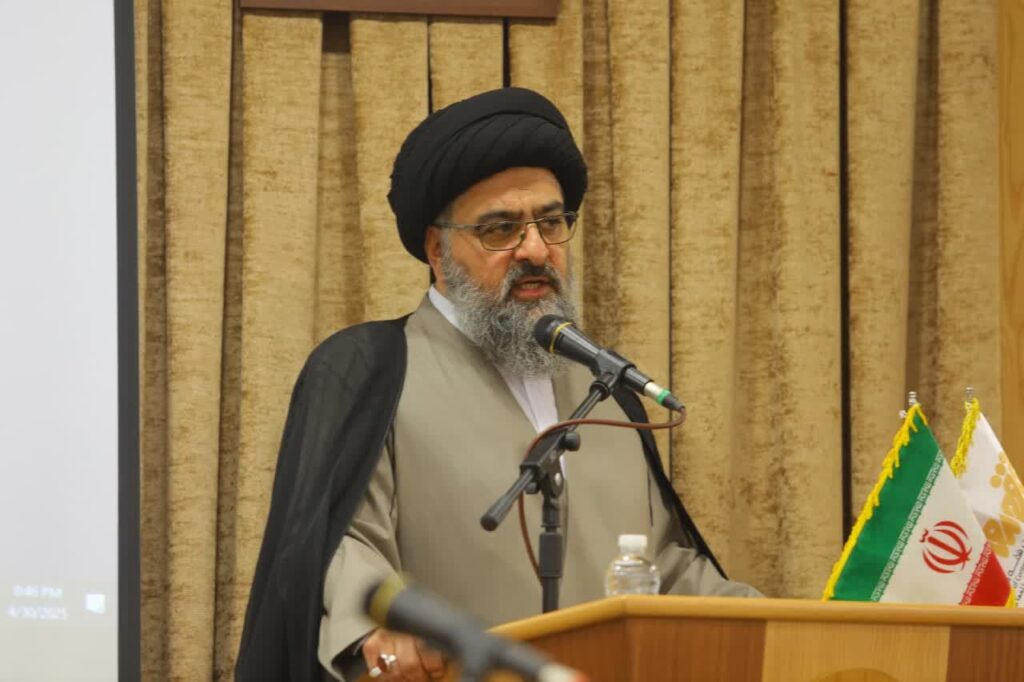
Professor of Advanced Jurisprudence and Principles at the Qom Seminary, in an exclusive interview with Ijtihad Network:
Seyyed Kamal al-Haydari neither made jurisprudence dynamic nor was he able to provide a correct answer to these doubts himself / Which Marja’ or professor has ever said, “Come receive healing from us?!” / Takfir and Tafsiq are not the ways to confront intellectual deviations.
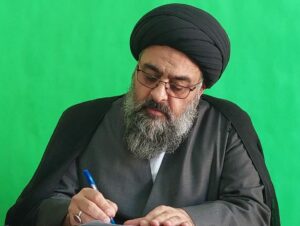
Exclusive to Ijtihad Network: Ayatullah Sayyid Mujtaba Nur Mufidi has been teaching advanced levels of jurisprudence (Kharij) and the principles of jurisprudence in the Qom Seminary for many years. In addition to his highly attended classes and numerous publications, he has a deep interest in contemporary intellectual issues. He stands at the intersection of tradition and intellectualism; he is both a proponent of traditional Jawaheri jurisprudence and a supporter of freedom of expression. He opposes the propagation of doubts, yet simultaneously condemns Takfir (excommunication) and Tafsiq (accusing others of impiety).
In this interview, the member of the Board of Trustees of the Jurisprudential Center of the Pure Imams (a.s.) discusses Seyyed Kamal al-Haydari and his failure to achieve his intended objectives. He expresses his deep regret over the injustice these statements inflict upon Shi’a jurisprudence, its scholars, and the Maraji’ (religious authorities). Below is the detailed transcript of the exclusive interview conducted by the Ijtihad Network with the head of the Dar al-Ma’rifah Institute of Qom.
Ijtihad: Recently, Mr. Seyyed Kamal al-Haydari had an interview with Al-Ekhbariya network, during which he claimed that Shi’a jurists engage in the Takfir (excommunication) of other Muslims. What is your opinion on this matter?
Ayatullah Sayyid Mujtaba Nur Mufidi: Regarding these and similar statements, I believe that rather than focusing on a specific remark, it is more important to analyze the overall approach he has adopted. He had previously raised similar issues, such as his comments on Shi’a hadith compendiums, the concept of Mahdism, or his statement—which I found highly peculiar—that one of the blessings of the COVID-19 pandemic was that it brought down the “official reading of Islam” in both Shi’a and Sunni seminaries!
Similarly, regarding rulings related to women, he claimed that ninety percent of the rulings concerning women mentioned in religious sources were specific to past historical conditions and are no longer applicable today. He made similar claims specifically regarding the hijab and the status of Hazrat Zahra (peace be upon her) as a role model for the hijab.
The most optimistic analysis we can offer for this approach—based on what the group associated with him claims—is that he seeks to highlight incorrect and irrational interpretations of religious scholars that lead to inefficiency, aiming to achieve two goals:
-
To raise questions and doubts to engage the minds of the elite, and indeed the general public, thereby generating a form of dynamism in societal thought and opening the door to analytical and critical discussions.
-
To provide, as a religious scholar, a correct response to these doubts and defend the realm of religion against them.
However, neither of these two goals has been achieved; in fact, the outcome has been quite the opposite. Searching through the hidden corners of jurisprudential, exegetical, or theological texts to place certain obscure views on display—simply to familiarize the public mind with these doubts and compel scholars to respond—is an unfair approach. It does not represent the entirety of jurisprudence, nor does it present the true image of all jurists; rather, it offers a highly distorted representation of them. Consequently, these doubts have not been resolved; instead, they have become deeply entrenched in the minds of many individuals within the Shi’a religious community, the broader Islamic world, and even beyond.
In the second aspect, he was also unsuccessful. The answers he provided—which he believed would resolve these objections and present a more accurate reading of religion—were not robust enough to solve the problem. He himself admits to receiving numerous messages from people stating that doubts had been cast on various religious rulings. I have personally encountered individuals who, relying on these very materials, have begun to doubt many issues, which in some cases has led to outright denial.
Among the opponents of the Shi’a, particularly the Salafis and Takfiris, the impact of these statements has been significantly worse. A broadcast by Adnan al-Arour, a Saudi Wahhabi mufti, was particularly telling. He stated: “We admit that Takfiri groups like the Kharijites, ISIS, and their like exist within the Islamic Ummah; however, Mr. Al-Haydari has claimed that abandoning Takfir is impossible unless one separates oneself from Shi’ism.” He then added: “Ibn Taymiyyah, Muhammad ibn Abd al-Wahhab, Abu Hanifah, and al-Shafi’i did not make such claims. This man is speaking from their own books so the world may know who the real Takfiri is.”
Even more striking was his subsequent remark: “I had prepared missiles and missile launchers to strike, but these statements grounded me, because he brought a Shi’ite missile and used it to strike the Shi’a themselves.” This requires no further analysis to show the destructive impact such statements have when broadcast through their media apparatus. It is indefensible by any logic that those who are at the vanguard of Takfir—and whose decrees have caused immense bloodshed in the Islamic world—now cite these statements to justify their actions.
Of course, I noticed that he subsequently issued clarifications, stating that his words had been cut out of context and that he was referring to “theological infidelity” (kufr-e kalami) rather than “jurisprudential infidelity” (kufr-e fiqhi). However, the crux of the matter lies in the timing and the context in which such statements are delivered. Expressing these concepts to an audience that does not differentiate between the various categories of kufr inevitably leads to damaging outcomes. While we may conceptualize various levels of infidelity academically, the general public and the audience of hostile media do not make these distinctions. They only hear the headline: “Shi’a jurists believe in the excommunication of all other Islamic sects.”
Furthermore, the global arrogance undoubtedly seeks to fan the flames of these internal conflicts. At a time when everyone knows the fragile state of the Islamic world, such remarks merely provide fuel to ignite fresh discord.
Even in his attempt to diagnose the problem and offer a remedy, he has been entirely unsuccessful. The solutions he proposed are not academically acceptable. In contrast, someone like Ayatollah Sistani issues a fatwa in these circumstances stating that the followers of all Islamic schools are Muslims both outwardly and inwardly, and if they act according to their duties, they are absolved of their obligations. I wish Mr. Al-Haydari, instead of presenting partial and selective historical searches, had taken a positive approach like Ayatollah Sistani by emphasizing the inward and outward Islamic status of all sects. There is a profound lack of intellectual prudence—if not fairness—in the way these issues were raised. If we wish to present scholarly views, we must present them comprehensively. I do not claim that everything he said is a falsehood, but it is certainly not the complete truth either. A person must evaluate the context and the vessel in which they choose to deliver the truth.
Ijtihad: Perhaps Mr. al-Haydari believes he is raising fundamental questions. Some argue that one of the challenges of Shi’a jurisprudence is that we have become mired in marginal and peripheral issues, whereas the questions he raises are foundational. In the history of science, we see that those who brought about paradigms shifts were those who raised fundamental questions. Furthermore, we do not need to defend every single statement made by jurists; we must distinguish between the understanding of the jurists and the authentic primary sources.
Ayatullah Sayyid Mujtaba Nur Mufidi: It is absolutely correct that we must distinguish between the understanding of the jurists and the primary sources of religion. The absolute statements (itlaq) of jurists do not carry the same weight as the absolute statements of the Lawgiver. When the Lawgiver speaks, His words carry absolute legal weight as they are issued from the station of legislation and take all universal conditions into account. The words of a jurist like the author of Jawahir or similar scholars are not of this nature; a portion of their statements may be influenced by the specific circumstances of their era. We are not obliged to defend every opinion of every historical jurist. Indeed, within jurisprudential texts, you see jurists constantly criticizing and challenging one another’s views.
The main issue here is that his statements have damaged the collective standing and reputation of Shi’a jurists by asserting that they excommunicate all other Islamic schools, which is simply not true. Those historical statements of jurists that he references can easily be understood and contextualized once we grasp what they actually meant.
We have similar expressions used regarding Shias themselves. For instance, there are narrations stating that if a Shi’a commits a certain act—such as abandoning prayer or committing suicide—they will be resurrected as a disbeliever (kafir). When our narrations and rulings use the term kufr in this manner, its contextual meaning is clear. Therefore, I truly believe that an injustice has been done to Shi’a jurisprudence in this instance.
If intellectual development is pursued through a path that completely closes the door to constructive dialogue, it defeats its own purpose. Reform must be gradual and requires specific conditions and prerequisites. For instance, is it more effective to raise a new generation of jurists trained on the foundations of Imam Khomeini, Martyr Baqir al-Sadr, or other contemporary jurists whose numbers are steadily growing, or to adopt this method of public confrontation and declaration?
Ijtihad: In your eminence’s view, what is the correct method for confronting religious and jurisprudential deviations when they are expressed by certain individuals?
Ayatullah Sayyid Mujtaba Nur Mufidi: The best and most correct method is the one outlined in the Holy Qur’an and the narrations of the Infallible Imams (peace be upon them). We must keep the methods and lives of our righteous predecessor scholars as our guiding light.
In our view, an intellectual doubt or a genuine question must be treated differently from obstinacy (‘anad), stubbornness, and outright denial. We cannot treat them identically or apply a single solution to both. When we speak of a doubt or a question, it makes no difference who raises it—it may come from a devout Muslim or from an atheist. In confronting a question, the best path is argumentation, logic, proof, dialogue, debate, and intellectual persuasion. Not every question or doubt, even those concerning the Divine Essence, is necessarily raised out of denial.
In the conduct of the Ahl al-Bayt (peace be upon them), we see how they permitted people to raise questions—even those challenging some of the most fundamental aspects of our beliefs—and how they treated them with respect, good character, and a genuine desire to persuade them. This is an opportunity that God Himself has granted to humanity. The human mind is naturally searching, questioning, and curious. The desire to know is an innate (fitri) disposition embedded within human nature, which is why the concept of compulsion in religion is strictly rejected. Religion must be built upon conviction and belief.
However, the issue of obstinacy and denial accompanied by stubbornness is entirely different. In dealing with such cases, responding with argumentation and logic alone is not sufficient. For example, regarding certain deviant sects such as the Ghulat (exaggerators) or the Murji’ah, we find the Imams stating: “May God curse the Ghulat,” or “May God curse the Murji’ah.” While cursing is distinct from using profanity, the Imams nevertheless placed restrictions on interacting with the Ghulat. For instance, they instructed their followers: “Be careful that your children do not associate with them; keep them away from the Ghulat.”
Unfortunately, we often see a lack of distinction in these matters. Some argue that we must always and in every circumstance respond solely with logic, dialogue, and proof, while others argue that we must deal with every issue heavy-handedly and crush any doubt or question in its infancy. How to distinguish between these two scenarios is a separate discussion.
My understanding of religious teachings is that the Ahl al-Bayt (peace be upon them) established their foundation on argumentation, logic, rational evidence, persuasion, and even providing the platform for questions to be raised. However, when dealing with certain individuals who lacked sincerity and whose intentions were clearly not scholarly, the Imams employed a different approach. Even then, it is highly important that our behavior in the face of stubbornness must be conducted in a manner that does not produce adverse effects. We must be highly mindful of how our reactions are perceived by others. An unwise reaction might allow the deviant party to play the victim, thereby increasing the impact of their deviation on society. Thus, this requires immense wisdom, capacity, and tolerance. Takfir (excommunication) and Tafsiq (accusing of impiety) are not the ways to resolve these intellectual challenges.
Ijtihad: Can we prevent the dissemination of these statements or boycott them by applying Tanqih al-Manat (refining the ratio decidendi) of the proofs concerning the prohibition of distributing “misleading books” (Kutub al-Dalal)?
Ayatullah Sayyid Mujtaba Nur Mufidi: Before turning to Tanqih al-Manat, some might argue that the proofs directly encompass these works. The concept of “misleading books” has undergone significant development conceptually, practically, and in terms of its exceptions. The debate is whether this concept refers exclusively to the books of abrogated religions, or if it extends beyond them. Some have expanded its scope to include the works of any opponents of the truth. According to some scholars, the scope of Kutub al-Dalal is so broad that it encompasses anything that causes deviation and misguidance. Some even classify certain books of philosophy and mysticism (Irfan) under this category.
If we expand the scope of misleading books to its absolute maximum and declare that anything causing society to deviate from the path of guidance—based on our own personal assessment of what guidance is—falls under this category, then these statements would naturally be considered examples of misleading books. However, this maximalist view is certainly subject to serious scholarly objection.
Therefore, while it is difficult to classify these statements under the primary ruling (al-unwan al-awwali) of misleading books, their dissemination is indeed impermissible under a secondary ruling (al-unwan al-thanawi). For the sake of the Islamic community, the preservation of unity within the Ummah, and preventing the destructive effects of these statements on the minds of the youth, I do not consider their publication to be correct.
To claim that the COVID-19 pandemic brought down the “official reading of Islam” in the seminaries of Qom and Najaf is something I truly cannot comprehend. What is the connection between these two matters? Which official reading of Islam did the coronavirus bring down?
Ijtihad: His intention was to critique the maximalist reading of religion, which claims that if we become Shias and Muslims and establish a spiritual connection with the Imams, all our physical and worldly problems will be resolved.
Ayatullah Sayyid Mujtaba Nur Mufidi: Who has ever made such a claim? Is this the official reading of the seminaries? If a few uneducated speakers on the pulpit have said such things, what does that have to do with the seminary as an institution? He claims that the “official reading of Islam in the seminaries” was brought down. Yet, in Qom and Najaf, all the Maraji’ issued fatwas declaring the religious necessity of following health guidelines and medical advice. Which Grand Ayatollah ever claimed that we would personally cure this pandemic? During historical outbreaks of plague and cholera, which jurist ever told the people, “Come to the seminary so we can heal you”?
Thus, an injustice was done here as well. Just as I consider his statement harmful and its dissemination incorrect, I find the claim of those who say, “Discard medical advice, healing is solely found in the Shrine of Imam Reza (a.s.), so come here for healing,” to be equally harmful. These two statements are equally damaging. Which respected Marja’, which scholar, or which professor has ever spoken in such a manner? This is truly unfair.
This is what I meant at the beginning of our discussion by a lack of intellectual prudence and fairness. Which seminary professor among these thousands of scholars ever called upon the public saying, “O people! If you want to be cured of illnesses, come to us”? If a tiny number of individuals have said such things, they are completely negligible. Therefore, the actions of a limited few who seek to substitute prayer and supplication for medical science must never be attributed to the seminaries.
Ijtihad: Some, relying on the famous narration of “Bahito-hum”, resort to making false accusations against those they deem deviant. What is your eminence’s opinion regarding the permissibility of relying on this narration?
Ayatullah Sayyid Mujtaba Nur Mufidi: As lexicographers and great jurists such as the author of Jawahir, Shahid al-Thani, and Fayd Kashani have stated, “Bahito-hum” (باهتوهم) means establishing firm, logical, and overwhelming arguments against them in a manner that leaves them speechless and without an answer.
Jurists of the caliber of the author of Jawahir and Shahid al-Thani have explicitly stated regarding innovators and those who fall under the Prophet’s warning that we must never attribute to them falsehoods that are not true. In his discussion on Qadhf (slander), the author of Jawahir states: “It is impermissible to attribute false accusations to them; this is a lie.” The idea that expediency permits us to confront them with various false accusations so that people will scatter from around them is something we can never accept.
Fundamentally, the entire system of our religious teachings is incompatible with such a meaning. Fairness and justice are among the foundational ethical principles of the Infallible Imams (peace be upon them). These noble figures maintained fairness and justice even in their dealings with their sworn enemies; how could it be acceptable to slander and make false accusations against others?
I believe the Imams (peace be upon them) maintained five core foundations in social ethics which they upheld toward friend and foe, supporter and opponent alike, and they never set them aside. Even with the most hostile adversaries, they never departed from the path of fairness and justice. With this in mind, how can anyone justify slandering others?
The corpus of religious teachings, the conduct of the Ahl al-Bayt, and the explicitly stated views of our greatest jurists all confirm that such behavior is strictly forbidden. While such methods might temporarily neutralize a threat in the short term, the long-term consequences of such behavior cannot remain hidden. Once people realize a falsehood has been told, they will no longer believe even the truths presented to them. They will assume everything is a lie.
Therefore, while this method might serve short-term interests, in the long run, it breeds deep distrust toward the leaders of religion, and people will cease to accept even their truthful words. From whatever angle I examine this issue, I cannot accept that the narration carries such a meaning. There is abundant historical evidence showing that these methods are ultimately ineffective and produce counterproductive results. We must be extremely cautious. If this behavior becomes an accepted practice, it will escape our control and become a weapon in the hands of the unqualified to undermine those who stand for truth and justice.