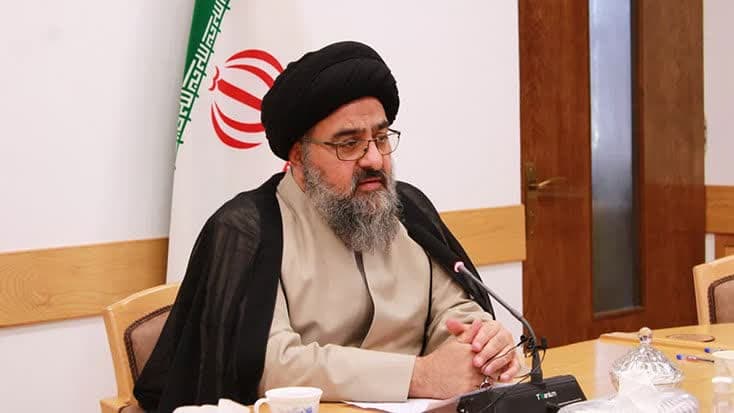
Thank you for placing your valuable time at our disposal. Our discussion concerns the blessed person of Imam Khomeini and his role and influence in the establishment of the Qom Seminary. We would like you to speak about his role and influence in establishing the Qom Seminary and his cooperation with Grand Ayatollahs Ha’eri and Borujerdi.
Thank you and Huzur magazine for addressing this subject. If we wish to take a general view of Imam Khomeini’s role from the beginning of his presence in Qom until 1964, when he was in this city, and during the period following the victory of the Revolution, we can divide the manner of his influence into several periods:
Initially, when the late Ayatollah Ha’eri Yazdi came to Qom at the invitation of some of the city’s prominent figures, such as the late Bafqi, the late Feyz, and others, Imam Khomeini and several other distinguished scholars were studying under Haj Shaykh in Arak. After it was decided, following the preliminaries familiar to everyone, that the late Haj Shaykh would come to Qom, the accompaniment of Imam Khomeini, Ayatollah Sayyid Mohammad Taqi Khansari, and Mr. Araki with Haj Shaykh certainly contributed to strengthening the newly established Qom Seminary. Perhaps because of his age and residence in Arak, Imam Khomeini played no direct role in Haj Shaykh’s move to Qom; but in Qom, the flourishing of the late Haj Shaykh’s classes was certainly due, first and foremost, to the presence of accomplished scholars such as Imam Khomeini. Imam Khomeini was one of the mainstays of the late Haj Shaykh’s class. Regarding the establishment of the seminary, he stated: “The work undertaken by the late Haj Shaykh in that period, when he established the seminary, was no less important than the establishment of the Islamic Republic.” In another statement, Imam Khomeini said: “If Haj Shaykh were alive today, he would do the same thing that I did.” Imam Khomeini’s very association with the late Haj Shaykh was an important factor in enabling the Qom Seminary to flourish academically in the early years after its establishment.
Following Haj Shaykh’s death, from 1936 until 1944, when Ayatollah Borujerdi came to Qom, Imam Khomeini’s cooperation with the Three Maraji‘ made his presence as one of the seminary’s leading teachers more prominent in shaping the orientation and direction of its affairs. I believe that Imam Khomeini’s influence within the seminary became more prominent during this second period than in the first. In the first period, in addition to accompanying Haj Shaykh and attending his classes, Imam Khomeini occasionally participated in meetings held at the seminary and in the decisions made there. His presence therefore became more influential during the second period. As a leading seminary teacher, Imam Khomeini held meetings and cooperated with the Three Maraji‘: the late Mr. Khansari, the late Mr. Hujjat, and the late Mr. Sadr. Of course, Imam Khomeini was on the same scholarly level as some of the Three Maraji‘ and played a highly important role in matters concerning the seminary.
During the third period, Imam Khomeini personally played a central role in efforts to bring the late Ayatollah Borujerdi to Qom. For both scholarly reasons and the need to centralize leadership and marja‘iyya and have a central figure in the Qom Seminary, Imam Khomeini and others sought to persuade the late Mr. Borujerdi to come to Qom, and they succeeded. From the time Ayatollah Borujerdi entered the Qom Seminary, Imam Khomeini worked closely with him. This cooperation manifested itself in various matters, such as stipends, attending to the students’ living conditions, the classes held at the seminary, and the examinations conducted to advance the students and assess their academic standing. Thus, during the third period, which lasted until the end of the late Mr. Borujerdi’s life, Imam Khomeini’s influence and role became more prominent than in the preceding period.
Following the death of the late Borujerdi, which marked the fourth period of Imam Khomeini’s influence in Qom, the question of Imam Khomeini’s marja‘iyya and his positions on the issues arising at that time came to the fore. During this period, Imam Khomeini played an entirely central and influential role, not only entering the struggle and movement himself but also bringing others into it. Following his exile to Najaf, his influence in the Qom Seminary continued through the presence of the students he had trained over the years. The fourth period therefore has two parts: the first comprises the time when Imam Khomeini was present in the Qom Seminary following Mr. Borujerdi’s death. The second began after Imam Khomeini’s exile to Najaf, when his influence in the Qom Seminary continued through his students, disciples, and admirers, and sometimes through messages and materials sent from Najaf.
A fifth period may also be identified following the Islamic Revolution. After the Revolution, Imam Khomeini’s influence on the seminary continued, but in other forms and manifestations.
What distinguishes these periods, and what are the differences between them?
If I were to describe the quality and manner of Imam Khomeini’s influence through a general classification, I could explain the similarities and differences between his influence before and after the Revolution. Following the Revolution, Imam Khomeini’s general orientation, in terms of his emphasis on the education and moral refinement of seminary students, remained as it had been before. Throughout these five periods, Imam Khomeini never neglected the two principal elements that constitute and sustain the seminary. The first was the seminary’s scholarly vitality; the second was moral refinement and self-purification, so that the souls of seminary students would pass through the stages of perfection and thereby become capable of assuming the position of guidance and religious propagation. These two elements were always present in Imam Khomeini’s outlook. Alongside them, the general orientation he consistently emphasized was that the seminaries must not remain indifferent to the people’s suffering and problems, the injustices committed by the Pahlavi regime, or arrogance and colonialism. Imam Khomeini was always sensitive to and took positions on Israel and Palestine and the arrogant disposition of the United States. His position did not change before and after the Revolution. He emphasized that the seminary must remain sensitive to the issues of the Islamic world and must not be indifferent to them.
Another point that may be identified as a clear and continuous feature of Imam Khomeini’s outlook on seminary affairs was his sensitivity to the issue of obscurantism in the seminaries. Regarding the period of the Three Maraji‘, Imam Khomeini said: “Messrs. Khansari, Hujjat, and Sadr were present at our home on a particular occasion, and they expressed concerns and held discussions about certain issues and events that had arisen. I told them there that so long as you do not free yourselves and the seminary from the hands of the pseudo-pious, you will be unable to accomplish anything.” This occurred in the 1940s. During that decade, Imam Khomeini warned about the danger of obscurantism and pseudo-pious individuals who created obstacles under various pretexts. Following the Revolution, he continued to warn against pseudo-piety and obscurantism, doing so until the final years of his blessed life. In Imam Khomeini’s thought, scholarly education, the refinement of souls, opposition to arrogance and colonialism, and resistance to obscurantism and false displays of piety may be identified as clear and common features throughout all these periods. Some of these features were, of course, more prominent in certain periods. In some instances, his involvement was direct; at other times, when another individual or other individuals led the seminary, he conveyed these matters to them.
On the other hand, one matter that Imam Khomeini emphasized more strongly following the Revolution, demonstrating his foresight, was that the seminary faced a flood of questions, inquiries, and needs and that the seminary, the clergy, and Islam were therefore responsible for answering them. Particularly after the establishment of the Islamic Republic, Imam Khomeini was deeply concerned that the Islamic Republic might be accused of inefficiency. He therefore gave fundamental attention to the role of time and place in ijtihad, emphasizing that mujtahids must understand today’s world, comprehend the complexities of the relationships and equations governing human life, and take interests and expediencies into account. Following the Revolution, Imam Khomeini referred to this matter as a global expectation of the seminaries.
Another matter was Imam Khomeini’s emphasis on the seminary’s independence and on ensuring that the seminary should by no means become governmental. This itself requires a separate and extensive discussion. We therefore see these two issues becoming more prominent in Imam Khomeini’s outlook on the seminary following the Revolution.
The earlier periods also differed from one another because of Imam Khomeini’s different levels of standing within the seminary during those periods. At one point, Imam Khomeini was an accomplished scholar attending Haj Shaykh’s class and receiving considerable attention from his teacher. Elsewhere, he was a leading teacher, and in another position, he was a marja‘ al-taqlid. The manner of Imam Khomeini’s presence therefore changed. We can nevertheless say that one issue stands out and is evident in all his activities concerning the seminary: he did not seek to promote himself within the seminary and did not seek to bring himself to prominence in various ways. Whenever he believed that the seminary had leaders, as it did during the period of the Three Maraji‘, he supported them. When he believed that someone such as Mr. Borujerdi should come to Qom and assume leadership, he respectfully attended his classes. This was despite the fact that Imam Khomeini had begun teaching advanced jurisprudence in 1944, when Mr. Borujerdi came to Qom, yet he still attended the late Mr. Borujerdi’s classes. Imam Khomeini genuinely believed that if someone became the standard-bearer of the seminary and a symbol of Islam and Shi‘ism, that person had to be strengthened. Although he criticized certain matters and disapproved of some conduct and actions, he did nothing that would weaken that standard-bearer and symbol. When Imam Khomeini was counted among the foremost maraji‘—indeed, as the most learned of the maraji‘ of Qom—he respected the standing and dignity of the other maraji‘ and cooperated, worked, and consulted with them.
What mattered to Imam Khomeini was that the seminary, as the legacy of the scholarly institutions of the era of the Imams (peace be upon them), should grow stronger by the day and develop both quantitatively and qualitatively. He did not seek to acquire a name or reputation for himself within this great scholarly institution and center. He always defined himself under the shelter and within the shadow of the greatness of the seminary and the greatness of Islam and Shi‘ism.
In part of your remarks, you referred to Imam Khomeini’s sensitivity and concern regarding the seminary’s independence and lack of dependence. Following the Revolution, how did Imam Khomeini interact with scholars and prominent figures in making decisions and issuing rulings and messages?
If your question concerns the period following the establishment of the Islamic Republic, when Imam Khomeini was the undisputed marja‘, the Leader of the Revolution, and a global and international figure, I must say that the totality of his conduct and statements on various seminary-related matters demonstrates that he attached particular importance to the seminary’s independence. This can be traced at both the infrastructural and intellectual levels. From an infrastructural perspective, he always emphasized that the seminary must preserve its financial independence. In his view, the seminary was a popular institution arising from among the people and had to be administered in accordance with the tradition followed by earlier generations and maintained since the past; it had to remain with and alongside the people. Following the Revolution, he therefore continued to use religious funds to provide seminary students’ stipends, and the other maraji‘ acted on the same basis. He opposed the government’s involvement in financing the seminary. Imam Khomeini also entrusted the seminary’s administration to the maraji‘ al-taqlid based within it. Similarly, disagreements sometimes arose over the sighting of the new moon. Although the sighting had not been established for Imam Khomeini himself, he would announce Eid on the basis that it had been established for some of the other scholars. There are many such examples I could cite. He was therefore sensitive regarding seminary affairs and certain matters regarded as falling within the seminary’s functions.
For Imam Khomeini, the seminary’s independence did not mean that it should remain indifferent to the affairs of the Islamic Republic and the Islamic world. Imam Khomeini expected the seminary to be a sincere and compassionate supporter and adviser. Because the Islamic Republic is the child of the seminary, the Leader of the Revolution emerged from the heart of the seminary, the foundations of the Revolution were clarified within the seminaries, and those active in this cause were educated there, the Islamic Republic is like a child in relation to the seminary, while the seminary is its compassionate mother. The seminary must therefore support the Islamic Republic while remaining vigilant regarding its lapses and mistakes. Imam Khomeini believed that the seminary must not remain indifferent, and that this non-indifference has both affirmative and negative aspects. The seminary must resist oppression, arrogance, and global domination; at the same time, as an astute observer, it must prevent and point out the Islamic Republic’s lapses, mistakes, and shortcomings. In the sphere of thought and ideas, Imam Khomeini believed that freedom among seminary students and members of the clergy was a principle, and he adhered to it. I am not concerned here with certain conduct that occurred because of the excitement prevailing at the beginning of the Revolution, but Imam Khomeini himself consistently believed that freedom of thought and diverse views must exist within the seminary and that no one should be harassed for scholarly discussions and criticisms. During that same period, Imam Khomeini’s views were criticized and challenged in some advanced jurisprudence classes in Qom. Some people informed Imam Khomeini that a particular person was criticizing his views and theories, but he responded with great openness.
My point is that when interpreting the seminary’s independence from Imam Khomeini’s perspective, we must be careful not to fall into excess or negligence. Some interpret the seminary’s independence to mean that it must be entirely disconnected from the Islamic Republic and its affairs. Others define the seminary’s independence from Imam Khomeini’s perspective in a manner that essentially negates the subject altogether. They have not formed a correct understanding of independence in their minds and therefore encounter difficulties.
You spoke about Imam Khomeini’s view of obscurantism in the 1940s. In your view, what were Imam Khomeini’s admonitions, warnings, and concerns regarding obscurantism within the seminary?
The issue of obscurantism has certainly long been one of Imam Khomeini’s concerns, and we cannot say that he became sensitive to it only after the Revolution. Imam Khomeini was as sensitive to eclecticism as he was concerned about obscurantism. We have heard the story of the late Haj Aqa Mostafa drinking water from a water jug, which dates back to the early 1940s. As a clear-sighted scholar who understood the world well, had tasted the true essence of religion and religious teachings, and was thoroughly familiar with Islamic history and the sufferings of the Ahl al-Bayt (peace be upon them), Imam Khomeini knew that the danger of obscurantism and pseudo-piety was no less than that of eclecticism and manifest deviations, if not greater. He warned against this issue on various occasions. Imam Khomeini’s reference, during his meeting with the Three Maraji‘, to the pseudo-pious and the dangers they posed may have concerned an internal seminary matter rather than subjects with broader public repercussions. Imam Khomeini said that if they did not settle matters with these individuals and put them in their proper place, it would be like trying to undertake a task with their hands tied—and nothing could be accomplished with one’s hands tied.
In later periods, when Imam Khomeini began his revolutionary activities, he naturally became more exposed to the attacks and assaults of the pseudo-pious. Imam Khomeini saw that some of the pseudo-pious suffered from misunderstanding and ignorance, while others had ulterior motives. They therefore struck from within and, in the contemporary world, prevented people from turning toward religion and religiosity. Imam Khomeini was consequently even more concerned about this issue and paid a price for it on some occasions. The costs he bore were not insignificant, and they became particularly pronounced following the Revolution. After the fatwas Imam Khomeini issued during the final years of his life, some scholars were upset. I personally heard them say: “This sayyid is destroying and trampling upon all the rulings of Islam.” So long as obscurantism and intellectual rigidity in the realm of thought and ideas remain confined among the pages of books, it is not that they pose no danger, but their danger is not as great as when they enter the practical sphere. We have faced intellectual rigidity since the beginning of Islamic history. There have been many people who suffered from intellectual inflexibility and were often in conflict with others. By carefully examining certain narrations, we can discern the intellectual depth or superficiality of some of the companions of the Imams (peace be upon them), because rigidity has different degrees. Obscurantism and rigidity do not have only one indicator; rather, they have various degrees, levels, and depths. Sometimes certain companions disputed particular matters and went to the Imam (peace be upon him) so that he would say which of them was right. Sometimes one person would accuse another of unbelief and polytheism because of a belief, even though that very belief was endorsed by the Imams (peace be upon them). We have this in several matters, and obscurantism has therefore existed from the beginning.
Sometimes obscurantism remains merely a personal thought or belief. At other times, however, an individual disseminates obscurantist ideas, puts them into writing, influences others, and produces consequences. Sometimes obscurantism manifests itself in the practical sphere, which is far more dangerous. Of course, the glorious history of Shi‘ism throughout all periods is a source of pride, and there is no doubt about that. We cannot criticize certain scholars and conclude that they were obscurantist merely because they took a particular action at a specific juncture. For example, some people may judge Haj Shaykh incorrectly. When he established the seminary and sought to preserve that fledgling institution, he exercised certain precautions and refrained from particular matters. Some may consider this caution and restraint objectionable. Yet the correct analysis of that conduct within its historical circumstances is precisely what Imam Khomeini expressed: “The establishment of the seminary was no less important than the establishment of the Islamic Republic.” Regardless of the judgments that some may make, however, throughout history we can clearly trace the reflections and manifestations of two schools of thought among Shi‘a leaders. For example, someone such as Akhund Khorasani expressed views on various social issues, and his views entered the practical sphere. Others, by contrast, held a different view. Thus, when obscurantism and intellectual rigidity enter the realm of action and implementation, their effects become more destructive. Following the Revolution, when Imam Khomeini perceived that certain ideas containing traces of obscurantism and rigidity were finding their way into the sphere of implementation, he took a firm position, resisted them, and warned of their danger.
Obscurantism is a sorrowful historical tale that has sometimes remained confined to the realm of thought and has sometimes spread from thought into action, causing extensive harm. Imam Khomeini therefore confronted obscurantist ideas and conduct. We must, of course, remain vigilant so that this does not become a means of destroying rivals. Unfortunately, one of our problems is that we are quick to label one another. Someone dislikes the opposing party’s belief and immediately calls that person an obscurantist. Conversely, someone dislikes another person’s ideas and immediately calls that person deviant. We must genuinely be careful not to accuse and label others merely because they differ from us in opinion or taste. Imam Khomeini also emphasized this point. While recognizing differences in taste as legitimate, he was firmly opposed to and struggled against eclecticism and obscurantism. Whenever he believed that these labels might be used as instruments of conflict and hostility among different groups of revolutionary and political forces, however, he warned that such matters must not become a pretext for further conflict and division.
What experiences and benefits did Imam Khomeini derive from the seminary’s hundred-year history?
There are two discussions here. First, Imam Khomeini was present in Qom from the beginning of the seminary’s establishment. Some of what he accumulated derived from his historical studies and reflection upon past events, while some related to what he personally witnessed at the heart of seminary affairs and within the clergy.
Second, part of the history of the clergy concerns the events occurring around them in society. For example, Imam Khomeini stated in his remarks that he went to the National Consultative Assembly, closely observed the representatives’ deliberations on a particular subject, and had a special devotion to Martyr Modarres. Among the contemporary scholars and clerics, Imam Khomeini clearly had serious emotional attachments to some and differences with others. This is highly important. Sometimes these differences became apparent, and sometimes they did not. Analyzing Imam Khomeini’s conduct toward the great seminary scholars who were his contemporaries requires careful scrutiny. In some of his speeches, Imam Khomeini repeatedly mentioned a great scholar of his time, such as the late Modarres, but did not mention certain others. In Imam Khomeini’s conduct, we see warm relations with some and less cordial dealings with others. These matters are separate from scholarly, ethical, and other considerations. By studying Imam Khomeini’s life, a researcher can discern certain points through an analysis of his conduct. Among the Three Maraji‘, Imam Khomeini was closer to and more fond of Sayyid Mohammad Taqi Khansari. He mentioned him several times and, on two or three occasions, referred to Sayyid Mohammad Taqi Khansari’s participation in the war and his captivity. His relations with the late Mr. Sadr were at a lower level and with the late Hujjat much more limited. During one period, the levels of Imam Khomeini’s relationships with these three individuals differed, depending on whether or not they were inclined to struggle. Analyzing Imam Khomeini’s conduct is therefore highly important. In addition to his own studies and analysis of personalities, Imam Khomeini observed and analyzed their actions and reactions, which naturally also influenced his conduct within the seminary.
As for the benefits Imam Khomeini derived from the seminary, he naturally gained extensive scholarly and moral benefits. He had teachers in mysticism, jurisprudence, principles of jurisprudence, and other disciplines. Given his own dispositions, however, he was sensitive to the events that occurred daily before his eyes both within and outside the seminary. Imam Khomeini may have understood the seminary’s strengths and weaknesses better than anyone else. He had precise knowledge of relations among members of the clergy and the households of the maraji‘. He understood the influential institutions within the seminary, the most important of which was the institution of marja‘iyya. He was familiar with the characteristics of those who administered these institutions and was fully aware of the strengths and weaknesses of influential seminary figures. So long as Imam Khomeini perceived no danger, he did not intervene in these matters and attempted to act in a way that would reform many of the existing processes. In some instances, however, when he did not consider the interventions of particular individuals advisable, he issued warnings. I do not wish to mention names, but there were questions concerning the identity of the person who distributed stipends during Haj Shaykh’s time, the problems and conduct associated with that person, and the actions of certain others. To the extent possible, Imam Khomeini dealt with these matters in a reformative manner and without commotion or uproar. The same was true during the period of the Three Maraji‘. During the time of the late Mr. Borujerdi, he disapproved of certain actions and conduct but was not inclined toward controversy. Whenever he felt that his involvement might have no effect or could be exploited, he withdrew. We have many examples of these matters.
A portion of Imam Khomeini’s precise understanding of seminary affairs was certainly the result of his presence in the seminary from its beginning; another portion resulted from his studies, and another from the lessons he had learned from past experience. All these factors enabled Imam Khomeini to understand the seminary well and undertake foundational and fundamental measures to reform it. When confronting difficulties and problems, everyone wishes to resolve and reform matters and act in a reformative manner, but some address the branches and leaves while others address the roots. Regarding both the seminary and society, Imam Khomeini addressed the roots and sought to reform matters from their foundations. This was the principal difference between Imam Khomeini and others. Others sought to reform affairs, but their reforms were outward and superficial; Imam Khomeini, by contrast, sought to reform issues at their roots. The Revolution itself resulted from this outlook, and he acted in the same manner within the seminary.