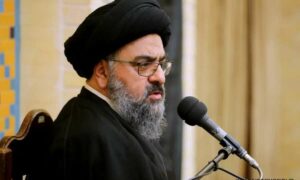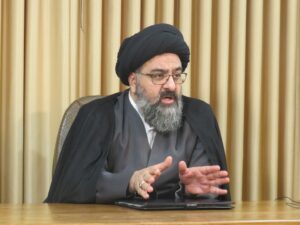
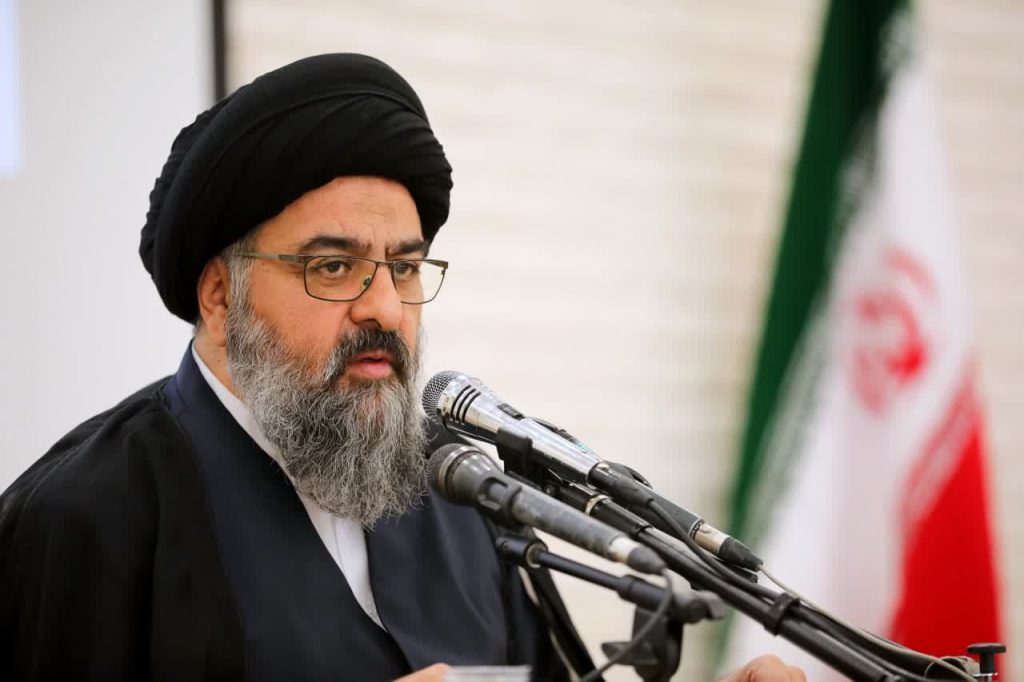
Text of the speech delivered by His Eminence Ayatullah Sayyid Mujtaba Nur Mufidi, Professor of Advanced Jurisprudence (Dars-e Kharij-e Fiqh) and Principles of Jurisprudence (Usul) at the Islamic Seminary of Qom, at the Conference “Contemporary Identity of Woman in the Mirror of the Quran and Hadith” – May 2024
In the Name of Allah, the All-Beneficent, the All-Merciful
Praise be to Allah, the Lord of the Worlds, and peace and blessings be upon Muhammad and his Pure Household, and may the curse of Allah be upon all their enemies.
An Overview of Six Perspectives on the Jurisprudential Challenges of Emerging Women’s Issues
A Note Regarding the Title of the Conference
Since time is short, I will proceed directly to the core of the discussion without preamble. There is only one note regarding the title of the conference that is not without benefit to mention. My understanding of the title “Contemporary Identity of Woman in the Mirror of the Quran and Hadith”—and perhaps the intention of the organizers—is “contemporanizing the identity of woman.” This is also the premise of my discussion; for despite differences of opinion regarding the meaning and concept of identity and its constituent elements, this word possesses an indispensable pillar, which is stability. Identity is something that has remained constant and shared throughout history, and historical transformations do not alter it. When we say “Iranian identity,” “Islamic identity,” or “religious identity,” we mean a reality that has been preserved over time while adapting itself to different conditions. In other words, a “sameness” and a “differentiation” are embedded in the meaning of identity—or in more technical terms, it possesses a mā bihi al-ishtirāk (common denominator) and a mā bihi al-imtiyāz (distinguishing factor). When we speak of an “identity crisis,” “identity seeking,” or “identity retrieval,” it refers to the fact that the continuous shared element has either been lost or faded. Therefore, in my view, it would be better if the conference title were: “Contemporanizing the Identity of Woman in the Mirror of the Quran and Hadith”; so that when we want to adapt this identity to spatial and temporal coordinates, that core reality is preserved while enabling one to live in modern times. Thus, this title is more appropriate. Since time is limited, I must present the discussion concisely, which may lead to some inadequacy, and I apologize in advance for this.
Two Important Arenas of Challenging Women’s Issues
If we consider “identity” as the answer to the question of what and who someone is, as has been said, and we wish to answer this question in the context of this conference, we must re-examine the question as follows: What and who is woman in the mirror of the Quran and Hadith? How can woman live in this era from the perspective of the Quran and Hadith while maintaining her identity constituents and at the same time moving along a correct path? In this regard, we must first pay attention to two aspects: one is the status, rank, position, and standing of woman, and the other is her roles, authorities, responsibilities, and duties. These two aspects can serve as our gateway to contemporanizing the identity of woman. How does today’s woman differ from yesterday’s woman? If we want to answer this question, we must first understand her status and position—where she was yesterday, where she is now, and how great the distance is between them. What are her authorities and responsibilities? What roles rested upon her shoulders in the past, and what roles have been assigned to her in the new world? Are this status and these roles legitimate? Were the status and responsibilities of woman in the past legitimate and are now illegitimate today? These questions require answers and sometimes necessitate providing solutions. Today, we face challenges and questions in both dimensions. Regarding status and position, one of the crucial questions is: Why so many differences between men and women? Why so much discrimination? Why deprivation of rights? Of course, these questions are not new, but now they have become very intense. In a sense, such questions have existed throughout history, though at times mild and at times more intense. Regarding responsibilities, authorities, and roles, these have also varied across different eras. Today, in the modern and postmodern world, roles have been assigned to woman, and responsibilities and authorities have been entrusted to her; but are these roles and responsibilities in the new world acceptable by the criteria of the Quran and Hadith? Are all these differences—which are sometimes referred to as discrimination—in matters of blood money (diyah), inheritance (irth), child custody (hadanah), and many other issues, defensible or answerable by the standards of the Quran and Hadith?
This issue has several facets and relates to various fields of knowledge: theology (kalam), history, sociology, and in one dimension and aspect it may even connect with philosophy. However, today I will try to focus primarily on what is related to the domain of jurisprudence (fiqh) and point out a crucial note.
The Six Perspectives
In both arenas—status and position along with differences and deprivations, as well as responsibilities, authorities, and roles—we encounter various answers and perspectives, which I have categorized into six groups. Ultimately, I will explain how we can free ourselves from these challenges and by what path we can solve the problem.
The First Perspective: Group One
One view, which I term the “extremist” view, is that there is basically no way to change the position of women in these two arenas, and the same status that existed in the past must remain; rather, we should try to return the situation to early Islam, and this is the requirement of the Shari’ah. In plain terms: “It is what it is! Take it or leave it!” These deprivations for women are established, derived from sacred texts (nusus), and are by no means interpretable or subject to change—such as non-participation in society, and so forth. Some proponents of this view approach the understanding (istizhar) of sacred texts with such rigidity that it leads to many harmful consequences, resulting in evasion and rejection of all religious bounds. In their view, any step taken to move away from these differences is inconsistent with the Quran, narrations, and religion, and goes against the way of religious believers. Those holding this view are not few, and of course it encompasses a broad spectrum where some think more intensely and others less so, existing among both Shia and Sunni scholars.
Group Two
This outlook is not found solely among religious and pious individuals; rather, some intellectuals who are not scholars of religious sciences also hold a similar view in a different manner, believing that this situation cannot be changed and nothing can be done. According to some of these individuals, the subordination of women stems from their physical weakness and sexual attractiveness, and these two things in their totality cannot be amended. Although women’s physical weakness has diminished in present times, sexual attractiveness remains intact and seems even stronger. Thus, they say what we can do is gradually reform structures and expand moral recommendations. This group also falls under this perspective in a way, but the former is within the circle of religious scholars while the latter is outside it. Their common denominator is that nothing can be done, that one must come to terms with this reality and truth, and that there is no way out—at most, we can try to resolve these through certain moral recommendations.
The Second Perspective
The second category, which I term “negligent/lax” (taffiti), consists of those who have truly benefited nothing from jurisprudence (fiqh) and juristic practice (faqahat). One group has benefited nothing at all, while another group may have studied jurisprudence for a brief period, but they do not speak based on established standards, and their methodology is far removed from the conventional and accepted methodology of deduction (istinbat) and ijtihad. These individuals are sometimes recognized as religious intellectuals, and while they are considered religious, they want to go along with these developments and solve problems at any cost. Proponents of this view have traversed various paths themselves, which I generally categorize into two groups. This is an important matter; sometimes these discussions are raised in informal circles and non-academic sessions, and even among the general public these discussions are sometimes observed—for instance, that a certain religious ruling does not accord with intellect—and on this basis, they criticize and protest certain rulings and fatwas, where their criterion is speculative intellect (‘aql-e zanni) or basically illusion.
Group One
In any case, some intellectuals hold this view and say we must measure rulings with the aid of intellect, and wherever a ruling falls outside the realm of intellect, we set it aside; however, the intellect they mean is speculative intellect (‘aql-e zanni). We have definitive intellect (‘aql-e qat’i) and speculative intellect (‘aql-e zanni). Everyone accepts definitive intellect; although some, like the late Mr. Khoei, say this is a major premise that lacks a minor premise, there is no doubt about the invalidity of speculative intellect for deducing religious rulings according to our school of thought. Sadr al-Muta’allihin (Mulla Sadra), the pinnacle of scholars, scientists, and rational thinkers, explicitly states that human intellect has no access to the underlying rationale (malakat) of religious rulings, meaning speculative intellect; definitive intellect is certainly valid and authoritative (hujjah), but speculative intellect has no validity. Yet some want to solve these issues using the standard of speculative intellect, to which numerous objections truly apply. According to some proponents of this view, speculative intellect acts as an implicit contextual indicator (qarinah-ye labbiya) for understanding sacred texts, and if the Shari’ah has a ruling in the domain of intellect’s governance, intellect is the authority, and religious proof is not decisive and is set aside. Some go even further and say collective wisdom across different times can be a decisive religious proof for determining the rationale of religious rulings, meaning speculative intellect, not definitive intellect. Or, for instance, another one among them says: “My intellect narrated to me from my Lord” takes precedence over “so-and-so narrated to me from so-and-so”; meaning that intellect, which is the internal prophet, if it says something, is inspired by God, Blessed and Exalted, and takes precedence over Zurarah narrating such-and-such from a certain person. In his view, all discriminatory rulings were in reality the endorsement of the practice of rational people (sirah-ye ‘uqala) in the era of the Lawgiver, and today the speculative ruling of intellect is stronger than them and must take precedence over them.
Is it not clear what disaster this perspective brings about? The form of the argument is rational, but the material and content of the argument are flawed; such deduction degrades religion. Hence you see that sometimes they easily question certain rulings merely because they do not accord with intellect. Which intellect is the one that should be the measure and judge? Is the distinction between speculative and definitive intellect even clear to them?
Group Two
Some also want to solve the problem through the path of “justice,” believing that the rule of justice takes precedence over everything, and therefore whatever does not seem just to us must be set aside. Now, for the time being, we leave aside one group that has a more acceptable formulation, because they say that if a religious ruling seems unjust to us but is definitively proven to be from the Lawgiver, this shows that our knowledge is deficient—it seems unjust to us, but in reality it is certainly just. However, if a ruling is speculative, even if based on valid speculation (zann-e mu’tabar), and is not definitive and is incompatible with justice, we must set that ruling aside in favor of the rule of justice.
For now, we exclude this view from the six perspectives under consideration in this discussion and will not enter into it, although this view is not without flaws either.
In any case, some have gone further and raised a strange contention. Although these foundations are discussed in academic domains and among specific audiences, their fruit becomes apparent in cyberspace through questioning religious rulings, and because it accords with the taste of the new generation, it is easily accepted. They say: justice is a temporal matter, and the Lawgiver enacted religious rulings solely in accordance with the justice of His time; therefore, it has no fixed interpretation in any issue, and its definition in every era is left to human beings themselves. This assertion has no foundation whatsoever, and numerous objections apply to it, the most important of which is that according to this view, justice is fundamentally a relative concept. According to this view, any religious ruling that is not compatible with the meaning of justice in this era must be set aside.
The Third Perspective
Some, in seeking to solve the problem in the two arenas I mentioned, believe we should solve the problem of differences, discriminations, responsibilities, and roles through secondary rulings (ahkam-e thanawiyyah) or governmental rulings (ahkam-e hukumiyyah). I call this perspective the “palliative” perspective. The first was extremist, the second was negligent, and the third is a palliative. Currently, many of the dilemmas we face are resolved almost through this very path.
‘Allamah Tabataba’i, regarding polygyny (ta’addud-e zawjat)—which is much discussed these days—while defending the principle of polygyny, simultaneously addresses certain corruptions and problems arising from it, stating: This has had corrupt consequences in Islamic societies, and injustices have occurred in this regard; ultimately, he suggests that the government and the ruler, based on public interest (maslahah), prevent such marriages so that those corruptions do not occur. This, in fact, becomes a secondary title (‘unwan-e thanawi) as a matter within the scope of the ruler’s and government’s authority.
Or, for instance, some prominent jurists have said something similar in another formulation. The prevalent opinion (mashhur) holds that a woman does not inherit from land and real estate and her share from her husband is less; however, they say this ruling was not considered oppressive in the past, because most families were large, and the difference resulting from this share was not so drastic, whereas today it is not so. In the past, land was not very expensive, but now it is very valuable. Now, if we want to execute that ruling, we face a problem: on one hand, we cannot abandon the religious ruling, and on the other hand, this difference is perceived as oppressive. Therefore, they say the best way is to reduce these distinctions through certain executive arrangements—for instance, that a man should bequeath one-third of his property to his wife, and the government should enact this as an approved law to solve the problem. Now, the Supreme Leader and some sources of emulation have issued fatwas and resolved the issue.
Some scholars also say that the government bears two responsibilities: 1) the implementation of religious rulings; 2) the implementation of justice. That is, alongside executing religious rulings, it must also be concerned with practicing justice and observe justice in the realm of legislation. They state that if the understanding of the religious community’s custom (‘urf-e mutasharri’ah) is that a ruling is oppressive, the jurist can introduce a secondary ruling (hukm-e thanawi) in the execution of the religious ruling.
This is the very path I mentioned. So one perspective is that we solve these dilemmas and challenges through secondary rulings and governmental rulings. But this is merely a palliative; how long do we intend to proceed with secondary rulings and governmental rulings facing issues that stand before us daily? Although this path is a mechanism devised by the Lawgiver and there is no doubt about it (for instance, we have 14, 15, or 20 secondary titles; if we consider public interest [maslahah], it has its own distinct discussion), we will gradually reach a point where we handle most religious rulings through secondary titles. What then happens to primary titles (‘anawin-e awwaliyyah)? Are they to be abandoned and set aside? This ultimately leads to the futility of primary rulings in many matters. It is not intended that we solve all religious rulings through secondary titles, governance, and public interest. Sometimes we consider public interest in the execution of a governmental ruling, and sometimes we want to assign a role to public interest in deducing a primary ruling. This itself is a detailed story. A few years ago, I held a discussion regarding the Rule of Public Interest (Qa’idah-ye Maslahah)—I think this work will be published this year—addressing how public interest exerts influence in various domains of legislation, deduction, or execution. I believe that public interest is involved in the deduction of primary rulings in a certain way—not just that I say it, but the late Imam [Khomeini] stated this. The late Imam believed that public interest influences the deduction of primary rulings; but how? This has a mechanism.
The Fourth Perspective
In any case, although this path is legitimate, the fundamental solution and the primary remedy is that which was articulated by the grand late Imam [Khomeini], namely the impact of time and space (zaman va makan) on religious rulings. This path differs from the previous one. The issue of time and space is among those matters regarding which a conference was held once and then abandoned, whereas this subject requires work. If we want to fundamentally solve these facing dilemmas and challenges, we must pay attention to this element. Of course, the intention is not to alter all rulings through this method; rather, the objective is that this is a path capable of creating a fundamental transformation in the deduction of religious rulings and removing many obstacles.
This path differs from the solution of some intellectuals who want to solve problems through speculative intellect or collective wisdom. What is this difference? What is the difference between what Imam [Khomeini] said and the negligent group? What is the difference between what Imam [Khomeini] said and the group I recently mentioned, such as the late ‘Allamah [Tabataba’i] and others? This requires a detailed discussion. Currently, in many cases in the Islamic Republic, these mentioned problems are solved through this very method—that is, through secondary titles or public interest. As I said, this is not a fundamental solution; deduction must be conducted by considering the two elements of time and space, and of course in a regulated manner. The domain of intervention of time and space in deduction, execution, and application must be determined—in primary rulings, secondary rulings, and governmental rulings; these must be clarified. On a certain occasion, I explained the domains of influence of time and space in deducing primary rulings. The intervention of these two elements in secondary rulings and governmental rulings is relatively clearer; what requires explanation is how time and space exert influence in the deduction of primary rulings. Several components must be taken into account: one is considering the temporal and spatial conditions under which narrations were issued; another is the impact that time and space exert on the subject (mawdu’), which itself has several forms; and the impact exerted on the ruling itself. All of these must be clarified.
Regarding the first component, I will make just one reference: the First Martyr (Shahid-e Awwal) in his book Al-Qawa’id wa al-Fawa’id—which is a very valuable book—uses a title: “Taghayyur al-Ahkam bi-Taghayyur al-A’dat” (The Change of Rulings through the Change of Customs). Now, how can rulings change with the change of customs? He then provides examples, one of which I will mention as he himself noted. According to a narration, if a dispute arises between husband and wife as to whether the dowry (mahriyyah) has been paid or not—where the husband claims, “I have given the dowry,” and the wife denies it—the husband’s statement is given priority, and the wife’s denial is not accepted. Shahid points out: the narration states this, but customs vary. He explains that this refers to the method customary in the past where men paid the dowry immediately after marriage. But in our time, it is not so, and therefore some have opined contrary to it. They asked the Imam (peace be upon him), and the Imam (peace be upon him) said that the husband’s word takes precedence; however, because this was customary and conventional practice, he stated that the husband’s word takes precedence. But if this custom changes—as in our time where it is not customary to pay the dowry immediately after marriage—can we still prioritize the husband’s word? This is a point that truly must be heeded. We cannot easily grab hold of every absolute statement (itlaq) we see. This is speech based on established principles; what Imam [Khomeini] says differs from what some intellectuals say. This has a rule. This is Imam’s statement in Kitab al-Bay’: “That which is necessary for the investigating jurist in understanding (istizhar) narrations, claiming contextual limitation (insiraf), absolute scope (itlaq), prevalence (ghalabah), or rarity (nudrah), is to observe the era and environment (time and space) in which the narrations were issued.”
In any case, this is the path: if we want religion to be preserved, if we want to update religion, if we want to contemporanize the identity of woman, if we want religion to be civilization-building, and if we want religion to advance with strength and power until the Day of Resurrection—as God willing it will—this must be viewed systematically, as a reality adaptable to ages and times, and its path is precisely what I have stated. Certain paths lead to the destruction of religion. Some, in their own imagination out of sympathy, want to render the rulings of Shari’ah defensible in some way; another group wants to solve dilemmas through secondary rulings and secondary titles, which also leads to primary rulings becoming obsolete. The rigidity from which another group suffers—claiming “religion is just this; whoever wants it, accept it, and whoever doesn’t, goodbye”—likewise leads to returning to the past and alienation from human civilization. Of course, this requires work, and one should not be discouraged; this is the beginning of the path.
Time has elapsed. I express my gratitude to all the professors, eminent figures, and organizers of this conference, both in executive and academic dimensions, and I especially apologize to my honorable teacher, the exalted master, His Eminence Ayatullah Nur Mufidi. Was-salamu ‘alaykum wa rahmatullahi wa barakatuh [May peace, mercy, and blessings of Allah be upon you].