

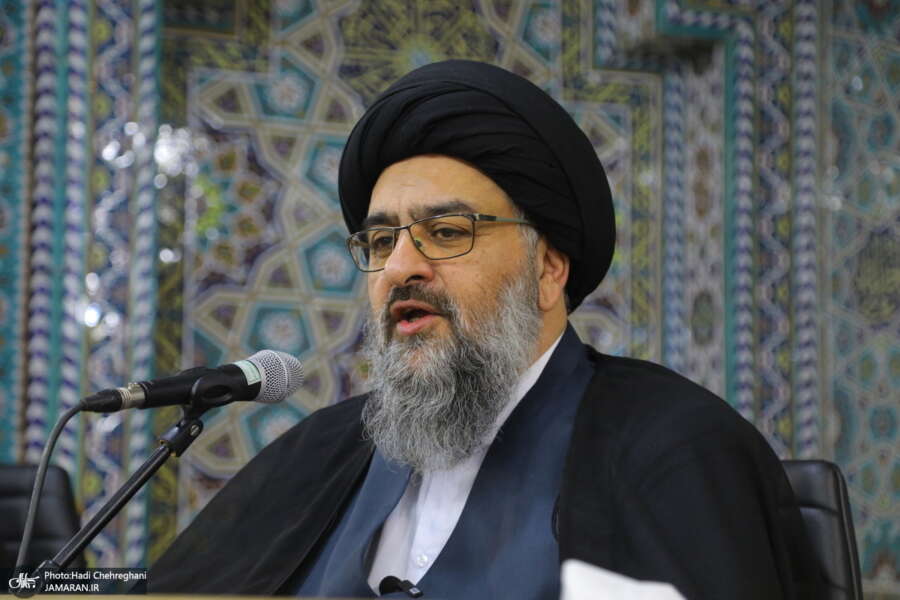
Ayatullah Sayyid Mujtaba Nur Mufidi: Stance-Taking by Jurisprudence Regarding Emerging Issues Is Essential
Ayatullah Sayyid Mujtaba Nur Mufidi, Professor of Advanced Classes (Dars-e Kharij) and Director of the Research Institute for Contemporary Jurisprudence, speaking today, February 6, at the conference “Jurisprudential Examination of Stem Cell Application” held at Ferdowsi University of Mashhad, referenced methods for resolving emerging issues with an emphasis on stem cells, stating: Jurisprudence claims to regulate human life in all dimensions; therefore, a stance-taking by jurisprudence regarding emerging issues is essential.
Pointing to various methods for resolving emerging modern issues (masā’il-e mustahdasah), the Director of the Research Institute for Contemporary Jurisprudence stated: Sometimes emerging issues are resolved through the use of secondary titles and rulings (‘anawin wa ahkam-e thanawiyyah), which in this respect makes them no different from old issues; secondary titles always maintain their own efficacy as well.
Stating that governmental and secondary rulings are not exclusive to emerging issues and that one can address emerging issues through these tools, he continued: Here lies the importance of discovering the primary ruling (hukm-e awwali) of every phenomenon, especially in today’s world where the speed of progress and emergence of new phenomena is extremely rapid—taking away the opportunity to reflect and presenting itself as threats of modern technologies.
Introducing vital elements and tools for discovering religious rulings in emerging issues, particularly regarding stem cells, Ayatullah Nur Mufidi noted: The first factor is a realistic approach toward modern technologies. Alongside a realistic approach, two perspectives—optimistic and pessimistic—exist regarding modern technologies.
The Professor of Advanced Classes and Director of the Research Institute for Contemporary Jurisprudence added: Dual pessimistic and optimistic approaches outside religious academic environments within the framework of modern technologies have generated pessimistic outlooks based on theoretical, philosophical, anthropological, and value-based foundations toward modern technologies. The main argument of these outlooks is considered the impossibility of technology existing without cultural backing and its resulting side effects.
He posited: The pessimistic view of technology poses significant threats to humanity, holding that technology has led to dehumanization, alienation, distortion of human relationships, rootlessness, and the destruction of spirituality. Stances adopted regarding satellite television and the internet reflect a type of pessimistic outlook on technology that can influence positions in this field.
Stating that in the pessimistic view, weaknesses and misuses are highlighted, Ayatullah Nur Mufidi noted: In contrast to this view, an optimistic view exists that sees only strengths and fundamentally sees no weakness whatsoever for technology. If we were to use two terms for these two perspectives, they could be named the instrumental view and the software view.
He further stated: The realistic view consists of examining both the weaknesses and strengths of technology together. Regarding stem cells, both views exist and are utilized in Iran. If we wish to look at this subject from a futures-studies perspective, we cannot close our eyes to the weaknesses of stem cell technology.
Ayatullah Nur Mufidi expressed: Stem cells certainly possess benefits, yet like all technologies, abuses can stem from them, such as commercialization, transformation into stem-cell tourism, and the exploitation of women for the production or extraction of stem cells.
He stated: Likewise, paving the ground for producing biological weapons is raised as another negative dimension of this technology. Therefore, one must not overlook the benefits and strengths of technologies due to potential abuses, and one must advocate for a realistic approach toward emerging phenomena. Nonetheless, we face extremist and negligent views in confronting technologies, and meticulous, comprehensive examinations of various dimensions in this topic must be conducted.
He noted: In certain types of stem cells, the issue of personality alteration exists. When stem cells are harvested from an embryo produced in a laboratory that potentially could become a human being, the question arises: Is this act not destroying a potential human being, and can these cells transfer the donor’s personality to the recipient?
Ayatullah Nur Mufidi said: Whether this cell truly transfers the foundation of a human being’s personality from the donor to the recipient to this extent is open to discussion and inquiry. What is conventional is that every ruling in relation to its subject stands in the relation of effect to cause (musabbab bi sabab)—meaning that until the subject exists, the ruling carries no meaning.
He posited: Subjects facing a religious ruling are regarded as subjects explained by Almighty God. For example, homeland (watan) possesses a meaning, but the Lawgiver, in order to assign a specific ruling to homeland, articulated boundaries for it. Therefore, these subjects require custom (‘urf) to clarify them.