
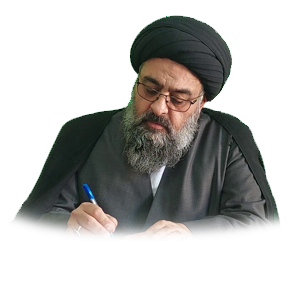
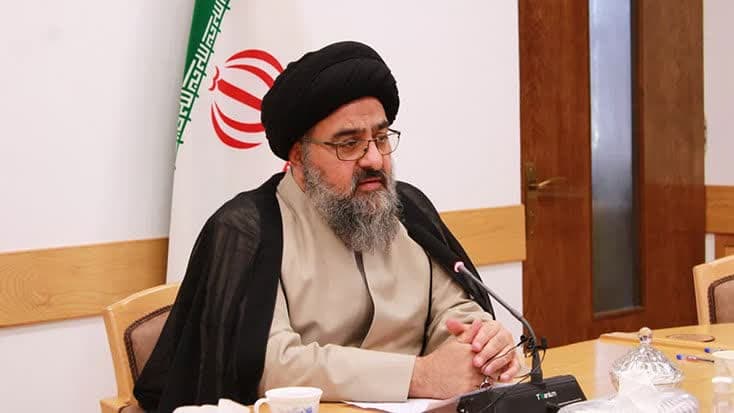
In the specialized seminar “Method of Transforming Jurisprudential Propositions into Social Norms in the Conduct of Imam Khomeini (may his soul be sanctified) Prior to the Revolution,” Ayatullah Sayyid Mujtaba Nur Mufidi, President of the Research Institute for Contemporary Jurisprudence, emphasizing values and the role of Imam Khomeini himself as a norm-maker, identified the production and reform of fundamental theological and jurisprudential propositions as the key to social transformation in Iran. He explained that Imam Khomeini (may his soul be sanctified), going beyond reliance on existing norms and benefiting from scholarly competence and personal traits, succeeded in transforming divine values into social norms, thereby laying the foundations of a new social order prior to the Revolution.
Ayatullah Sayyid Mujtaba Nur Mufidi explained the methods of Imam Khomeini (may his soul be sanctified) in the process of social norm-making during the academic seminar. Pointing out that methods of norm-making can be shared, he stated that what distinguishes the Imam’s method is the values governing the norm-making process itself and the centrality of the “norm-maker” (the Imam). Instead of mere reliance on existing norms, he engaged in “producing and reforming fundamental theological and jurisprudential propositions,” where his scholarly competence, distinguished character traits, and primary actions served as the basis for societal transformation.
On the eve of the anniversary of the passing of Imam Khomeini (may his soul be sanctified), on Sunday, June 1, the specialized seminar “Method of Transforming Jurisprudential Propositions into Social Norms in the Conduct of Imam Khomeini (may his soul be sanctified) Prior to the Revolution” was held by the Research Institute for Contemporary Jurisprudence in collaboration with the Desk for Development and Empowerment of Islamic Sciences at the Islamic Propagation Office.
In this academic seminar, Ayatullah Sayyid Mujtaba Nur Mufidi, President of the Research Institute, presented a profound analysis of the process of norm-making in the thought and practice of Imam Khomeini (may his soul be sanctified).
In the introduction to his remarks, pointing to the commonality of methods and difference of values in norm-making, he stated: What distinguishes the method of the Imam (may his soul be sanctified) are the values governing the norm-making process, around which these methods were shaped.
Ayatullah Nur Mufidi introduced the triangle of norm-making as comprising three sides: the “norm-maker,” the “norm-adopter,” and the “idea or value that must be transformed into a norm,” proceeding to examine the personality and method of the late Imam (may his soul be sanctified) as the norm-maker.
The Professor of Advanced Jurisprudence at the Islamic Seminary added: The primary mission of divine leaders and Prophets is norm-making and shaping social order based on divine values; therefore, whenever proponents of great ideals propose an idea, they must institutionalize it in the form of enduring rules within society.
He further stated: In the intellectual system of Imam Khomeini (may his soul be sanctified), values and ideals did not remain merely at a mental level, but transformed into social behaviors and public norms. This perspective stems from the Imam’s personality as a spiritual leader raised in the school of the Household of the Prophet (peace be upon them) and the historical and religious role of the clergy—a role for which the Imam posited a profound mission.
The President of the Research Institute for Contemporary Jurisprudence examined the Imam’s personality in three sections:
-
First, the qualifications of Imam Khomeini as a norm-maker;
-
Second, his personal character traits;
-
And finally, the measures the Imam took in this path, divided into primary and secondary categories.
Pointing to the scientific and practical qualifications of Imam Khomeini, Ayatullah Nur Mufidi said: He was raised in a pious family and in the school of the Household of the Prophet (peace be upon them), acquiring the highest ranks of jurisprudence (fiqh), exegesis (tafsir), and gnosis (‘irfan) under the most prominent professors of the era, to the extent that his scientific stature was matchless.
The Professor of Advanced Jurisprudence described Imam Khomeini’s personality as prominent in the practical dimension as well, adding: From youth, through self-purification, behavioral vigilance, and adherence to moral conduct, the Imam was a clear exemplar for those around him. His character traits, from the start of the movement through his leadership of the Revolution, consistently demonstrated perfection, courage, and steadfastness.
Ayatullah Nur Mufidi added: Honesty in behavior and speech was one of the Imam’s vital traits. Imam Khomeini (may his soul be sanctified) never deceived the people and called officials to honesty. What he spoke stemmed from his deep heartfelt belief, as he himself was the first believer in his ideals, and this faith rendered his words and actions impactful. The principles and foundations of his summons were drawn from the Quran and Nahj al-Balaghah.
He divided the Imam’s measures in creating social norms into two stages—producing propositions and transforming them into social norms—stating: The Imam (may his soul be sanctified) did not limit himself merely to changing certain existing norms, but engaged in producing and reforming fundamental theological and jurisprudential propositions, which was a vital step in norm-making.
Ayatullah Nur Mufidi referenced the reform of theological propositions such as divine worldview, Tawhid, human status, the connection between Tawhid and Islamic government, the link between religion and politics, the comprehensiveness of religion, and the issue of Imamate and Guardianship of the Islamic Jurist (Wilayat al-Faqih).
He further addressed the Imam’s production and reform of jurisprudential propositions concerning dissimulation (taqiyyah), legal evasions of usury (hiyal al-riba), congregation upon enjoining good and forbidding evil (ijtima’ ‘ala al-amr bi al-ma’ruf wa al-nahy ‘an al-munkar), and the necessity of religion taking charge of government, stating: The Imam elevated jurisprudence from individual confines to the social sphere and the Islamic Ummah—a matter serving as the primary foundation of his norm-making.
Furthermore, the Imam repositioned many jurisprudential propositions; for instance, regarding legal evasions of usury (hiyal al-riba), he opposed them because he believed that although oppression in usury is its wisdom (hikmah) rather than its cause (‘illat), it belongs to those wisdoms that cannot be ignored. This perspective laid the ground for transforming such concepts into social norms.
Likewise, regarding the obligation of Enjoining Good and Forbidding Evil, the Imam believed that if its execution requires collective participation, it must transform into a collective act and universal duty. This attitude elevated individual duty into social responsibility and an obligation of the Islamic Ummah.
The President of the Research Institute for Contemporary Jurisprudence identified attention to time and the lengthy nature of the norm-making process as important points in this matter, stating: The Imam was well aware that norm-making is a long-term, time-consuming, and gradual process. Understanding that transforming an idea and value into public behavior and social norm requires patience and endurance, he entered this arena from the early 1960s [1340s Solar Hijri] and gradually expanded his measures.
Ayatullah Sayyid Mujtaba Nur Mufidi identified communication with elites and reference groups of society as necessities for norming values, reminding: Another strategy of the Imam in norm-making was establishing effective communication with elites and societal reference groups. Through his students, he dispatched letters to scholars across regions, and at higher levels held meetings with sources of emulation (Marja’s). These communications were conducted to secure support from influential strata of society to advance norm-making objectives.
He considered identifying grievances and accompanying the audience as one method for eliminating anomalies, stating: Imam Khomeini (may his soul be sanctified) emphasized the importance of identifying societal grievances and expressing sympathy and empathy toward audiences. He believed that to eliminate an anomaly and substitute a value, one must first thoroughly understand societal anomalies and grievances, and then convey to audiences that proposed changes will benefit them. This empathetic approach played an important role in securing public trust and facilitating the norm-making process.
The Professor of Advanced Jurisprudence at the Islamic Seminary termed the Imam’s discourse in conveying his message and ideas as Balagh Mubin (Clear Conveyance), explaining: This method, rooted in Quranic teachings, emphasizes delivering the message in an overt, clear, simple, and fluent manner without complexity or obscurity. The Imam’s speeches and messages were such that even individuals with low literacy in the most remote areas were capable of understanding the depth of his message. This simplicity and fluency in expression was one factor in the Imam’s success in connecting with the masses.
The President of the Research Institute for Contemporary Jurisprudence described paying attention to the young generation in creating and transforming values into social norms as vital, adding: Imam Khomeini (may his soul be sanctified) paid special attention to the youth and adolescent generation as the driving engine of social change. He viewed young people as energetic, hopeful for the future, dynamic, and fearless, attributing a key role to them in the norm-making process. This attention to youth was one reason for widespread support from this class for the Islamic Revolution.
Referring to obstacles lying ahead in transforming values into social norms, he reminded: The late Imam (may his soul be sanctified) was well aware that in the path of norm-making he would encounter resistance and opposition. He maintained a clear stance against opponents—whether inside the seminary or outside, such as court-affiliated scholars (‘ulama-ye darbari) and conservative factions—addressing them through a combination of advice, guidance, threats, and warnings. The Imam knew that for success in norm-making, existing obstacles must be removed or aligned.
Globalizing norms was one of the most vital traits of Imam Khomeini (may his soul be sanctified) referenced by the President of the Research Institute for Contemporary Jurisprudence, who added: One outstanding characteristic in the Imam’s thought was bestowing a global and international dimension upon his intended propositions and values. He did not view his ideas as confined to the demands of a single nation or specific geographic region, seeking their realization at the level of the Islamic Ummah and beyond. The issue of Palestine and fighting oppression and arrogance are instances of this global vision in the Imam’s thought.
He further added: Imam Khomeini (may his soul be sanctified) emphasized the vital importance of social solidarity in the norm-making process. Throughout norm-making, the Imam utilized declarations, messages, lectures, student networks, and direct communication with scholars and the public, considering any factor weakening social solidarity an obstacle to realizing desired norms and insisting on strengthening unity and cohesion in society.
In conclusion, Ayatullah Nur Mufidi stated: The norm-making process in Imam Khomeini’s thought was a complex, multifaceted, and long-term process. Relying on personal qualifications, deep societal understanding, effective communication with various strata, and modern methods, he created fundamental transformations in the norms of Iranian society. Meticulous examination of this process holds valuable lessons for today and the future, requiring reflection on how to preserve and adapt norms to current conditions.