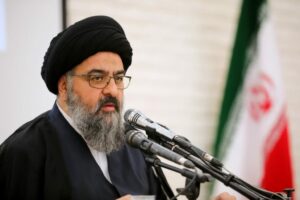
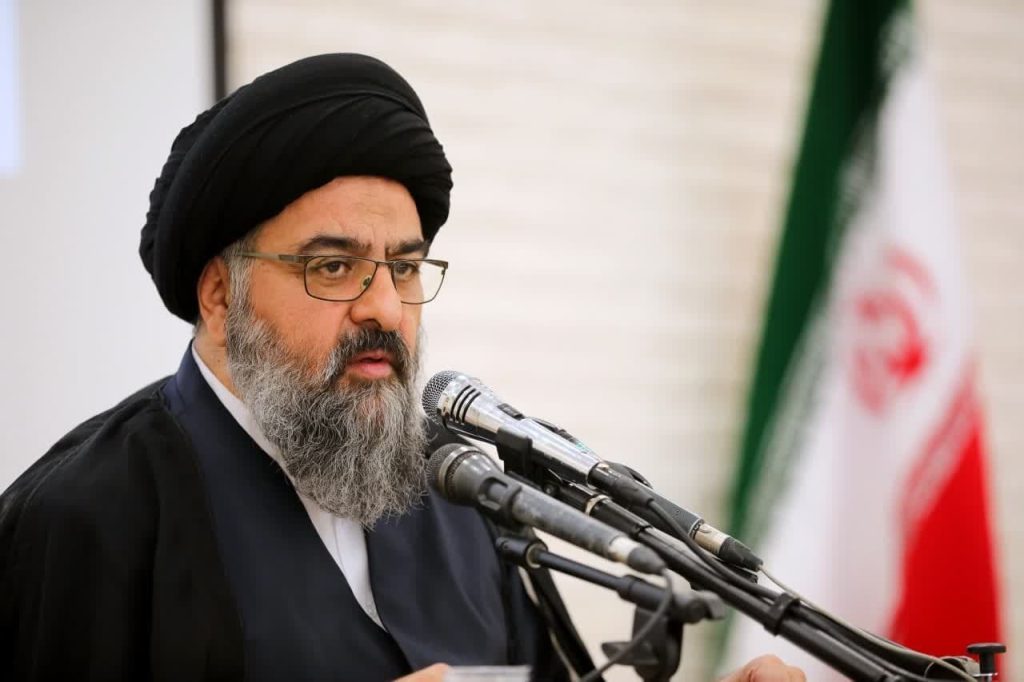
Address by Ayatullah Sayyid Mujtaba Nur Mufidi on the Topic “Method of Transforming Jurisprudential Propositions into Social Norms in the Conduct of Imam Khomeini (may his soul be sanctified)”
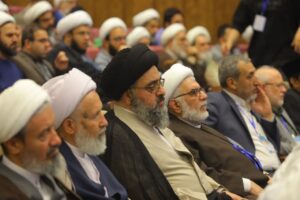
Session Moderator: While extending a warm welcome to our respected master, Ayatullah Sayyid Mujtaba Nur Mufidi, and the esteemed figures present in our company, on the eve of the anniversary of the demise of the founder of the Islamic Republic of Iran, Imam Khomeini (may his soul be sanctified), explaining his thoughts—particularly in the realm of jurisprudence—can serve as a vital and impactful topic. “Method Sundays” has convened 45 sessions to date, primarily addressing topics related to the methodology of contemporary jurisprudence. In the spring season of this seminar series, methods of transforming jurisprudential propositions into social norms have been predominantly discussed and examined.
In this session, we will benefit from the presence of Ayatullah Nur Mufidi on the topic “Method of Transforming Jurisprudential Propositions into Social Norms in the Conduct of Imam Khomeini.” This session is dedicated to the pre-Revolution period—a period when the intellectual foundations of the late Imam matured and acquired order, paving the ground for implementing jurisprudence in society. I should remind the friends present here and those following us online that if any question regarding the topic and presented discussions comes to mind, please convey it to us; God willing, at the end of the presentation, we will pose it to our respected presenter. Without wasting time, we now benefit from the presentation of Ayatullah Nur Mufidi.
Ayatullah Sayyid Mujtaba Nur Mufidi: I seek refuge in Allah from the accursed Satan. In the Name of Allah, the All-Beneficent, the All-Merciful. Praise be to Allah, Lord of the Worlds, and peace and blessings be upon Muhammad and his Pure Household, and may the curse of Allah be upon all their enemies. Given the limited time allocated, I am obliged to present my remarks in a concise and summarized manner.
A Few Preliminary Points
Before entering the main discussion, I must briefly mention a few points:
First Point: Methods of norming values or ideas, irrespective of evaluating the ideas and values themselves, are sometimes shared. That is, whether an idea or value is viewed by us as positive and genuinely considered a value, or not viewed by us as a value, the methods of transforming ideas into norms may well be shared. What can distinguish them from one another—setting aside the ideas themselves—are the values governing the norm-making process itself. When we speak of the Imam’s method in social norm-making, it obviously possesses a characteristic and component distinguishing it from certain other forms of norm-making—namely that these methods themselves follow specific values.
Second Point: The intermixing and entanglement of methods and factors of norm-making are to an extent unavoidable. Thus, I state from the outset regarding some of the instances I will mention that some might assume these are not methods, yet from a certain perspective, I can consider all of them as types of methods.
Third Point: Some of these items might appear to the audience as distant preliminaries (muqaddamat-e ba’idah) to the topic; however, if we envision three sides for norm-making—the norm-maker, the norm-adopter, and the norm itself (or that idea/value to be transformed into a norm)—a vital portion connected to our discussion pertains to the norm-maker himself. The personality of the norm-maker (or in some terminology, norm-setter) is immensely influential in transforming ideas and propositions into social norms, and addressing his qualifications and competencies constitutes an essential part of the discussion. Therefore, let it not be assumed that some matters addressed in this session are distant preliminaries, for they definitely participate in the norm-making process and must be addressed.
The Necessity of Norm-Making
Regarding the definition of a norm and the necessity of norm-making, there is no need for further debate here; these have been explained in their proper place. It is self-evident that any idea or value—especially from those holding great ideals—cannot remain merely a mental desire, but must transform into a social behavior: an enduring rule across society that becomes a norm. Thus, a personality such as Imam Khomeini, with his characteristics, could not refrain from engaging in norm-making. The Imam posited a vast mission for the clergy, and from a deeper and broader perspective, divine leaders and Prophets fundamentally cannot be detached from the thought of norm-making. The core foundation of prophetic summons is norm-making—transforming their desires, ideas, and divine summons into social norms. Therefore, this is an absolute duty and necessity. Obviously, the Imam, as a leader, a cleric, and a product of the school of the Ahl al-Bayt and Islamic seminaries, had to pay attention to this vital matter.
Our discussion today primarily concerns one side of these three sides: namely the “norm-maker” or “norm-setter.” Therefore, I present my remarks regarding this side and presently do not deal with the “norm” or the “norm-adopter,” although in the course of discussion connections with these two sides may arise.
General Headings Regarding the “Norm-Maker”
Regarding the first side, namely the norm-maker—who in this discussion refers to the Imam (may Allah rest his soul)—I wish to address four sections:
-
Section One: Regarding the qualifications of the Imam as a norm-maker.
-
Section Two: His personal character traits.
-
Section Three: Actions, divided into two parts: “Primary Measures” and “Secondary Measures.”
Now, to what extent time permits addressing these remains to be seen based on available time.
1. Qualifications
The qualifications of the norm-maker constitute beyond doubt one of the vital topics of social norm-making. The Imam’s qualifications in both scientific and practical dimensions are clear to all and require no debate; let us not linger long here. The Imam (may Allah rest his soul) acquired qualifications and distinctions in his family upbringing environment, and among teachers and professors in Islamic seminaries was recognized scientifically as a comprehensive personality—preeminent in jurisprudence (fiqh), theology (kalam), philosophy, exegesis (tafsir), and gnosis (‘irfan), such that no doubt exists regarding his scholarly stature. I need not detail further, as you are all aware. Practico-morally he was likewise, renowned for sanctity and piety. Stories narrated of the Imam’s behavioral vigilance even in youth are at times astonishing; companions and masters unanimously concur on this. The Imam’s scholarly and practical perfections are comparable to the great figures of Islamic seminaries in past eras. This regarding qualifications.
2. Character Traits
Regarding character traits, several traits were prominent throughout his life—from the beginning, prior to entering struggle and movement, amidst events, and post-Revolution until his demise:
-
Deep Heartfelt Belief in What He Spoke and Hope for Impact: One seeking to transform an idea into a social norm must first deeply believe in it himself, and the Imam possessed this heartfelt conviction. He was resolute and decisive; even in the harshest conditions, no doubt entered his mind regarding the struggle. You have surely heard the account that on the night he was being transferred from Qom to Tehran, agents drove the car toward the Salt Lake on the route to frighten him into thinking they intended to eliminate him. The Imam himself stated: “By God, they were afraid, whereas I was not afraid.” Courage, resoluteness, and deep conviction that this was a duty requiring fulfillment were among his outstanding traits.
-
Steadfastness in Goal and Patience: This is another trait of the Imam—steadfastness and patience belong to the traits of Prophets: “Indeed, those who say, ‘Our Lord is Allah,’ and then remain steadfast…” [Quran 41:30]. This trait belongs to the nature of traits of divine leaders and Prophets, because the core message, summons, and idea to be transformed into a norm were drawn from divine commands, the Quran, and Nahj al-Balaghah. One raised in such an environment must possess steadfastness. This characteristic manifested on various occasions: when losing his son, the late Haj Aqa Mustafa—whom the Imam considered the future hope of Islam—in exile, and during other perils, he practiced patience and invited others to patience and steadfastness. Those close to him mentioned that at the peak of problems, when viewing the Imam’s face, he appeared completely resolute.
I recall once the late Mr. Taheri Khorramabadi—under whom we studied Makasib—narrated that during the height of problems and events of 1963 [1342 Solar Hijri], we said to the Imam: “No matter how much we try, our minds cannot concentrate; we cannot study or read.” The Imam said to us: “When I sit down to study, it is as if nothing exists in the universe except this book and this topic.” This requires extraordinary power to remain so tranquil and patient. -
Avoiding Duality in Conduct and Practice—In a Word, Honesty: This characteristic is truly crucial for anyone seeking to transform an idea into a norm. Honesty was among the Imam’s traits, seen in various stages pre- and post-Revolution. He never engaged in dishonest behavior with the people and constantly reminded officials: “Whatever you wish to do, even if you cannot tell the people now, perform it in such a manner that if one day you are forced to explain it to the people, you are able to do so, not that you can never explain it.”
-
Avoiding Family Entanglements and Distance from Personal Interests (Material and Spiritual): Interests are not always material; sometimes they are spiritual: prestige, reputation, social respect. These were the Imam’s character traits, over which I will now pass.
3. Measures
The Imam’s measures comprise two parts: Primary Measures and Secondary Measures.
One of the most crucial primary measures consists of actions leading to the production of norms.
1. Reforming and Producing Certain Theological and Jurisprudential Propositions:
We have a stage where propositions must transform into social norms; however, these propositions themselves are paramount. The critical question is: Did the Imam transform existing propositions into social norms, or did he seek to produce and reform certain propositions? Some jurists normed famous theological and jurisprudential propositions in some way. Few great scholars existed who paid no thought to norming, yet the breadth of their intended social environment varied greatly. Some pursued norming only within a neighborhood, city, or province. Norming by past jurists was mostly performed based on well-known jurisprudential propositions; perhaps norming fundamental underlying propositions to transform society from its roots—as the Imam conceived—had little precedent.
One distinguishing mark of the Imam was seeking norming for propositions serving as the infrastructure for societal transformation. To this end, he enacted reforms in both theological and jurisprudential propositions. That jurisprudential propositions possess theological foundations is indisputable. The Imam faced a society where even intellectual foundations of religious individuals held flaws. Certain theological propositions needed plowing and reform: for instance, distinguishing between divine Tawhidi worldview and material worldview, human status in the universe, anthropology, the relationship between Tawhid and Islamic government (viewing a concomitant connection between them), the link between religion and politics, religion’s presence in diverse spheres, comprehensiveness, eternity, and global nature of religion, and Imamate extending into the Occultation as establishing guardianship for the jurist (Wilayat al-Faqih). The Imam conveyed these directly or through students and study circles. Reforming propositions present in public consciousness constituted a vital step; without reforming them, progress was impossible. This regarding theological propositions.
Regarding jurisprudential propositions, we observe the same dual engagement from the Imam: reforming famous jurisprudential propositions and producing new ones. To make this concrete: the obligation of dissimulation (taqiyyah) is a jurisprudential proposition held by all. Exceptions exist where dissimulation is not permissible (mustathnayat al-taqiyyah). The Imam expanded the scope of exceptions: it is not that dissimulation is obligatory for everyone under any condition. If a prominent social figure like a Marja’ were to dissimulate because coerced, the fallout of his action is obvious. He stated that the social stature of the dissimulating individual must be factored in. Likewise, where essential tenets of religion or the foundation of Islam are at risk, personal bodily harm loses significance. Many avoided entering struggle based on taqiyyah; the Imam shifted the boundaries of this proposition.
Or regarding legal evasions of usury (hiyal al-riba), the Imam famously opposed them, arguing that although oppression in usury is its wisdom (hikmah) rather than its cause (‘illat), it belongs to those wisdoms that cannot be ignored. In any case, transforming these propositions into norms first required reforming the propositions themselves.
The Imam also produced certain jurisprudential propositions—the matter was not solely reform—including the necessity of religion taking charge of government. Government is an integral matter inseparable from religion; in his view, government is the practical philosophy of all jurisprudence across all dimensions. This proposition—the necessity of establishing government, its structure, conditions of the ruler—was presented partly in Wilayat al-Faqih. Regarding Enjoining Good and Forbidding Evil as an obligation, all scholars mentioned it; however, the Imam maintained that at times collective action is required. Instead of solely an individual duty for duty-bound individuals, when the duty requires a congregation of individuals, it transforms into a collective action. This represented an elevation of jurisprudence from individual confines to the social realm, highlighting social jurisprudence. He stated that Enjoining Good and Forbidding Evil might be a collective duty—whether residents of a city, a nation, or the entire Islamic Ummah.
Or regarding the probability of impact in Enjoining Good and Forbidding Evil, defining evil (munkar) in its true sense and identifying priorities among evils: he raised these repeatedly in fatwa manuals and confrontations with the Shah’s regime—violation of Islamic laws, squandering of public treasury (bayt al-mal). From 1962 onward, in speeches, messages, and letters to the Shah, during the State and Provincial Councils affair in 1962, in a letter advising and then threatening him, or in his message to Tehran scholars, he stated: “Islamic principles are in danger; the Quran and religion are in danger. With this probability, dissimulation is forbidden and stating truths is obligatory, whatever the cost.” This shifted the boundaries of these propositions. Thus, producing jurisprudential propositions that, when transformed into norms and generalized, yielded clear outcomes that indeed transpired.
2. Cadre-Building: Another primary measure was cadre-building, accomplished within study circles. He trained a wide spectrum of students—prominent figures who later carried the ideas and values founded by the Imam, contributing effectively to norm-making.
Thus far, I presented points regarding qualifications, traits, and primary measures. Norm-making is a long-term, gradual process. Evidence shows the Imam entered this arena in the early 1960s [1340s Solar Hijri], though earlier instances existed—such as a 1944 [1323 Solar Hijri] letter following Reza Shah’s fall calling on people to rise for God. From the early 1960s, these measures began publicly and officially. In secondary measures, he utilized tactics and methods:
I recommend compiling a comprehensive list of jurisprudential propositions targeted by the Imam for norm-making. In this section, I state several axes:
-
Sympathy and Empathy with Audiences/Norm-Adopters Through Identifying Grievances: To eliminate an anomaly and transform a desired value into a norm, one must recognize societal grievances and convey to audiences that proposed changes benefit them. The Imam was matchless in identifying societal sensitivities—such as the gap between rich and poor in a wealthy nation.
-
Using the Method of Clear Conveyance (Balagh Mubin): Rooted in Quranic methodology, this relies on overt, simple, fluent delivery without complexity. While his academic lectures contained technical complexity, when speaking to the public his speech was firm yet fluent, allowing even low-literacy villagers to comprehend his message depth.
-
Special Attention to the Youth: When asked where his soldiers were, he replied “they are in cradles.” He viewed the young generation as energetic, hopeful, dynamic, and brave.
-
Effective Communication with Elites and Reference Groups: Dispatching letters to regional scholars via students, holding meetings with Marja’s, and urging influential non-clerical figures to realize the critical situation.
-
Addressing Opponents of Norm-Making (Aligning or Boycotting Them): Addressing internal and external seminary opposition—such as court-affiliated scholars (‘ulama-ye darbari)—through advice, warnings, and defining proper public stances toward them.
-
Bestowing a Global/International Dimension upon Propositions: Not confining ideas solely to geographical Iran, but expanding to the Islamic Ummah—such as opposition to Israel, rejection of oppression and dominance, which became widespread behaviors across the Islamic Ummah at a given juncture.
-
Strengthening Social Solidarity: Countering anything weakening social empathy and solidarity.
What was stated constitutes tools, methods, and factors of norm-making validated academically. The Imam did not possess modern academic education in sociology, yet his actions align with criteria evaluated in academic centers. This pertained to the pre-Revolution period. Question arises: Is norm-making easier from power or without power? Power offers legislation, an effective tool absent pre-Revolution. Yet the Imam’s pre-Revolution work required patience and perseverance, successfully transforming jurisprudential propositions into social norms. What must be done to preserve these social norms? Is the method of norm inception identical to norm maintenance? I thank all present and virtual attendees for their patience.
Q&A Session
Session Moderator: Thank you very much to Ayatullah Nur Mufidi for his valuable remarks. If friends in the session have questions, we are at their service. Please proceed.
Questioner: Thank you for your remarks. I have two questions. Given your acquaintance with companions of the late Imam pre-Revolution and his household, were the “secondary measures” planned as an explicit roadmap in advance, or devised dynamically as events unfolded? In memoirs, I found no mention of formal planning sessions outlining sequential steps; rather, measures were executed dynamically. Was this an overall master plan in his mind?
Ayatullah Sayyid Mujtaba Nur Mufidi: I see no conflict between the two. The destination was certainly clear to him from the outset, regardless of whether he would reach it. Feeling a duty to stop deviations, law violations, and treasury squandering, he acted as situations arose. The idea of government and that Islam cannot reach its ultimate goal without government was in his mind. However, formulating a step-by-step written plan in advance is unlikely; conventional methods were used dynamically. For instance, realizing elite contact alone was insufficient, he engaged the masses and relied on youth based on historical experience. Another method is myth/hero-building: highlighting Modarres alongside Imam ‘Ali (peace be upon him) and Imam al-Husayn (peace be upon him) was unwritten hero-building. Thus, at a macro level, a destination was held and movement initiated, deciding specific steps dynamically per situation alongside personal traits and divine assistance.
Questioner: Another question: You noted social solidarity and sympathy with audiences. We observe two aspects in the Imam’s life: acting strictly out of duty regardless of consequences (“we are bound by duty, not result”), vs. seeking public awareness and alignment. Regarding mandatory hijab in the country today, what would the Imam do if present? Would he disregard opposition to execute Shari’ah, or wait for grounds to develop until a significant majority aligned?
Ayatullah Sayyid Mujtaba Nur Mufidi: As you know, we had a discussion on mandatory hijab (currently in press) regarding whether compulsion possesses theoretical legitimacy. My general perception is that while the Imam emphasized executing Shari’ah rulings and accepted no laxity, he simultaneously considered social realities. Considering conditions was vital: for instance, regarding stoning (rajm), the late Mr. Ardebili narrated that when they informed the Imam of the consequences and problems of executing this ruling, the Imam stated: “Do not perform it.” Halting a ruling due to secondary titles does not mean laxity toward Shari’ah. On other occasions, he took strict action. It depends on conditions. Someone like the Imam, holding serious regard for public interest (maslahah), weighed factors together. Social solidarity is desirable per se, but not to the extent of abandoning essential tenets of Islam or endangering Islam’s foundation.
Questioner: I think the opposite: the Imam opposed norm-making prior to the Revolution’s victory. What you described were efforts for victory and reaching government, not norming jurisprudential rulings.
Ayatullah Sayyid Mujtaba Nur Mufidi: Wait right there—let me ask you a question: Was the Imam opposed to norm-making?
Questioner: Yes, he was opposed.
Ayatullah Sayyid Mujtaba Nur Mufidi: Could the Imam form a government without transforming those propositions into norms, especially since his method differed from armed groups and sought a popular movement? Can someone like him keep his ideas solely in his mind without seeking public belief and general behavior in society? Even had he not succeeded politically, if society exhibited those actions and reactions, he would have achieved a stage of his destination. A religious leader calling people to religion must transform his goals into public belief and general behavior. That is undeniable.
Questioner: My conception is that the Imam’s movement held one central signifier: government (pre-Revolution as “the Shah must go,” post-Revolution as “preserving the system”). Before the Revolution, he refrained from public conflicts with the Hojjatieh Society, Shariati, Shahid Javid, or Fada’iyan-e Islam to maintain unity solely for struggle and political victory…
Ayatullah Nur Mufidi: Several issues are conflated here. That fighting regime corruptions and addressing roots rather than branches was his focus is true: he frequently used “severing the root of corruption” (hasm maddat al-fasad) in scholarly works. He did not initially demand “the Shah must go and I shall rule,” but began with advice. Furthermore, why did the Imam never authorize armed struggle, despite fatwas issued by others for assassinations? Because he viewed issues fundamentally, stating: “Until the nation changes and the general public transforms, nothing will happen.” Ironically, the points you cited confirm my thesis that the Imam intensely pursued norm-making. Had he not sought norm-making, he would have approved armed struggle or engaged in secondary peripheral activities. He focused all energy on reforming the roots. Thus, your points align with mine and are fully reconcilable.
A Proposal
That parts of religion and jurisprudence were social norms before the Revolution is beyond doubt. However, the specific question is: Which neglected jurisprudential rulings that were not societal norms did the Imam raise to transform into norms? I propose examining this issue and listing these propositions.
Part of the Imam’s work was application (tatbiq): applying established propositions to temporal conditions. For example, the obligation to combat oppression is a rational, universal, and religious proposition; even the Pahlavi regime claimed to fight oppression! But the Imam applied it to the ruling regime. In religious pulpits, the oppressor was viewed only as Yazid who beheaded Imam al-Husayn (peace be upon him), as if no other Yazid existed in history. One crucial task of the Imam was applying clear propositions to current conditions—such as applying the obligation to combat oppression to the Pahlavi regime. Few possessed this courage.
Another part consisted of propositions the Imam reformed or produced—theologically and jurisprudentially—such as “Islam is inseparable from politics.” Listing the theological foundations and derived jurisprudential propositions of this link is essential. In those days, public perception held that whoever abstained from politics was more respectable and ascetic, but the Imam reformed this mindset.
Session Moderator: Thank you very much. We benefited from the remarks of Ayatullah Nur Mufidi and our respected attendees. God willing, may these discussions prove beneficial, and may Almighty God elevate the noble soul of the late Imam during these days surrounding his demise