Key Insights
-
The Prophet (PBUH) did not view politics as an instrument for dominance or supremacy over others.
-
The Islamic Ummah must return to the Prophetic model of justice and purity to regain its honor.
-
Any power that sacrifices social justice for its own interests lacks Prophetic legitimacy.
-
The Prophet never endorsed blind faith / In the Prophetic conduct, ethics does not erode even under the harshest conditions.
Question: In a world grappling with moral crises, poverty, war, and discrimination, which teaching from the conduct (sirah) of the Prophet of Islam (PBUH) requires re-reading and revival more than ever?
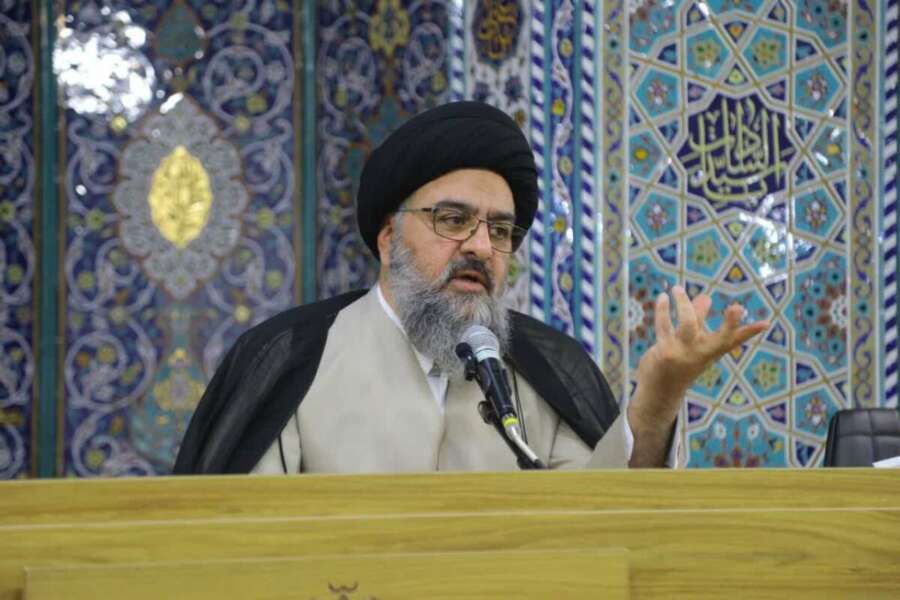
Ayatullah Sayyid Mujtaba Nur Mufidi: In the Name of Allah, the All-Beneficent, the All-Merciful. While offering condolences on the sorrowful days of the end of the month of Safar, in response to this question it must be said: In a world full of tensions, injustices, and human suffering, it seems that one of the most vital teachings of the Prophet of Islam’s (PBUH) conduct requiring re-reading and revival is human mercy and dignity. The Prophet (PBUH) introduced his mission with the expression “And We have not sent you except as a mercy to the worlds” [Quran 21:107]; meaning his mission was nothing other than spreading mercy to all humankind. Of course, mercy in its true sense is Tawhid, servitude to God, and liberation from all other servitudes. This mercy manifests across three vital dimensions for man:
-
Mercy Facing Hostility and Violence: The Prophet (PBUH) treated even those who harmed him with forgiveness and magnanimity (such as the Conquest of Mecca and pardoning enemies). In a world trapped in cycles of war and revenge, this perspective offers a path to reconciliation and coexistence.
-
Human Dignity and Eliminating Discrimination: He did not categorize human beings based on race, color, or class, stating: “People are as equal as the teeth of a comb.” Today, against racial, gender, and class discriminations, this teaching presents a path to justice and human solidarity.
-
Mercy Toward the Poor and Deprived: A vital portion of the Prophet’s (PBUH) conduct involved attending to the needy and supporting the oppressed (mustadh’afin). In a world where poverty and hunger coexist alongside accumulated wealth, this message illuminates the path to fairer redistribution and social empathy.
In other words, if we were to highlight one central axis, it can be stated: “Reviving the compassionate perspective of the Prophet (PBUH) toward humanity and the world is the key to resolving many modern crises.”
Question: How can the Prophetic conduct inspire interfaith dialogue, peaceful coexistence, and overcoming sectarian and religious violence in today’s world?
Ayatullah Sayyid Mujtaba Nur Mufidi: Since a major portion of modern human suffering roots in religious misunderstanding or misusing religion for violence, the Prophetic conduct possesses immense inspiring capacity in this field, including:
-
The Principle of Dialogue and Respect for Religions: The Prophet (PBUH) maintained dialogue and covenants with followers of various monotheistic religions, rather than elimination and negation. God addresses the Prophet (PBUH): “Say, ‘O People of the Scripture, come to a word that is equitable between us and you – that we will not worship except Allah and not associate anything with Him'” [Quran 3:64]. The basis of the Covenant of Medina (Mithaq al-Madinah) was a society that, despite all diversity, must live based on justice and defending the oppressed. He permitted the Christian delegation of Najran to perform their worship, representing a symbol of respect for religious freedom and genuine dialogue.
-
Emphasis on Shared Human Values: Confronting these problems, instead of focusing on differences, the Prophet (PBUH) emphasized shared values. The Quran reflects this perspective: “Come to a word that is equitable between us and you…” [Quran 3:64]. This logic can serve today as the foundation for interfaith dialogue toward justice, peace, and preserving human dignity.
-
Negation of Compulsion and Religious Violence: The key slogan of Islam in Prophetic conduct is “There is no compulsion in religion” [Quran 2:256]; adopting religion through force carries no meaning. This principle can serve as a foundation for critiquing extremism and takfir, demonstrating that true faith grows solely in an atmosphere of freedom.
-
Exemplar of Mercy Even Toward Opponents: The Prophet (PBUH) repeatedly preferred forgiveness and mercy over enemy violence. The Conquest of Mecca was the pinnacle of this behavior: those who fought him for years were forgiven with the phrase “Go forth, for you are the freed ones” (Idhabu fa-antum al-tulaqa’). This perspective can inspire national reconciliation processes, inter-sectarian compromise, and halting cycles of revenge.
The conduct of the Prophet of Islam (PBUH) demonstrates that religion can serve as a factor for coexistence and justice rather than violence and separation. If this model is re-read in today’s world, the path toward interfaith dialogue, reducing sectarian tensions, and transcending religious violence will be smoothed.
Question: Given the growth of Islamophobia and distortion of the Prophet’s image in Western media, what responsibility rests upon the shoulders of Muslims, elites, thinkers, and Islamic media in presenting the Prophet as the messenger of universal mercy?
Ayatullah Sayyid Mujtaba Nur Mufidi: When the image of the Prophet of Islam (PBUH) is distorted in Western media to portray him as a symbol of violence, the responsibility of Muslims and elites becomes far heavier. These responsibilities can be categorized across several levels:
-
Responsibility of Ordinary Muslims: The best introduction of the Prophet (PBUH) is the behavior and moral conduct of his followers. Honesty, kindness, seeking justice, and serving people demonstrate that the Prophet was a messenger of mercy far more than any slogan or propaganda. Moreover, avoiding violent reactions against Islamophobia is highly effective, as such reactions reinforce the exact image enemies desire.
-
Responsibility of Elites and Thinkers: Scientific, updated re-reading of the Prophetic conduct and presenting it in modern language suited to human concerns (human rights, justice, environment, peace). Active presence in international arenas and participating in interfaith and intercultural dialogues to correct misconceptions also assists this direction. Furthermore, scholarly responses to media and academic doubts and critiques using the language of reasoning and courtesy play a key role in countering the distortion of the Prophet’s luminous image.
-
Responsibility of Islamic Media: Producing artistic works, documentaries, films, books, and digital content depicting the true image of the Prophet (PBUH) as the Prophet of mercy and justice. Using the language of art and modern media for global impact, rather than repeating dry stereotypical slogans, is far more effective. Active presence on international networks and cyberspace to counter distorted narratives must be pursued.
-
Shared Responsibility of All Muslims: Fostering unity in introducing the Prophet (PBUH) and avoiding sectarian disputes that tarnish Islam’s image. Another point is practicing Prophetic ethics in family, social, and political spheres; for an act contrary to Prophetic conduct—even if committed in the name of Islam—serves as the best fuel for Islamophobia.
In summary, against Islamophobia, Muslims must represent the true persona of the Prophet of Islam (PBUH) through ethics, science, dialogue, and media—a persona presenting him not as a symbol of violence, but as the messenger of universal mercy.
Question: To what extent have we succeeded in conveying the image of the Prophet of justice, mercy, and rationality to the contemporary world? What are our strengths and weaknesses in this field?
Ayatullah Sayyid Mujtaba Nur Mufidi: Your question addresses a collective self-evaluation: To what extent have we managed to convey the true persona of the Prophet (PBUH) to today’s world?
Strengths briefly include:
-
Global Reach of Islam: Islam today has followers on all continents, and this breadth is itself an opportunity for the Prophet’s (PBUH) message to be heard globally.
-
Authentic and Rich Resources: The Quran, Prophetic conduct (sirah), and Hadith heritage present a clear image of the Prophet of mercy and justice that can serve as a firm backing for accurate presentation.
-
Brilliant Exemplary Muslims: Figures in the Islamic world (scholars, thinkers, social reformers, and successful Muslims in science and art) have provided a positive, rational image of Islam and the Prophet.
-
Increase in Interfaith Dialogues: In recent decades, numerous centers for interfaith dialogue have formed where Muslims gained opportunities to present the Prophet (PBUH).
Weaknesses include:
-
Weakness in Media and Storytelling: Our greatest weakness is that we failed to reflect the true persona of the Prophet attractively and globally through art, cinema, literature, and modern media. Hostile media filled this vacuum.
-
Contradictory Behavior of Some Muslims: When violence, corruption, or discrimination is observed in certain Islamic societies, the image of the Prophet is questioned. Our actions are sometimes the greatest obstacle in conveying his message.
-
Sectarianism and Internal Conflicts: While the Prophet (PBUH) was the messenger of unity and a single Ummah, sectarian disputes in the Islamic world presented a fragmented and contradictory image of Islam to the world.
-
Emotional and Irrational Reactions to Islamophobia: Instead of wise, rational responses, harsh and violent reactions by some Muslims confirm the exact violent image of the Prophet promoted by enemies.
-
Lack of Active Presence in Western Academia: We have rarely been able to present the rational and moral face of the Prophet continuously and authoritatively in Western academic centers.
To date, part of the Prophet of mercy and justice has been introduced to the world, but not enough to overcome distorted narratives. Our strength lies in authentic sources and dialogue capacities, while our main weakness lies in “not acting upon the sirah” and “falling behind in media and storytelling.”
Question: Today’s generation, especially the youth, holds spiritual thirst, desire for justice, and a need for honesty and meaning. How can the Prophet be taken beyond the mold of mere rituals and presented as a model for lifestyle, critical thinking, fighting corruption, and seeking justice?
Ayatullah Sayyid Mujtaba Nur Mufidi: The reality is that many young people today do not connect with dry, repetitive rituals; yet when the Prophet (PBUH) is presented as a model of real, human living, their thirst for spirituality, justice, and truth-seeking is quenched.
To take the Prophet (PBUH) beyond mere rituals, several strategies appear:
-
Presenting the Prophet as a Real Human Being, Not a Distant, Unattainable Figure: Showing that he lived simply in daily life, accepted people’s errors with magnanimity, and exhibited the most humane behavior in the market, home, and battlefield. Modeling the Prophet not in slogans, but in “lifestyle”: family respect, financial integrity, simple living, and social courage.
-
Granting Scope to Critical Thinking: The Prophet invited people to inquiry—“Do you not reason?” [Quran 2:44]—and never endorsed blind faith. This perspective can inspire modern youth seeking rationality and inquiry.
-
The Prophet’s (PBUH) Quest for Justice: His Eminence stood against tribal and class discriminations, building a society where slaves, migrants, and the poor held equal rights alongside the wealthy and aristocratic.
-
Presenting Him as a Living Model Against Corruption: Introducing this dimension transforms the Prophet into a living model against corruption and inequality. His conduct demonstrates that he never remained silent before oppression and corruption, even if detrimental to his closest associates. This teaching is the most appealing message for youth fatigued by injustice.
To achieve this, art, films, podcasts, literature, and social networks must be used to recreate the Prophet’s life in the language of today’s generation—narrating real stories from his life wherein modern youth see themselves, rather than repetitively reproducing sermons and advice.
For today’s generation, the Prophet (PBUH) must be introduced not merely as a “historical and religious figure,” but as a living companion in the search for meaning, justice, and freedom.
Question: Concepts such as human dignity, social justice, and freedom have become global concerns. Can the teachings and conduct of the Prophet of Islam (PBUH) assist in redefining and deepening these concepts, and how?
Ayatullah Sayyid Mujtaba Nur Mufidi: Yes, the teachings and conduct of the Prophet of Islam (PBUH) can not only assist in redefining concepts such as human dignity, social justice, and freedom, but possess the capacity to elevate these concepts from superficial slogans to practical and ethical depths. Several examples are noted:
-
Human Dignity: The Prophet’s (PBUH) view regarded man as the vicegerent of God (Khalifatullah) possessing inherent dignity, regardless of color, race, tribe, or class. Respectful treatment of slaves and liberating them, seating the poor and wealthy side by side, and the famous statement “People are as equal as the teeth of a comb” are clear examples. In a world where man is sometimes reduced to a tool of consumption or politics, Prophetic conduct reminds us that human dignity transcends economic profit or social status.
-
Social Justice: The Prophet (PBUH) viewed justice not merely in adjudication, but in redistributing wealth, responsibilities, and opportunities—such as equal distribution of war spoils, prohibiting aristocratic privileges, and supporting orphans and the deprived. This teaching can inspire systems seeking to reduce class divides and protect vulnerable strata instead of structural discrimination.
-
Freedom: From the Prophet’s (PBUH) perspective, faith and thought are not formed through force: “There is no compulsion in religion” [Quran 2:256]. Respect for religious freedom in the Covenant of Medina is a clear example.
These items can serve as a foundation for redefining freedom bound to moral responsibility and social justice—a freedom meaning human flourishing within the framework of dignity and justice, rather than unbridled licentiousness. Prophetic conduct reminds today’s world that human dignity possesses intrinsic authenticity and must not be sacrificed to discrimination, war, and consumer economics. Social justice is a fundamental principle, not a secondary privilege. Freedom acquires meaning solely when bound to truth and ethics. Thus, Prophetic teachings can elevate modern global concepts from scattered theories into practical, moral solutions for a more humane life.
Question: How did the Prophetic conduct place human dignity—regardless of race, religion, gender, or social class—at the center of his divine summons, and how can this principle be reconstructed in a world full of humiliation and discrimination?
Ayatullah Sayyid Mujtaba Nur Mufidi: It can truly be stated that “human dignity” is not a secondary aspect, but a core pillar of the Prophetic mission (ba’thah). Abundant evidence proves this claim:
-
Universality of the Summons: The Prophet (PBUH) conveyed his summons not to one tribe or class, but to mankind (al-nas): “O mankind, indeed I am the Messenger of Allah to you all” [Quran 7:158]. This means initiating religion with inclusiveness and rejection of discrimination.
-
Social Equality: In a tribal and class-stratified society, he declared: “People are as equal as the teeth of a comb.” Neither color, tribe, nor wealth grants privilege. The Farewell Pilgrimage (Hajjat al-Wada’) sermon is a complete example of this view.
-
Dignity of Women: In an environment where women were inherited or female infants buried alive, the Prophet (PBUH) introduced woman as possessing rights, will, and personality. Respecting daughters, emphasizing wives’ rights, and prohibiting violence against women formed part of this fundamental reform.
-
Emancipation of Slaves: Although slavery was a historical reality, the Prophet (PBUH) opened a gradual path toward freeing slaves: encouraging emancipation, establishing slave-freeing as expiation (kaffarah) for many sins, and equal coexistence with others (such as Bilal the Abyssinian).
-
Respect for Followers of Other Religions: In the Covenant of Medina, Jews and Christians enjoyed protected rights and dignity as citizens, and he permitted the Christians of Najran to worship.
Reconstructing this principle in today’s world requires practical, rather than merely sloganistic, re-reading. Human dignity must manifest in the conduct of Muslims, Islamic institutions, and governments. In a world where humiliation appears as modern racism, structural poverty, sexism, or economic marginalization, Prophetic teachings must be reinterpreted in the language of social justice and human rights. Muslims can form alliances with other religious and human traditions in defense of human dignity, just as the Prophet (PBUH) joined others in Hilf al-Fudul (Alliance of the Virtuous) prior to his prophetic mission to support the oppressed.
Question: The Prophet of Islam (PBUH) placed human dignity at the heart of his mission. In an era when humiliation, violence, racism, and dominance are reproduced, what lessons does the Prophet of Islam (PBUH) as a dignity-bestowing model offer for reforming contemporary political, media, and social discourse?
Ayatullah Sayyid Mujtaba Nur Mufidi: Considering the Prophet of Islam (PBUH) as a dignity-bestowing model, fundamental lessons emerge for reforming modern political, media, and social discourse:
-
Lesson for Political Discourse: The Prophet (PBUH) did not view politics as an instrument for dominance or supremacy over others, but as a means to establish justice and safeguard human dignity. The principle of Consultation (Shura) in managing society demonstrates his people-centered, anti-despotic vision, inspiring moral and justice-based democracies today. In managing Medina, he discarded race and tribe, adopting competence and piety (taqwa) as criteria.
-
Lesson for Media Discourse: In his communications, the Prophet (PBUH) abstained from humiliation, rumors, and falsehood, prohibiting slander and humiliation of enemies even in war. His tone, even toward opponents, was mixed with courtesy and kindness—offering a model for modern media often tainted by hate speech, humiliation, and destruction. The Prophet (PBUH) described his mission as “bringing glad tidings and warnings” (tabshir wa tandhir)—awareness and caution, not propaganda and thought manipulation.
-
Lesson for Social Discourse: From the Prophet’s perspective, society is a shared home. In the Covenant of Medina, Jews, Muslims, and even polytheists (in the absence of conflict) were accepted within a single society. Combating humiliation and racism was prioritized; in the Farewell Pilgrimage sermon, he emphasized: “No Arab possesses superiority over a non-Arab, nor any white over black, except through piety.” Through pardon and mercy (such as in the Conquest of Mecca), he broke the cycle of revenge, opening the path to social reconciliation.
Returning to this model builds a new benchmark for political and media ethics—one placing the human being at the center rather than power.
Question: The passing of the Prophet of Islam (PBUH) can be regarded as the beginning of a new phase of historical testing for the Islamic Ummah. How did the Ummah emerge from this test, and what lessons should be learned from post-demise events to reconstruct unity, honor, and rationality among Muslims?
Ayatullah Sayyid Mujtaba Nur Mufidi: The passing of the Prophet of Islam (PBUH) was indeed a turning point placing the Islamic Ummah into a vast test concerning preserving unity, sustaining honor, and loyalty to Prophetic rationality. One primary test was succession: instead of focusing on the Prophet’s mission, some—contrary to his bequest and solely for power—drove the fledgling Ummah into factionalism. In less than half a century, political disputes led to civil wars (Jamal, Siffin, Nahrawan), eroding the Ummah’s energy and paving the way for Umayyad and later Abbasid domination. With conquests expanding, wealth and luxury entered Islamic society, gradually dimming the spirit of asceticism, justice, and equality founded by the Prophet. Internal fractures paved the ground for foreign infiltration and domination—the exact danger against which the Prophet repeatedly warned.
Historical lessons for today:
-
The Ummah must learn that differences of opinion are natural, but must not lead to disunity that sacrifices the core mission (mercy, justice, guidance).
-
Power and wealth constitute a test harder than poverty. If the Islamic Ummah seeks to regain its honor, it must return to the Prophetic model of justice and purity.
-
Following the Prophet’s passing, tribalism resurfaced, fragmenting the Ummah. Historical experience proves that whenever tribal or sectarian identity dominates the “Single Ummah,” weakness and collapse ensue.
-
A major portion of deviations stemmed from emotional domination, worldly pursuit, or extremist interpretations of religion. Reconstructing Islamic rationality and dialogue among thinkers can prevent repeating those lapses.
In any case, the Prophet’s passing marked a phase where the Ummah needed to demonstrate maturity, yet worldly pursuits and sectarianism compromised many achievements.
Question: Today in many governments and groups speaking in the name of Islam, we witness behaviors in conflict with Prophetic conduct. How can the Prophetic conduct be redefined and promoted as the criterion for political legitimacy and Islamic ethics?
Ayatullah Sayyid Mujtaba Nur Mufidi: Your question addresses what constitutes today the paramount crisis of the Islamic world: the departure of many governments and movements speaking in Islam’s name from the spirit of Prophetic conduct. If the Prophet of Islam (PBUH) is the criterion, power-seeking, discriminatory, and violent behaviors hold no religious legitimacy. For Prophetic conduct to serve as the criterion for political legitimacy and Islamic ethics, several actions must be undertaken:
-
The Prophet (PBUH) viewed politics without justice as meaningless; any power sacrificing social justice for self-interest lacks Prophetic legitimacy.
-
The Prophet (PBUH) lived among the people, not above them. His governance rested upon service to the Ummah, rather than supremacy and despotism.
-
In Prophetic conduct, ethics does not erode even under the harshest conditions (war, conquest, conflict). Politics built upon deception, violence, and humiliation departs from the Prophetic model.
-
Jurists, scholars, and thinkers must present clear criteria evaluating governments and groups by re-reading his conduct. Islamic civil society can use Prophetic conduct to demand justice, dignity, and transparency. Islamic media must reflect concrete instances of Prophetic management, adjudication, justice, and mercy rather than repeating slogans.
-
In seminaries and universities, Prophetic conduct must be taught not merely as a historical subject, but as the charter of Islamic ethics and politics. In public education, concrete narratives from the Prophet’s life must be retold in the language of today’s generation to internalize criteria.
The conduct of the Prophet of Islam (PBUH) must be reintroduced as the benchmark for political and moral legitimacy; any government, party, or movement acting in the name of Islam must be weighed by these three criteria: Justice, Service, Ethics.
Redefine and promote this perspective, which can rescue Islam from being hijacked by power-seekers and perpetrators of violence, presenting its compassionate and rational face to the world.