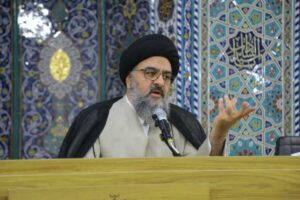
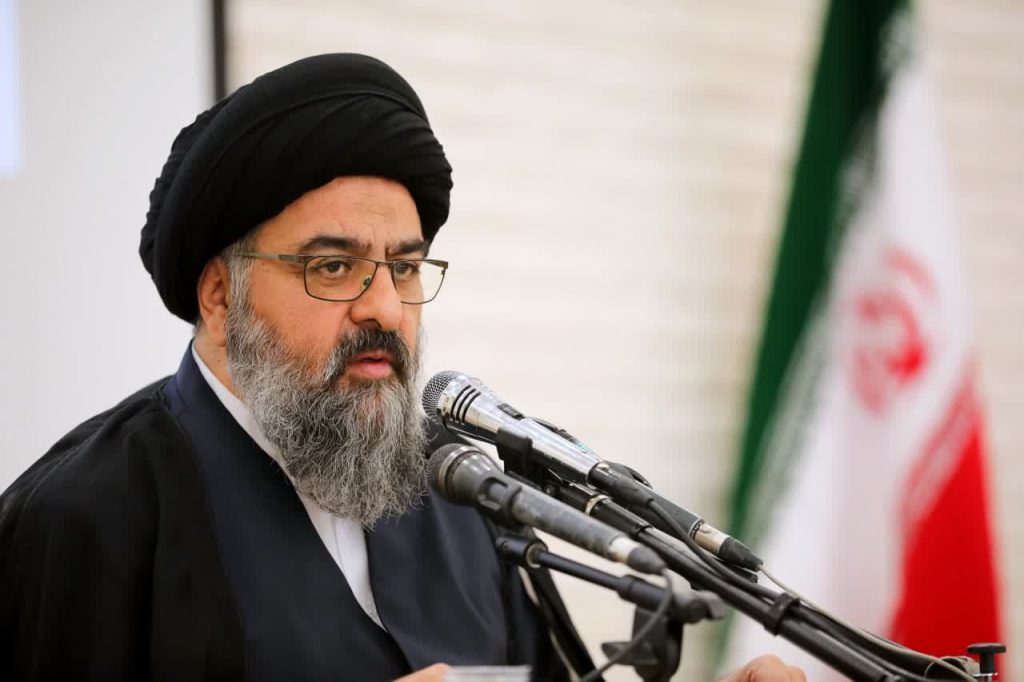
Statements of Ayatullah Sayyid Mujtaba Nur Mufidi on the Occasion of the Anniversary of the Demise of Imam Khomeini (may his soul be sanctified) in His Advanced Jurisprudence (Dars-e Kharij-e Fiqh) Class
Why Was the Movement of Imam Khomeini (may his soul be sanctified) Prophetic?
The movement of Imam Khomeini possesses such grandeur that no incident, occurrence, or bitterness can call that movement into question; whatever problems we may have, no one can question that great man and that monumental movement by virtue of the existence of these problems. The movement of the Imam was a prophetic movement; I say this citing a narration from Imam al-Sadiq (peace be upon him) quoted in the noble book Al-Kafi. That is, the origin and destination of the Imam’s movement were the exact origin and destination of the Prophets. Consider this narration: Imam al-Sadiq (peace be upon him) states: “إِنَّ اللَّهَ عَزَّوَجَلَّ أَدَّبَ نَبِيَّهُ فَأَحْسَنَ أَدَبَهُ فَلَمَّا أَكْمَلَ لَهُ الْأَدَبَ قَالَ إِنَّكَ لَعَلى خُلُقٍ عَظِيمٍ، ثُمَّ فَوَّضَ إِلَيْهِ أَمْرَ الدِّينِ وَ الْأُمَّةِ لِيَسُوسَ عِبَادَهُ”—“Indeed, Allah, Mighty and Majestic, disciplined His Prophet and disciplined him most excellently; and when He completed his discipline, He said: ‘Indeed, you possess a noble character’ [Quran 68:4], and then He entrusted to him the affairs of religion and the nation so that he may govern His servants.” Allah, Mighty and Majestic, nurtured and disciplined His Prophet; the Prophet (PBUH) is nurtured by Allah. Thus, He disciplined him most excellently; Allah Himself undertook the discipline of the Noble Prophet of Islam (PBUH) and nurtured him in the best manner. When He completed his discipline, He stated: “Indeed, you possess a noble character,” referring to verse 4 of Surah al-Qalam. Now, what this “noble character” (khuluq ‘azim) is, we leave aside for now, as it requires a separate discussion. That is, Allah disciplined the Prophet (PBUH) in the best and most sublime manner until his discipline was completed and he attained the station of noble character; then He entrusted the affairs of religion and the Ummah to him so that he could manage and govern His servants.
This noble tradition contains several important and fundamental points; we can benefit from this narration from several angles.
Firstly: Leadership over the affairs of religion and the nation is impossible without divine and religious discipline. Before the affairs of religion and the nation were entrusted to the Prophets, they all underwent divine discipline, at the head of whom was the Noble Prophet of Islam. It states that Allah first disciplined the Prophet in the best manner and completed his discipline until he reached the station of noble character; this is the first condition for religious leaders. We cannot say this is exclusive to Prophets—no! Any religious leader and anyone who takes charge of religious affairs, if they do not take this step, the affairs of religion and the nation will not be entrusted to them at all. That which is said, “Indeed, the scholars are the heirs of the Prophets,” this inheritance lies within this journey; that same discipline must take place. However, the discipline of the Prophets and the Noble Prophet of Islam is a special discipline—he is a chosen human being, and others must traverse this path: divine and religious discipline, self-building, inner purification, and self-cleansing (tazkiyah). The Imam took this step; the Imam swam in the ocean of gnosis (ma’rifah) and dived into the depths of the sea of knowledge and action. Look at the life of the Imam (may his soul be sanctified); from the beginning, he was earnest in the path of studying, learning, teaching, and self-purification. The moral personality of the Imam was clear from the outset to all his peers and associates—a refined, polished personality who had only God in view, was not seeking himself, and was not pursuing carnal desires. Yes, the station of noble character (khuluq ‘azim) is exclusive to the Prophet of Islam (PBUH); but moving along this path and approaching this status is an endeavor necessary not only for all leaders, but for all human beings. This is the path of human trajectory, though for Prophets, educators, and guides of humanity, it is a necessity and a prerequisite.
The clergy and propagators of religion must keep this beginning in mind to the extent of their capacity. If we think that without this divine discipline—not merely learning a few terms—and without inner refinement we can propagate God’s religion, and imagine that God has absolutely entrusted the affair of religion to us, we are mistaken. Of course, everyone according to their capacity, everyone to the extent of their ability must pay attention to this issue. If we want to be effective in society and our surrounding environment, possess eloquence and influential speech, and have God pleased with our actions, words, and deeds, we must truly acquire this in reality; we must adorn ourselves with this virtue. After all, a person can present an attractive exterior everywhere—speak very well, act impeccably groomed—but God knows the interior; it is God who knows on what basis and with what motive our actions are performed. We must try never to distance ourselves from this path; divine discipline is also unending; we must watch over this dimension until the end of our lives. The Imam, truly and as testified by all, did not abandon this stature until the final moments of his life and was always vigilant, both for himself and as an educator and teacher of the Ummah, never forgetting the duty of reminding and guiding others. You saw that at the peak of political disputes, conflicts, and debates, he would deliver speeches reminding people to observe ethics, guard against the machinations of Satan, and exercise self-restraint against temptations. Satan can very easily beautify deeds for a human being; the root of an action or word can be envy, narrow-mindedness, or egocentrism, yet its outward appearance may be divine and religious, under the guise of “I am saying this out of duty.” Nowadays, a sense of duty arises in everyone! Truly, a person knows within oneself whether this sense of duty stems from seeking God or seeking self. A person must keep this issue in mind in the components of one’s life as much as possible. Yes, after all, we have impurities, and whatever we do, we remain important to ourselves; but as much as we can, we must reduce this egocentrism and diminish the “I” (maniyyat).
When the Noble Prophet of Islam (PBUH) reached this point, Allah then assigned and entrusted the affairs of religion and the people to him. The second stage is taking charge of the affairs of religion and the Ummah. It does not merely say “the affair of religion”; it says “the affairs of religion and the Ummah.” It makes no sense for someone to say, “Our job is religion and we have nothing to do with the people”—it makes no sense at all! Is it possible to separate religion from the people? Is it possible for someone to be responsible for religious affairs yet have no concern with the well-being or corruption of the people? Religion is fundamentally for guiding the people; religion exists to bring people to bliss. The very act of entrusting the affairs of the people to the Prophet (PBUH) speaks of an important matter: the Prophet (PBUH) carries a heavy responsibility toward the people. The narration continues: “li-yasusa ‘ibadah”—He entrusted the affairs of religion and the nation to the Prophet (PBUH) so that he may govern (yasus), manage, and administer His servants. The Imam walked this exact path; that is, he adorned himself with religious discipline, and because he regarded scholars as the heirs of the Prophets, he viewed his responsibility as taking charge of the affairs of religion and the people. He believed that what was entrusted to the Prophets was also entrusted to the scholars. In the discussion of the Guardianship of the Islamic Jurist (Wilayat al-Faqih), one of the proofs cited by the Imam is this very narration: “Indeed, the scholars are the heirs of the Prophets.” Being the heirs of the Prophets is not merely stating rulings; it makes no sense that only stating rulings was entrusted to scholars. Rather, the affairs of religion and the Ummah were entrusted to them; this possesses an absolute scope (itlaq) that encompasses all matters—the general matters and overall direction of religion and the people—so that they may govern His servants. After all, God Himself does not govern directly without mechanisms, without law and Shari’ah, and without a Prophet or successor to the Prophet; He is not going to run affairs purely through existential power (takwinan). He brought religion and entrusted the matter of guidance to a group so that people would be guided. Therefore, the destination of the Prophet (PBUH) is governing the affairs of servants through religion; hence, religion cannot be separated from governing the affairs of servants. This is a completely clear and obvious matter. Can anyone truly say that God entrusted the affair of religion to the Prophet (PBUH) and assigned the affairs of the people to Prophets only in the dimension related to rulings and stating rulings for the people, but has nothing to do with the rest of their affairs? This is not feasible at all. It makes no sense to say that God told the Prophets, “Go explain religion to the people and do nothing else; let them do whatever they want.” Without tools, without companions, without helpers and organization, is it possible at all to govern the servants of God? Can such a task be accomplished without government? “Li-yasusa ‘ibadah” (so that he may govern His servants) makes no sense without government and is not achievable at all. That is, as if Almighty God told the Prophet (PBUH): “Go guide the people and do nothing else; let all tools be in the hands of enemies and tyrants (taghut); you just speak, advise, and talk, and whatever problem the tyrant creates for you, do not bother with him and just do your own work.” How could that be? They would neutralize all efforts and destroy all endeavors. Therefore, this objective is clearly derived from this narration.
The Imam also correctly understood this destination and insisted upon it. The Imam believed that without establishing a government based on religion, achieving those goals is impossible; there is no doubt about this. We have abundant rational and textual proofs establishing this issue. Some people, due to current problems and existing shortcomings, say, “This is the result of religious government!” What does this have to do with it? These problems and troubles, if properly managed, are solvable; and if not, the problem lies not in the theory, but in you and me, who must act and implement this accurately and correctly. The Imam stepped onto this very path: he immersed himself in the sea of religious teachings, tasted from that ocean according to his capacity, washed himself in the ocean of self-purification to the extent of his ability, and saw himself in a position where the affairs of religion and the Ummah were entrusted not to his person, but to his persona as an heir of the Prophets to govern the affairs of servants. He spent his entire being in this path, and under no circumstances is the value of this great work diminished; his work was a duty and an obligation. All of us are like this: everyone, according to the proof and capability they possess and the responsibility they feel, must strive—now, to what extent the desired results are achieved and are optimal is another discussion.
It occurred to me that this is the least we can do in these days regarding that great man, gnostic (‘arif), sage (hakim), philosopher, jurist (faqih), scholar of methodology (usuli), and commentator (mufassir)—a divine man. Under these circumstances as well, everyone must strive and work to the extent of their ability. That you see the Supreme Leader emphasizing the Imam so much is not without reason. Truly, few people rely on this personality, this path, and this destination as he does; on every occasion, he insists on this direction so that we recognize the path and destination and do not lose our way.