
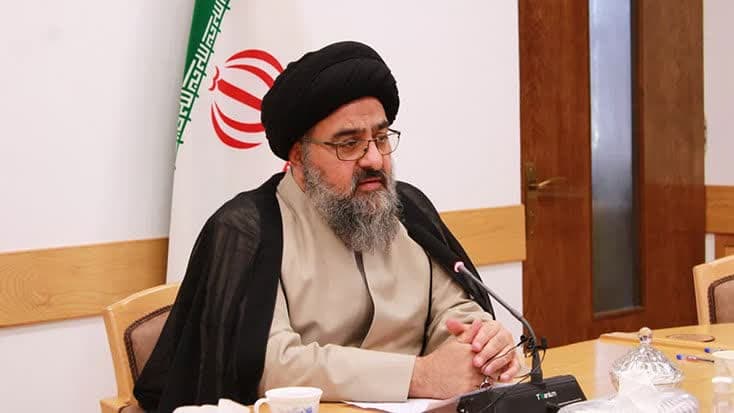
Statements of Ayatullah Sayyid Mujtaba Nur Mufidi on the Occasion of Unity Week in His Advanced Jurisprudence (Dars-e Kharij-e Fiqh) Class – Wednesday, September 18, 2024
The Emphasis of Imam Khomeini (may his soul be sanctified) and the Supreme Leader on Unity Has Roots in the Quran and the Sunnah of the Prophet (PBUH) and the Ahl al-Bayt (peace be upon them)
Since these are the days celebrating the blessed birth of the Noble Messenger of Islam (PBUH) and also the birth of Imam al-Sadiq (peace be upon him), on this occasion I shall cite a narration regarding these two peerless personalities—firstly, the Noble Messenger of Islam (PBUH) and then Imam al-Sadiq (peace be upon him)—suited for this week, which has been named Unity Week.
The Messenger of Allah (PBUH), in a very short narration quoted from him in Nahj al-Fasahah, states: “الجماعة رحمة و الفرقة عذاب”—“Unity (community) is a mercy, and division is a torment.” Perhaps one could not depict the value of unity, harmony, and togetherness, as well as the danger of division, separation, and dispute, better than this. Community, oneness, and being together—these are mercy; whereas separation, division, and discord are torment. Of course, this is explicitly stated in the verses of the Quran. Where unity exists and hearts are close to one another, divine mercy pours down upon the people; the spiritual blessing of unity is far greater than material blessings. If a society enjoys all material blessings, but dispute, conflict, and fighting exist among them, that place is hell, and there is no peace. When there is conflict, souls become tainted with restlessness, anxiety, and strife; but where there is unity, equality, and brotherhood—even in a dry, barren desert—that place is paradise. A wealthy, affluent family that lacks nothing materially, but where there is constant fighting, dispute, and conflict among family members—do they enjoy that wealth and those facilities they possess? On the other hand, a family that has no wealth or possesses minimal means, but the bonds of this family are strong and intimacy and affection prevail among them—they truly live as if in paradise. Division, discord, and disunity are truly a torment; there is no torment worse than these conflicts, disputes, and divisions.
Consider what effects torment and mercy have in a small family; when this moves to a larger environment—in a group or organization, in an institution, in a country, in an Ummah—the wider the scope of the community, the harsher the torment of division, and the harder the hardship resulting from disunity. The wider the scope of the community, the greater the impact of unity and equality, and the power derived from this harmony is a greater power; no one can stand against this power. Right now and under current circumstances, if Muslims were united, even with minimal military and defense capabilities against major global powers, if this great Ummah were to unite, none of these arrogant powers could withstand them. That we see ourselves and the eminent figures among our jurists, the late Imam Khomeini (may his soul be sanctified), and the Supreme Leader emphasizing this issue so much is because it is one of the most important Islamic doctrinal teachings that has roots in the Quran and the Sunnah of the Prophet and the Ahl al-Bayt.
Time has passed; let me read a narration from Imam al-Sadiq (peace be upon him) and conclude my remarks. Imam al-Sadiq (peace be upon him) states: “صَدَقَةٌ يُحِبُّهَا اللَّهُ إِصْلَاحٌ بَيْنِ النَّاسِ إِذَا تَفَاسَدُوا وَ تَقَارُبٌ بَيْنِهِمْ إِذَا تَبَاعَدُوا”—“An act of charity that Allah loves is reconciling between people when they fall into corruption/discord, and bringing them closer when they distance themselves from one another.” Reconciling between people… Here it does not even say “reconciling between Muslims” or “reconciling between believers”; it says “reconciling between people” (islah bayn al-nas) at a time when division, separation, and corruption occur among them. By the contextual indicator of “reconciling between people,” it becomes clear that “tafasadu” means separation and division. When they move far apart, when they become separated, bringing them closer… Bringing people closer at the time of separation, reconciling between people at the time of dispute and disagreement, is a charity that Allah loves. Charity is not merely giving money, property, or food. The very effects attributed to charity apply to this as well. Certain effects have been mentioned for charity; charity is broader than financial and non-financial charity. Those effects mentioned for charity are not solely for financial charity: longevity of life, repelling various afflictions—these are for all types of charity. Should a person who has no financial means to give charity have all afflictions descend upon them? No! They may lack wealth, but they can reconcile between people; they can bring people closer when they drift apart. If anyone, God forbid, takes a step causing discord and separation between two human beings, two Muslims, or two compatriots, it is unequivocally an act detested by Allah, Blessed and Exalted. If we want to be loved by God, if we want to give a charity that God loves, what work is better than creating friendship, intimacy, and empathy among people, among friends, among loved ones, and among brothers? Why do some people take pleasure in separation? Why do some seek dispute and fighting among others? What kind of view and mindset is this that some of us suffer from, whether in the realm of personal life or social life? May Allah, God willing, grant grace to all of us so that we may be kind and empathetic toward one another.