

For modern man, Ashura is not merely an elegy, but a charter of felicitous living wherein ethics takes precedence over wealth and power, human and moral values override transient worldly desires, and the outcry against oppression, tyranny, and injustice alongside defending the oppressed is the loudest cry, so that moral deadlocks and identity crises may thereby be resolved.
Question: How did a society that had seen the Noble Prophet (PBUH) and heard the Quran arrive at the event of Ashura?
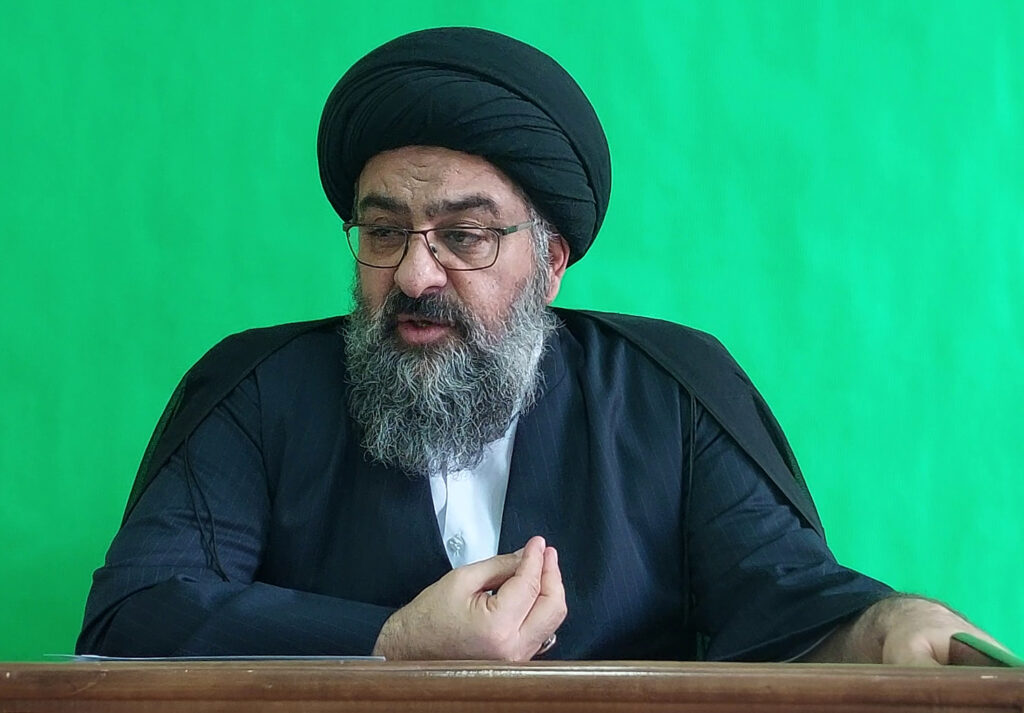
Ayatullah Sayyid Mujtaba Nur Mufidi: While offering condolences on the arrival of the days of sorrow of the Household of Allah (Aal Allah), commemorating the memory of the martyrs of imposed wars—especially the martyred Imam—and extending appreciation to the noble, patient, and resistant nation of Iran that, following Sayyid al-Shuhada [Imam al-Husayn], has thus far never bowed before the Yazids of the age and has stood heroically, in response to your question I must state that the transition of Islamic society from the era of the Noble Prophet (PBUH) to the bitter event of Ashura in less than half a century was caused by a series of gradual changes and cultural, social, and political factors, to the most vital of which I shall briefly refer in this opportunity.
From a theological perspective, the seed of Ashura was planted on the day political leadership was severed from scientific and spiritual authority. The Noble Prophet (PBUH) at Ghadir Khumm designated succession based on divine text (nass) and intrinsic merit. However, by ignoring this explicit text, the criterion for selecting a leader shifted from divine meritocracy to human expediency, tribalism, and later conquest by the sword. Once society accepted placing someone lacking divinely inspired knowledge (‘ilm-e ladunni) and infallibility (‘ismah) in the position of divine vicegerency, the way was paved to justify the rule of any individual—even someone like Yazid. The Holy Quran had warned: “So if he was to die or be killed, would you turn back on your heels?” [Quran 3:144]. This regression to the past occurred precisely through reviving tribal structures. The Umayyads—who fought Islam until the Conquest of Mecca and survived through the Prophet’s pardon as the freed ones (Tulaqa’)—gradually infiltrated key government posts. During the third Caliph’s era, governance of vital provinces such as Levant (Syria), Kufa, and Egypt fell into the hands of the Umayyad clan like Mu’awiyah and Walid ibn ‘Uqbah. This power shift reignited the ancient hatred of the Umayyads against the Hashemites, specifically vengeance for Badr and Uhud that lay hidden beneath the ashes of Islam. Yazid’s famous sentence after Ashura—“The Hashemites played with kingdom; no news came and no revelation descended”—is the complete manifestation of this hidden disbelief and pre-Islamic tribal fanaticism (‘asabiyyah).
Another factor was worldliness and wealth accumulation. With the expansion of Islamic conquests in the decades following the Prophet’s (PBUH) passing, immense wealth flowed into Islamic lands. This influx altered the spirit of simple living and equality of the Prophet’s era, giving rise to a new aristocracy. Many Muslims, including certain companions, engaged in rivalry to acquire worldly material interests, and gradually the consumption of illicit gains (haram-khwari) prevailed. Naturally, stomachs filled with illicit and doubtful gains could no longer bear hearing the word of truth. This is the very truth articulated by Sayyid al-Shuhada (peace be upon him) on the Day of Ashura: “Indeed, your stomachs have been filled with the forbidden.” Imam al-Husayn (peace be upon him) on the path to Karbala also referenced this: “People are servants of the world, and religion is merely a lick upon their tongues.”
Another factor was the distortion of religion, toxic propaganda, Hadith fabrication, and sectarianism. The Umayyad caliphate apparatus, particularly during Mu’awiyah’s era, aggressively utilized media tools—namely the pulpits. In the Levant region, governed by Mu’awiyah from the outset, people learned Islam through the Umayyad lens and lacked accurate knowledge of the Ahl al-Bayt (peace be upon them). Hadith fabrication, tarnishing the image of Imam ‘Ali (peace be upon him), and turning religious concepts upside down caused public opinion to be easily deceived. By hiring court traditionists such as Abu Hurairah and Samurah ibn Jundab, he fabricated numerous traditions extolling the Umayyads and reviling the Commander of the Faithful ‘Ali (peace be upon him).
Furthermore, to justify government oppressions, they promoted the doctrine of determinism (jabr) so that people would accept Yazid’s rule as divine decree. ‘Ubaydullah ibn Ziyad in Kufa said to Hazrat Zaynab (peace be upon her): “Did you see what God did to your brother?”, confronting her crushing response: “I saw nothing but beauty” (Ma ra’aytu illa jamila). In such a toxic atmosphere, cursing ‘Ali (peace be upon him) in mosques transformed into a tradition, to the point that when news of the Commander of the Faithful’s (peace be upon him) martyrdom in the Mihrab of Kufa Mosque reached Levant, Syrians asked in surprise: “Did ‘Ali even pray?!”
Creating terror and intense repression was also a vital factor. To consolidate power, the Umayyad government spared no violence. Martyring prominent figures loyal to the Ahl al-Bayt, severing opponents’ stipends from the public treasury, and creating terror via governors like Ziyad ibn Abih and ‘Ubaydullah ibn Ziyad forced many to ignore truth or remain silent out of fear for life and property. The Umayyad state established a policy built upon absolute terror (Al-nasru bi al-ru’b). The tragic martyrdom of illustrious companions such as Hujr ibn ‘Adi and ‘Amr ibn al-Hamiq al-Khuza’i, alongside severing limbs and crucifying Shia, suffocated all breath. Farazdaq’s description of Kufans responding to Imam al-Husayn (peace be upon him)—“Their hearts are with you, but their swords are with the Umayyads”—reflects this reality: they recognized the truth of the Ahl al-Bayt, yet intense world-attachment and paralyzing fear of Ibn Ziyad’s sword forced them to act contrary to their inner belief.
The fifth factor was that many societal elites, companions (sahabah), and successors (taabi’in) remained silent before gradual deviations. Seeking comfort and fear of endangering social status led to forgetting Forbidding Evil at a macro level. Perhaps the most dangerous factor in this society’s fall was the silence and compromise of companions and successors before religious innovations (bid’ah). Two years prior to Mu’awiyah’s death, in his famous sermon at Mina, Imam al-Husayn (peace be upon him) in a reproachful tone held religious elites and scholars accountable for abandoning Enjoining Good and Forbidding Evil, stating: “You know that the covenants of Allah are broken, yet you do not panic…” Fear of stipend cuts and risking life led figures who had seen the Prophet (PBUH) himself to remain silent before the wine-drinking, openly debauched Yazid.
In summary, Ashura was the inevitable collision of two readings of Islam: pure Muhammadi Islam manifested in Sayyid al-Shuhada, and distorted Umayyad Islam manifested in Yazid. Through his uprising, Imam al-Husayn (peace be upon him) tore apart this shell of hypocrisy, preventing the total destruction of religion by sacrificing his life.
Question: In your opinion, where should the primary root of Ashura be sought: in the deviation of power structures, transformation of social values, weakness of public ethics, or society’s distance from the spirit of religion?
Ayatullah Sayyid Mujtaba Nur Mufidi: As I noted in answering the first question, the event of Ashura was not the product of a single factor, but an intertwined combination of all items you mentioned forming an interconnected chain. Yet if we were to name one as primary, we can point to society distancing itself from the spirit of religion, because this issue caused the other three problems. Had the spirit of religion been preserved and the Ahl al-Bayt (peace be upon them) as true bearers of religion not been marginalized, these events would not have occurred. Conversely, one can claim that deviating the course of political leadership, transforming social values, and public moral decline gradually emptied religion of its truth.
In any case, deviating political-social leadership and severing scientific-spiritual authority from political power—ultimately transforming the Caliphate into hereditary Umayyad monarchy—placed rulers lacking commitment to Islamic principles on the throne. When this vital matter strayed from truth, and the public treasury, pulpits, and appointments were employed to alter society’s direction, the new regime altered societal values to consolidate itself. Influx of conquest wealth and unequal distribution transformed values of simple living, equality, and piety into aristocracy, comfort-seeking, and worldliness. Tribal fanaticisms abolished by the Prophet (PBUH) resurfaced as social values and factors of supremacy.
Shifting values gradually decayed public morals: prevalence of bribery and intimidation entrapped society in welfare-seeking, fear, covenant-breaking, and hypocrisy. As Imam al-Husayn (peace be upon him) stated, stomachs filled with the forbidden blocked hearing the truth. A society sacrificing ethics for transient interests easily submits to murdering its Prophet’s son.
These factors left solely an outward shell and name of Islam, destroying religion’s spirit based on justice, freedom, and true Wilayah. The society confronting the Imam on Ashura performed outward rituals like prayer, yet completely lost religion’s spirit and the power to distinguish truth from falsehood. Amidst this, Imam al-Husayn’s (peace be upon him) uprising served as a monumental shock awakening a society caught in this vicious cycle.
Question: What image does Ashura present regarding the responsibility of rulers, elites, scholars, and the public facing social and political deviations?
Ayatullah Sayyid Mujtaba Nur Mufidi: Ashura, as a peerless social school, depicts the role and responsibility of each group during fundamental societal deviation:
-
Rulers: Governance is a trust (amanah), and the ruler’s responsibility in Islam is guarding divine bounds and practicing justice. When a ruler like Yazid forfeits moral and religious legitimacy, viewing government not as a trust but as spoils (ghanimah), the entire societal structure inclines toward corruption. Ashura conveys that an oppressive, corrupt, deviant ruler is the greatest factor in destroying religion, ethics, and people’s rights.
-
Elites: Ashura is the manifestation of the defeat of society’s elites—elites who recognized the truth, yet remained silent out of fear for life or greed for bread. In his Mina sermon, Imam al-Husayn (peace be upon him) addressed and rebuked elites for failing to cry out against oppression using their social prestige. Karbala demonstrates that if intellectual reference figures fall into doubt or comfort-seeking at historical junctures, catastrophes occur taking centuries to remedy.
-
Scholars (‘Ulama): Scholars bore a duty to prevent innovations (bid’ah) and concept distortions, crying out against the injustice of Yazid and his agents, yet shirked this vital responsibility. Even in the camp opposing Imam al-Husayn (peace be upon him), pseudo-scholars misused concepts like obeying those in authority (Oli al-Amr) or divine determinism to justify Umayyad crimes. Ashura teaches scholars that their primary duty is standing against innovations and demanding justice, even at the cost of isolation.
-
The Public: Ordinary people were caught between bribery and threats, leading them either to apathy or accompanying the oppressor despite knowing the situation. Kufans represent a society possessing knowledge but lacking will, succumbing to inaction. Neutrality in the battle between truth and falsehood is practically aiding falsehood. Public responsibility lies in possessing insight (basirah), power to distinguish truth from falsehood, and avoiding worldliness; for when people become servants of the world, in hard moments they abandon religion.
In summary, political-social deviation reaches a point of no return when the ruler becomes oppressive and corrupt, the scholar remains silent, the elite seeks transaction, and the public falls into apathy and comfort-seeking. Thus, Imam al-Husayn’s (peace be upon him) uprising was a cry returning each class to its core responsibility.
Question: If we regard Ashura not as a single incident but as the result of a process, what is its most vital warning regarding the trajectory of societal collapse and decline?
Ayatullah Sayyid Mujtaba Nur Mufidi: The paramount warning of Ashura as a historical process is the danger of gradual value transformation and normalizing corruption in society. Society’s fall does not occur overnight, but materializes slowly. When authentic values such as justice, seeking truth, and simple living gradually give way to anti-values such as wealth accumulation, tribalism, and self-interest, the bell of collapse tolls.
Striving to preserve the outer shell and rituals of religion or law while neglecting their core—where anti-oppression, ethics, and freedom have perished while everyone pursues superficial pretense—indicates danger lying in wait.
When society loses sensitivity toward injustice, corruption, and trampling human rights, accepting silence and passivity under the guise of comfort-seeking, fear, or expediency, collapse initiates.
When informed individuals, scholars, and influential figures, instead of defending truth, refuse minor risks, pursue personal gain, and remain silent before initial deviations, society’s wound deepens into incurable stages.
In summary, Ashura’s great warning is that if societal decline is not halted in its initial stages, it brings society to a point where it closes its eyes to the greatest atrocities and even accompanies the oppressor.
Question: In a world where contemporary man faces crises of meaning, war, discrimination, violence, alienation, and moral collapse, what fresh horizon does Ashura open before him for human, ethical, and spiritual living?
Ayatullah Sayyid Mujtaba Nur Mufidi: Ashura is a school as vast as history itself, opening fresh horizons in ethical and spiritual living for modern man grappling with existential and structural crises:
-
Freedom (Hurriyyah) vs. Instrumentality: In a world where man is reduced to an instrument serving economic systems or political profit-seekers, the logic of Husayn ibn ‘Ali (peace be upon him) emphasizes freedom. His famous statement—“If you do not have religion, at least be free human beings in your worldly life”—transcends doctrinal boundaries, presenting freedom as a pre-religious, fundamental element of human existence, rescuing man from self-alienation.
-
Meaning in Suffering and Death: The crisis of meaning in the modern world often terminates in futility, whereas Ashura converts death from a biological end into a conscious choice for the survival of truth, viewing suffering not as absolute evil but as a tool for spiritual growth and social reform. Real living depends on adherence to human values and moral principles, even at the cost of life.
-
Distinguishing Resistance from Violence: Ashura draws a precise line between violence and resistance for justice. Facing the enemy army’s brutal assault, Imam al-Husayn (peace be upon him) never departed from the road of ethics and fairness, standing solely against a discriminatory structure classifying human dignity based on lineage and wealth. Until the final moment, he sought to awaken sleeping consciences held captive by gold, force, and deceit (wealth, power, and hypocrisy). Ashura teaches modern man confronting modern discriminations the lesson of saying “No” to unjust structures without falling into moral vices.
-
Social Spirituality vs. Isolated Asceticism: In Ashura, a spirituality surges that forms not in monastery isolation, but in the heart of society facing human suffering. Spiritual elevation proceeds through seeking justice and altruism, answering modern individualistic spiritualities that summon man to silence before oppression; Ashuran spirituality renders man responsible for the fate of others.
In one sentence, for modern man Ashura is not merely an elegy, but a charter of felicitous living wherein ethics takes precedence over wealth and power, human and moral values override transient worldly desires, and the outcry against oppression, tyranny, and injustice alongside defending the oppressed is the loudest cry, so that moral deadlocks and identity crises may thereby be resolved.
Living around the orbit of Karbala’s teachings in today’s world is not a luxury choice, but a necessity for modern man struggling in a whirlpool of restlessness, identity loss, and depression, urgently needing a savior to bring him to the shore of tranquility. This very point links Ashura with Mahdaviat, keeping alive hopes for true human liberation and ending oppression, humiliation, and discriminatio