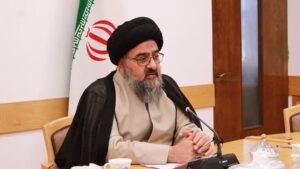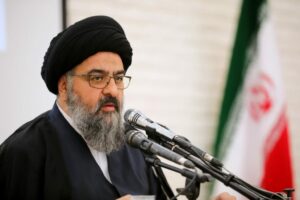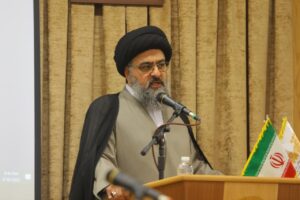
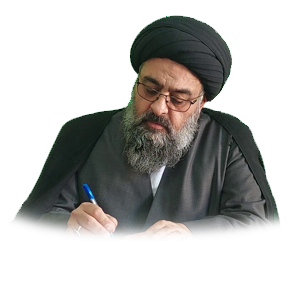
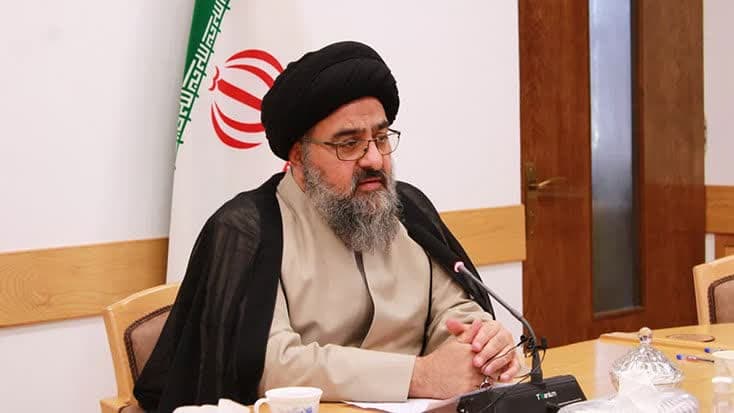
Stating that the duty of religious preachers is the rational and documented explanation of the Ramadan War and the personality of the martyred Leader—because today’s society, especially the young generation, needs analysis, reasoning, and clear answers far more than slogans—Ayatullah Sayyid Mujtaba Nur Mufidi said: Preachers must explain and demonstrate the personal, ethical, scientific, and managerial dimensions of the dear martyr using language tailored to the audience.
Hawzah News Agency, Tehran: Holding farewell, funeral, and burial ceremonies for the pure body of the martyr, His Eminence Grand Ayatullah Sayyid Ali Khamenei, Leader of the Ummah, carries various dimensions and consequences whose exploration is a necessity. In this connection, Hawzah News Agency conducted an interview with Hujjat al-Islam wa al-Muslimin Sayyid Mujtaba Nur Mufidi, President of the Research Institute for Contemporary Jurisprudence and Professor of Advanced Classes in Jurisprudence at the Islamic Seminary of Qom, the full text of which follows below.
Question: What messages does the funeral ceremony for the pure body of the martyred Leader of the Revolution convey under today’s conditions in the region and the world?
Ayatullah Sayyid Mujtaba Nur Mufidi: While offering condolences once more on the martyrdom of the Leader of the Islamic Revolution, and recalling that no matter how much time passes from that bitter, painful event, the grief of losing that great man in the history of Islam and Iran never fades, in response to your question I must state that undoubtedly, the funeral procession for the martyred Leader is not merely a mourning ritual, but a historical ceremony whose audience encompasses the Iranian nation, regional nations, global public opinion, and future generations.
The primary message of this ceremony, particularly during the days of the month of Muharram, is the manifestation of the people’s loyalty, steadfastness, and attachment to ideals and values—in a word, the school of Sayyid al-Shuhada [Imam al-Husayn]. In Islamic logic, martyrdom is not the end of the path, but the beginning of the impactful life of a divine human being. The Holy Quran states: “And never think of those who have been killed in the cause of Allah as dead” [Quran 3:169]. From this perspective, the widespread presence of the people in the funeral is not merely an expression of emotion, but a renewal of the covenant with values for which that martyr strived throughout his life.
Moreover, this presence represents appreciation for the sincere, diligent efforts of that great martyr who spent his life elevating Islam and Iran.
This ceremony also showcases social capital and cohesion. Enemies of the Iranian nation constantly strive to induce despair, division, and fractures in society; yet when people, despite differing tastes and viewpoints, stand side by side in a national and religious arena, this presence transmits a clear message of solidarity and social firmness. Obviously, this social capital counts as one of the most vital components of national power.
Furthermore, this ceremony loudly proclaims the failure of the strategy of eliminating personalities to eliminate a school of thought. The history of Islam has taught us that with the martyrdom of great personalities, although an irreplaceable loss (thulmah) occurs, the movement and current of the school does not stop. Just as the martyrdom of Sayyid al-Shuhada (peace be upon him) did not extinguish the Ashura movement, but rendered it eternal, in contemporary history as well, the martyrdom of influential figures—when coupled with the faith and awareness of the people—can lead to reviving ideals and reinforcing the spirit of resistance.
In today’s world, power is not limited solely to military equipment or economic capability; nations endure when backed by identity, cultural, and doctrinal support. The magnificent funeral procession demonstrates that the great Iranian nation still possesses the capacity to reproduce thought and ideas, holding high motivation and solidarity, which itself constitutes a vital component of soft power.
Finally, such a ceremony demonstrates that hope for the future surges and the path of service remains open. One objective of enemies in this bitter event was stopping the movement of the Revolution and the Iranian nation by eliminating the martyred Leader; yet such a ceremony declares to the world that the clear path of the Revolution and the people is not dependent upon an individual—even if the leader of society—but continues based on faith, the people, and divine ideals, with this nation forging an asset out of losses to move toward the future, as demonstrated in this period following the martyred Imam’s martyrdom.
A point I deem necessary to note is that this ceremony must serve as an opportunity for the “Jihad of Explanation” (Jihad-e Tabyin)—meaning that rather than merely stirring emotions, it should address intellects, acquaint the young generation with the truth of ideals, reinforce hope in society, and demonstrate that the culture of self-sacrifice, responsibility, and service remains alive and inspiring.
Therefore, the funeral of the martyred Leader is not merely bidding farewell to a personality, but declaring the vitality of a school of thought, the dynamism of the resistance line, showcasing national cohesion, and delivering a clear message to the region and the world that the faithful, aware nation of Iran does not abandon its ideals upon losing the martyred Imam, but continues its trajectory with firmer resolve under the guidance of the new Leader of the Revolution.
Question: What characteristics must this ceremony possess to transform into the manifestation of the authority of the system of the Islamic Republic?
Ayatullah Sayyid Mujtaba Nur Mufidi: Generally, we must note that authority in Islamic logic—and even in today’s world—is not summarized merely in displaying crowds or outward grandeur, but takes shape when several elements align side by side:
-
Massive Public Participation: The broader the public participation stemming from belief and affection, the more penetrating the ceremony’s message will be. In Islamic thought and from the perspective of the late Imam and the martyred Leader, the people are not mere spectators of events, but the primary owners of the Revolution and system, and their presence is the greatest asset of Islamic society. True authority springs from public trust and accompaniment.
-
Preserving National Unity and Cohesion: Enemies constantly strive to transform major events into platforms for division and polarization; yet if this ceremony gathers all social strata around shared values, independence, national honor, and service to people, it transforms into an exhibition of national unity—a core pillar of national power.
-
Order, Dignity, and Islamic Ethics: Islam, even in grief and tragedy, commands preserving human dignity, respecting people’s rights, and avoiding any conduct outside Islamic stature. To whatever degree the ceremony is conducted with order, serenity, mutual respect, and proper management, it displays a more dignified and enduring image of Islamic culture and Iranian civilization.
-
Accurate Explanation of the Martyred Imam’s Personality and Ideals: If the ceremony is limited solely to emotional expression, its effect will be short-lived; but if media, preachers, academics, and seminary scholars accurately explain the thought, conduct, sincerity, populism, and goals of that martyr to society—especially the youth—this ceremony transforms into an educational and cultural school. This is where emotion links with cognition, cementing social capital into an enduring asset.
It must be noted that the finest commemoration of martyrs and servants—and this dear martyr—is continuing their path along resistance, service, justice, progress, science, ethics, and resolving people’s problems. If this ceremony reinforces the spirit of patience, endurance, responsibility, hope, empathy, and striving to build the future, it transcends a mourning ritual into a strategic asset for the country.
In summary, a ceremony can manifest the authority of the Islamic Republic wherein enthusiasm and awareness, emotion and cognition, people and officials, unity and insight, and faith and rationality stand side by side. Such a ceremony not only generates tranquility and hope domestically, but conveys the message globally that the power of the Iranian nation is rooted in faith, cohesion, culture, and social capital prior to material equipment.
Question: How can religious preachers and the general seminary body transform this ceremony into an arena for the “Jihad of Explanation” and instilling hope?
Ayatullah Sayyid Mujtaba Nur Mufidi: Islamic seminaries have consistently assumed the role of intellectual and spiritual guidance at historical junctures. In such occasions as well, the mission of preachers and seminary scholars is not merely organizing ceremonies or reciting elegies, but transforming this massive gathering into an opportunity for the “Jihad of Explanation” (Jihad-e Tabyin) and instilling hope.
-
Rational and Documented Explanation: The primary duty of preachers is rational, documented explanation of this event and the personality of the martyred Leader. Today’s society, especially the youth, needs analysis, reasoning, and clear answers far more than slogans. Preachers must explain the personal, moral, scientific, and managerial dimensions of the dear martyr using language tailored to the audience, demonstrating that the secret of great figures’ endurance lies in sincerity, service, responsibility, and adherence to divine values. Jihad of Explanation means illuminating these truths, not merely repeating slogans—linking emotion with cognition.
-
Converting Emotion into Deeper Cognition: The funeral procession naturally overflows with emotion, yet the art of a religious preacher is converting this emotion into deeper knowledge. If public tears and affection are accompanied by insight (basirah), awareness, and correct understanding of ideals, that emotional asset transforms into an enduring cultural and social capital.
-
Instilling Hope Based on Religious Teachings: The Holy Quran forbids the believing society from despair, deeming the future belonging to truth. Religiously, martyrdom is not the end, but the beginning of deeper impact. The preacher’s speech must assure the people that no nation loyal to its ideals stops upon losing great figures. The history of the Islamic Revolution shows that whenever a bitter event occurred, the Iranian nation, through solidarity and faith, converted it into an opportunity for progress and cohesion.
-
Honest Dialogue with the Young Generation: Today, Jihad of Explanation occurs not solely behind pulpits, but in cyberspace, universities, schools, mosques, and cultural circles. Preachers must patiently and respectfully listen to youth questions, answering with logical, documented, and ethical language. Modern audiences accepting honesty and logic embrace truth more deeply.
-
Transforming the Ceremony into a School of Ethics and Responsibility: Commemorating a martyr is completed not merely by listing virtues, but by reviving the question in society: “What is our duty to continue this path?” If people feel greater responsibility toward resistance, service, justice, empathy, rights-observance, scientific endeavor, and preserving unity after the ceremony, the ceremony has achieved its primary goal. In current conditions, reinforcing national cohesion and unity is paramount, pursuing maximum participation across political and cultural orientations as demanded by the late Imam, martyred Imam, and the Leader of the Revolution.
-
Preachers as Role Models of Jihad of Explanation: Preachers themselves must serve as models: humility, honesty, ethics, fairness, avoiding exaggeration, respecting audiences, and addressing people’s intellectual and social issues form the finest tools for religious propagation. People see the preacher’s behavior before hearing his words.
In conclusion, if seminaries and preachers convert this ceremony from a purely emotional gathering into an opportunity for deepening resilience, enhancing cognition, reinforcing unity, answering questions, promoting ethics, and breathing hope into society, they have genuinely fulfilled the mission of “Jihad of Explanation”—a mission preserving spiritual assets while illuminating a hopeful path forward.