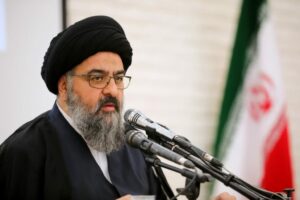
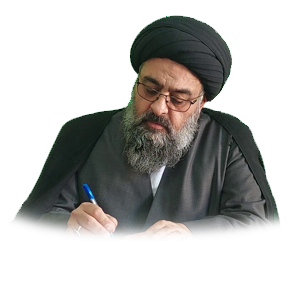
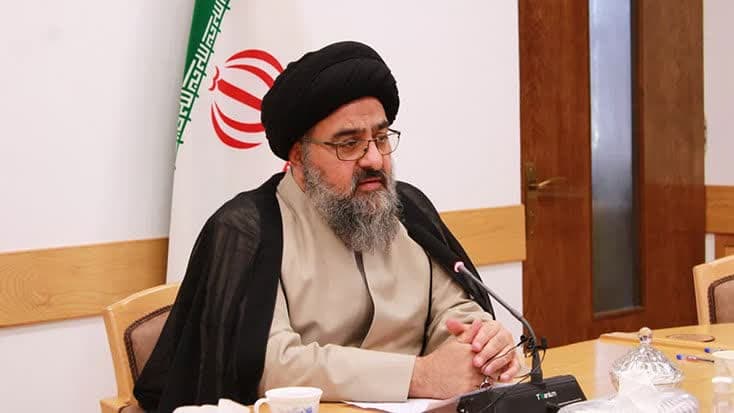
Ayatollah Seyyed Mojtaba Nourmifidi, professor at the Qom Seminary, told Jamaran: “I believe it is somewhat necessary for the seminaries to attach more importance to the aspect of ethical training, and no one should assume that because they carry a national or revolutionary duty on their shoulders, this serves as a permit to, God forbid, disrespect the Maraji’ and scholars. This is incompatible with the teachings and conduct (sirah) of the Ahl al-Bayt (a.s.), with what we have heard from the great masters of ethics in the seminaries, and with what we have witnessed from our own professors.”
What is your opinion regarding the recent stance of Grand Ayatollah Safi Golpayegani concerning relations with countries around the world?
Principally and naturally, throughout history, the Marja’iyyah has always been the base and sanctuary of the people, religion, the country, and the defense of the interests and expediencies of Islam and Muslims. In fact, as those who are familiar with history admit, we can clearly find and cite numerous instances where at critical and sensitive junctures, the Maraji’ performed their historical role. To preserve Islam, the country, and the general interests of Muslims, they utter words and adopt stances that carry immense impacts and blessings.
This has always been a clear and continuous path that we have witnessed in all eras: the presence of the Marja’iyyah in matters concerning the welfare of the people and the expedience of Islam has been highly beneficial, effective, and decisive. Naturally, in the current circumstances where there are difficulties and tribulations, the expectation is that the Maraji’ always defend the people, speak of the rights of the people, and convey their reminders and advice to the officials and authorities.
Naturally, based on our familiarity with the grand Marja’, Grand Ayatollah Safi Golpayegani, he too, based on his own assessment and the necessity he felt, gave a reminder to the officials. This also has historical precedent and is not the first time that a Marja’—because they are exposed to the demands, words, and problems of the people—points out and conveys these matters to the authorities in charge and requests attention and action. Therefore, in general, we can say that what he expressed is a conduct (sirah) that the Maraji’ have always possessed, currently possess, and, God willing, will continue to possess in expressing the concerns and problems of the people.
What is your assessment of the reactions that occurred in response to his statements?
The reaction that they tried to dress in the garb of critique and criticism was, in my view, fundamentally a multi-faceted character assassination. That is, it sought to disparage the personality of this grand Marja’ due to what he had stated, and to disparage the Maraji’ as a whole. That is to say, this issue was not merely about attacking Mr. Safi, but rather points and issues were raised that targeted all Maraji’ in a sense. In that very piece, they also attempted to implicitly attack him in other aspects. Thus, it possessed an explicit disparagement, an implicit disparagement, and a general disparagement of the Maraji’ and their decision-making mechanisms.
Indeed, no matter how I reflect upon it, these attacks bore no relation to critique or criticism. No one says that one should not critique or that the duty of “Advising the leaders of the Muslims” (Al-Nasihah li-A’immat al-Muslimin) should be abandoned; no one says that one cannot politely raise objections to a statement or view of a Marja’ of Taqleed. This has also been the case in the past, where within the classes of the Maraji’, critiques and objections are raised very seriously by their students against their opinions and views. However, what one witnesses in this offensive piece bears no relation to critique or criticism at all; it was an entirely overt character assassination.
This is something that is not in the interest of the Revolution, the country, the people, or the seminary. If this firm base is shaken—even though it will not be—nevertheless, religion will face us with difficulties and tribulations in our future. Those who engage in such actions out of compassion, or, God forbid, out of ill intent, must be mindful of the losses this path and method can bring about for the country, the system, and the Revolution.
I believe that as exemplified by “But perhaps you hate a thing and it is good for you”, the support shown for Grand Ayatollah Safi by formal and informal institutions and individuals of various tastes, alongside the reaction that occurred against that offensive and entirely disparaging piece, overall demonstrated unity, cohesion, and the necessity of consensus around this issue, showing that this foundational pillar of the seminary, the system, and the country must be preserved.
Overall, I think that despite the efforts of the writer, publishers, and those who wished to pursue this line of thought, it will ultimately lead to the strengthening and consolidation of the institution of the Marja’iyyah. God willing, it will make this institution even more resolute both in defending and accompanying the people, and in defending the system and the Revolution. Because, after all, accompanying the system and defending the Revolution and the Leadership does not mean merely praising everything and endorsing everything; this is not what the Leadership itself wants either. Those who compassionately express problems, weaknesses, and defects, and wish for these problems to be resolved with wisdom and prudence, are the ones who are truly compassionate. One must recognize that compassion and support are not limited to one-hundred-percent endorsement without expressing defects and flaws. A clear manifestation of compassion is the expression of certain problems and shortcomings so that, God willing, in light of solving these problems and resolving these shortcomings, the country, the system, and the Revolution can continue their path with greater power and firmness.
What is your analysis of the parts of Grand Ayatollah Safi Golpayegani’s statements regarding not turning one’s back on (reconciling with) many countries in the world?
It must be noted that I do not think anyone in the country intends for us to close the doors of the country to ourselves and others and have no relations with anywhere. This is not something that even if someone inwardly believed it, they could utter. In this very administration, Mr. Raisi has repeatedly emphasized, both before and after the elections, that we wish to interact and connect with the entire world except for a few countries. Therefore, I do not think anyone in today’s world believes in this turning away in the sense of a complete severance of relations, unless they are very distant and alienated from global affairs.
Presumably, his intention was that by resolving certain unnecessary problems that can be solved, some of the issues currently gripping the people can be resolved. But certainly, Grand Ayatollah Safi does not mean that we should connect with the world in a humiliating manner. He never intends for us to ignore Islamic honor and the honor of Muslims and seek relations with the world at any cost. Certainly, his intention is not for us to become dependent on major powers, for instance.
However, the discussion centers on how we can, with wisdom and prudence, resolve certain issues and problems that exist in the relations between Iran and some countries, to the benefit of the nation’s interests. With the knowledge I have, I do not believe his intention was to deny the line of resistance against Zionism. After all, I do not think he meant that Islam, Muslims, and the Iranian nation should not preserve their independence and resist the excessive demands and domination-seeking of Global Arrogance and Zionism, or that Muslims should not be supported in certain parts of the world.
Rather, what can serve as the accompaniment to this relationship is “wisdom”, “foresight”, and “intelligence”. Someone might assume that in confronting countries and powers, we should engage in slogan-mongering and act emotionally, chanting slogans in meetings and negotiations just as we do in demonstrations. This requires maturity, expert study, and precision so that we can preserve the interests of the people in these interactions and relations. This is by no means incompatible with dialogue and advancing with wisdom to preserve general interests, while simultaneously observing the three principles of “Honor, Wisdom, and Expedience” in all these relations.
Considering that the writer of this piece is apparently a graduate of the seminaries, yet insists on his statement and has written another point, in your opinion, how can we pay attention to the status of the Marja’iyyah and strengthen this position?
I have no knowledge of the writer of this piece and do not know whether he is fundamentally a graduate of the seminary or not. However, I speak principally: if someone grows and is trained in the core of the seminary, in a real and correct manner, under the ethical training of the seminary and under the guidance of the moral teachers and mentors of souls within the seminary, what is expressed in the lectures, books, and language of the moral guides of the seminary is entirely foreign to these types of behaviors.
What is expressed in the lectures of the seminary and books related to the etiquette of the seeker (Adab al-Muta’allim)—which are numerous—is that an etiquette must govern the soul of the student so that they always preserve the sanctity and respect of their professors and the professors of their professors, let alone the Maraji’, whose existence and blessed souls sustain the seminary. Even if they do not like a point or do not tolerate a statement, this respectful atmosphere has always governed the discussions, lectures, and ethical training of the seminaries.
Observe how the Imam himself behaved even toward his opponents and those who did not accept him. Sometimes some of his friends might say something regarding certain Maraji’ whose path was separated from the Imam, but the Imam would reprimand them sharply and would not permit an atmosphere of disparagement to form.
I believe it is somewhat necessary for the seminaries to attach more importance to the aspect of ethical training, and no one should assume that because they carry a national or revolutionary duty on their shoulders, this serves as a permit to, God forbid, disrespect the Maraji’ and scholars. This is incompatible with the teachings and conduct (sirah) of the Ahl al-Bayt (a.s.), with what we have heard from the great masters of ethics in the seminaries, and with what we have witnessed from our own professors. In any case, it seems necessary to make certain young students—who may engage in such behaviors out of even pure emotions—mindful.
They must be made to understand that even critique must be accompanied by its specific etiquette, and they must realize how these kinds of writings can become a tool for extensive character assassination by others, the misuses that may be made of them, and the rifts that may be created from this angle. I believe the authorities must pay greater attention to the issue of ethical training and practical ethics of the students.