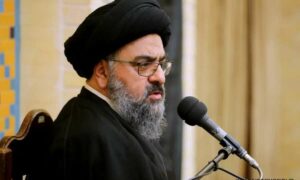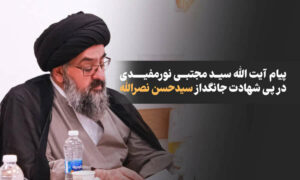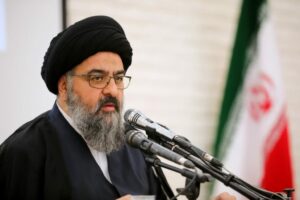
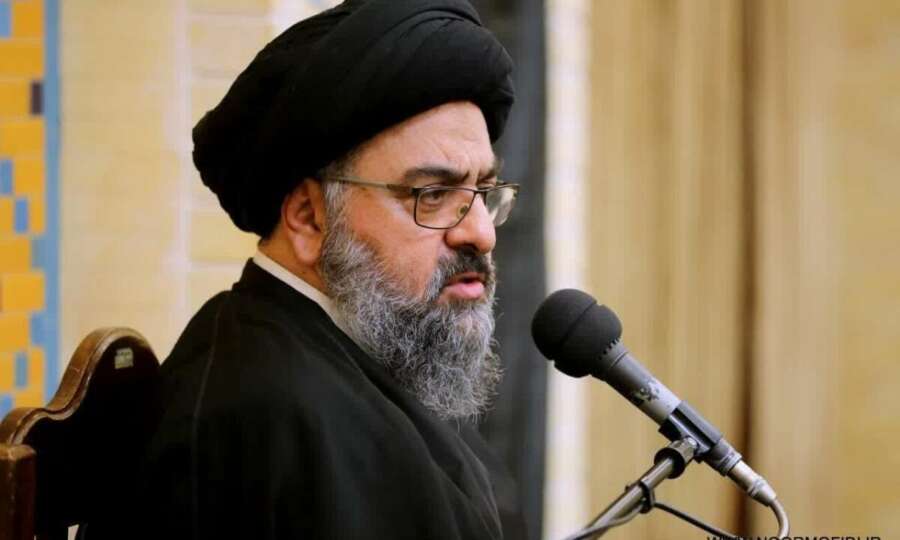
Jamaran News: Ayatollah Sayyid Mojtaba Nourmofidi, a teacher of advanced jurisprudence and principles of jurisprudence at the Qom Seminary, emphasized the necessity of realizing unity in society and said: “People must recognize one another, engage in dialogue, and choose the path that is more beneficial to the people and more compatible with their religious and cultural values.”
The full text of Jamaran’s interview with Ayatollah Sayyid Mojtaba Nourmofidi follows:
One of the subjects the Leader recently emphasized in his remarks was the need to pay attention to “national unity,” regarding which he used certain expressions. We would like to hear your view on national unity and the foundations upon which it is formed.
If we properly understand the personality of the Prophet (peace be upon him and his family) and pay attention to the various aspects of his conduct and way of life, there is no doubt that one of the loftiest manifestations of his conduct and one of the most prominent points found in the statements of the Noble Messenger of Islam is his emphasis on unity, solidarity, and cooperation in order to strengthen the foundations of society and weaken and neutralize the enemies’ plots.
The subject of your remarks and question has a clear connection with the Prophet’s mission. Union and unity are extremely important not only in the order of divine legislation but also in the order of creation. By comparing the order of divine legislation and the order of creation in various discussions, some great Islamic thinkers draw certain conclusions regarding various matters. One of these concerns the unity, cooperation, and common direction of the components of the universe, without which the order of the universe would collapse.
The order of creation is therefore founded upon the components of the universe moving together toward a specific objective. In the order of divine legislation as well, unity has always been presented as an unchangeable component in all divine religions, heavenly scriptures, and the counsel of the prophets. In Islam, the roots of unity must be sought in the Qur’an. When we say that the roots of unity lie in the Qur’an, it means that unity is unchangeable; it is neither incidental nor a tactic, but rather a strategy.
In Islamic narrations and the statements of the Prophet and the Infallible Imams (peace be upon them), much has been said about unity. They have both emphasized the principle of unity and pointed to the harmful consequences of division, fragmentation, and conflict, the most important of which are weakness, debilitation, and the destruction of society.
This is something that human reason understands. We may even say that the recommendation of unity is an instructive recommendation; when the words of the religious authorities refer to something consistent with human reason and nature, they are guiding people toward the judgment of reason. Therefore, when a subject is of such importance, it naturally must not be disregarded by the followers of that great Prophet and those who follow the path of that eminent personality. Anyone who acts contrary to it has distanced himself from religiosity and from following the great Prophet. Unity is therefore one of the pillars of religion and the foundation of society.
Even if we set aside the history of early Islam, in recent decades, one of the important factors that brought the efforts of the late Imam and the people to fruition and led to the victory of the Islamic Revolution was unity. Without unity, the Revolution could not have achieved victory. The Imam, the people, and unity were the three important elements in the Revolution’s victory. If victories were achieved for the people, the Revolution, and the Islamic Republic during the early years of the Revolution and the Sacred Defense, they were achieved under the shelter of unity. Wherever unity and solidarity grew stronger, they produced brilliant results, and wherever division, conflict, and hostility replaced them, we suffered defeat.
Throughout all these years, the country, the Islamic Republic, and the Revolution have faced highly significant junctures at which the enemies may have hoped that their efforts would bear fruit, but the people’s unity and solidarity thwarted all their plots. Unity is therefore not merely a need of the present day; it is a need of humanity, societies, religions, and Islam throughout all periods, and this is an evident and clear matter.
On the other hand, unity requires certain foundations, some of which have a cognitive aspect and require profound knowledge and understanding, while others have a practical aspect. Unity must therefore be considered in both its theoretical and practical dimensions.
The Supreme Leader’s emphasis on unity does not pertain only to the present time. He has always emphasized the unity of the Islamic ummah against overt and covert enemies, obscurantists, Salafists, and takfiris. In fairness, valuable work has been done with regard to the unity of the Islamic ummah.
When unity is discussed, it does not mean that everyone must set aside their beliefs or abandon their denomination. Unity has never meant that Shi‘as should become Sunnis or Sunnis should become Shi‘as. Rather, it means that people and religious denominations, while retaining their own beliefs, should recognize one another, identify their commonalities, and strengthen them. Differences, on the other hand, cause no difficulty if they are raised in scholarly discussions.
Throughout the years, the Supreme Leader has consistently emphasized unity and, in fairness, has prevented many problems.
In your view, what form should national unity take within Iran’s borders?
Within the country, national unity is an instance of the same unity I mentioned because unity has various manifestations. From the smallest social institution, which is the family, to the largest institutions, such as Iranian, Iraqi, or Islamic society, there can be no success without unity. If constant disagreement and conflict exist within a family, all the family’s energy will be wasted, its resources will be destroyed, and its talents will be lost. Neither the individuals nor the family as a whole will reach a bright destination or summit. At the national level, national unity means recognizing what the nation and Iranians have in common. The homeland, Islam, defending territorial integrity, growth and progress, curtailing foreign interference, closing the way to foreigners, and preserving independence are, for example, among the nation’s commonalities.
The Islamic Republic, which arose from the votes of the majority of the people, is certainly one of the components of national unity because the Revolution emerged from within the people. There may now be shortcomings in some of the functions and performances of the Islamic Republic and the government, but unity must fundamentally be observed. Most important of all, we must recognize the destination toward which we wish to move and bring together the forces capable of helping us reach it, despite their differing opinions, outlooks, and preferences.
I do not think that anyone who speaks of unity means that everyone should think alike. This is impossible; even within a family, the thoughts of all its members cannot be made identical. What matters is that a standard should govern the regulation of conduct and interactions among individuals. If there is a difference of opinion, it should be resolved through sincere and friendly dialogue and ultimately by taking the law as the standard capable of governing conduct. Therefore, what matters in the first step is recognizing and understanding the components of unity, and in the second step, recognizing one another, accepting the diversity and variety of views and ideas, and refraining from insults, accusations of unbelief, and character assassination.
When we say that we must recognize one another, it means that we must respect those who think differently from us. Of course, I consider those who have no attachment to Islam or to the land and soil of the country separately. If someone’s slogan is that there is nothing wrong with the country being partitioned, that person cannot be engaged in dialogue, and his ranks are separate from those of the nation. Likewise, if someone—God forbid—believes that Islam is the cause of the country’s backwardness, his ranks are separate from those of the nation. This is because the overwhelming majority of the people are Muslims, love the Ahl al-Bayt (peace be upon them), believe in territorial integrity and its preservation, and care deeply about the country’s future.
People must recognize one another, engage in dialogue, and choose the path that is more beneficial to the people and more compatible with their religious and cultural values. We have no choice but unity. In my view, under the current circumstances, national unity is an undeniable necessity. God forbid, if insufficient attention is paid to it, we fear that problems may arise for the country for which future generations will reproach us.
In your view, what negative effects do mistrust and the creation of divisions among political groups have on hope and Iran’s future?
The Leader also pointed out in his remarks that differences of opinion, discussion, and debate on various issues are highly beneficial and lead to growth and flourishing. Scientific growth and progress in various fields result from debates, discussions, and criticism. New ideas are always born from debates, criticism, objections, and challenges. Had there been no criticism or objections, humanity would have remained at the earliest stages of knowledge. This also applies to social, political, and economic matters and everything related to the people’s livelihoods and lives.
Therefore, when the Supreme Leader stated that discussion and debate are beneficial, this statement was supported by great historical experience and by human reason and understanding.
Thus, if dialogue takes place in a sincere and friendly atmosphere, it will produce brilliant results. But if matters lead to hostility, or reach the point where everyone else is deemed to be on the side of falsehood while I alone possess the truth, that is different. If anyone imagines that society can be advanced through exclusion, this method is neither correct nor possible.
There is no doubt that we suffer from weaknesses and problems and that wounds exist within the body of our society. Everyone acknowledges this, and it cannot be denied. The weaknesses must be eliminated and the wounds healed. At the same time, our enemies have brought all their power into the field to confront the nation and the Islamic Republic, and there is no doubt about this either. Although the Islamic Republic’s capabilities have increased compared with the early years of the Revolution, the enemies are united in confronting the nation and the Islamic Republic. On the other hand, in certain areas we have acquired capabilities that have frightened our enemies; nevertheless, we have weaknesses and deep wounds. These weaknesses and deep wounds cannot be healed except through cooperation, solidarity, and the use of all available capacities.
The present circumstances require us to employ all our forces and capacities along a single path in order to reach the lofty summits of Islamic Iran’s progress. If, under these circumstances, anyone thinks that only my ideas, my group, and my faction can achieve this objective, that is childish and shortsighted thinking, and it is impossible. Such an approach may move matters forward for a short while, but it will lead nowhere in the long term.
We must therefore accept that different thoughts and ideas may each offer part of the solution. For this reason, we must value and respect different ideas and make it possible to utilize all forces and capacities. Trust also cannot be created through words alone; it must be earned in practice. If we set aside the idea of exclusion, pursue friendship and sincerity, seek to benefit from all thoughts and views, and are able to employ all believers and concerned individuals in resolving problems, there is no doubt that no harm will befall us.