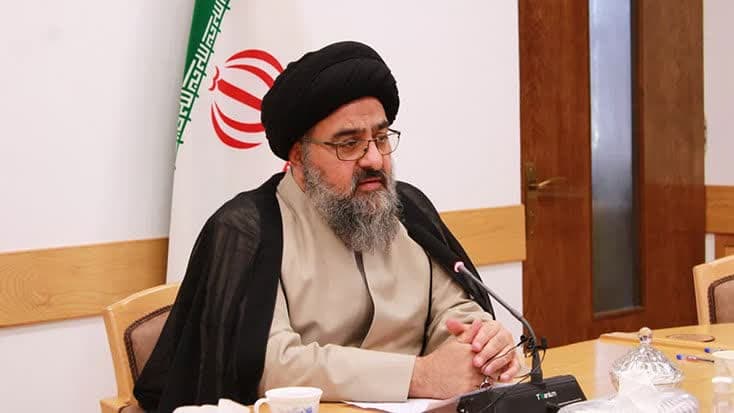
Ayatullah Sayyid Mujtaba Nur Mufidi: Imam Khomeini Has Come Under Attack Simultaneously from Multiple Fronts by Various Groups and Individuals / Popular Sovereignty and Granting a Central Role to the People Are Among the Core Principles of Imam Khomeini’s Thought / No One Wanted the War; Neither the People nor the Imam
Jamaran News Agency: You are aware that these days, Imam Khomeini has been attacked in various ways, and we witness his character being distorted in different forms. In today’s societal landscape—unfortunately manifested more visibly in cyberspace—some hold the Imam responsible as the primary source of all political, economic, and social difficulties and hardships. We would like you to address this environment: What is your proposal for confronting this phenomenon of anti-Khomeini sentiment, and what is your perspective on this matter?
Ayatullah Sayyid Mujtaba Nur Mufidi: In the Name of Allah, the Most Compassionate, the Most Merciful. I likewise extend my greetings and congratulations to you. At the outset of our conversation, I wish to draw your attention to the fact that throughout history, the character assassination of great figures, saints (Awliya), and prophets has always existed; this is not a novel phenomenon. Generally, the weapon used by the enemies of the path of truth has been the defamation and distortion of the personalities of great leaders and guides of the people. Look at the Holy Quran; it points out that almost all prophets during their prophethood and lifetimes were addressed with labels ranging from “madman” (Majnun) and “sorcerer” (Sahir) to many titles that were actually fitting for the accusers themselves.
During the era of the Noble Prophet of Islam (PBUH), we witnessed this same reality. During the era of the Imams of Guidance (AS), this practice was likewise pursued by the front of falsehood. Even after the lives of these great figures, to prevent the enduring impact of their names and memories, enemies did not abandon these behaviors. Therefore, this is a practice with a long historical precedent and deep roots. We must not assume that this is happening for the first time. If you recall, the late Imam himself alluded to some of these improper behaviors in several of his statements and messages.
Therefore, we must recognize—without, God forbid, treating it with indifference—that such actions have always existed. This is a tactic designed to diminish the influence of these great personalities; hence, it is not an unprecedented matter.
Nevertheless, it remains deeply regrettable. These days—God knows I state this without any personal bias, affection, or animosity—when I see the Imam placed in such a state of oppression (Mazlumiyyat), and how friend and foe, the knowledgeable and the ignorant, are doing an injustice to that great man from various angles, my heart truly aches, and tears sometimes flow from my eyes.
A personality who endured such bitter hardships, struggles, and tribulations over a prolonged period—solely and purely for the sake of God, to save the people from the hands of devils and foreign domination, and to liberate them from servitude to foreign powers—initiated a movement inspired by religious teachings, the Quran, the traditions (Ahadith), adhering to the conduct of the Infallibles (AS), and backed by the historical experiences of nations and this nation. That movement culminated at a specific juncture, yielding a monumental asset for this nation. If I were to speak about that period and enumerate the assets—both material and spiritual—accrued by the Iranian nation through the Revolution, it would constitute an extensive discussion. I am prepared to prove with logical evidence that if that Revolution and the event of that juncture are evaluated in their own right, the enduring impacts it produced can never be erased.
I believe that currently, unfortunately, the Imam has come under attack simultaneously from several fronts by various groups and individuals. In these current conditions—where people face hardships, economic problems, and naturally hold grievances—such assertions may align with the inclinations of some, leading them, God forbid, to accept certain fallacies. Enemies are pursuing this systematically, while others, influenced by the surrounding clamor, make statements that represent genuine injustice and unfairness.
When I state “multiple fronts,” one front consists of intelligent enemies who systematically, methodically, and according to a plan have pursued this from the very beginning and have never ceased their character assassination of the Imam through various means. Another group consists of ignorant friends, who themselves comprise several spectrums. One group opposes the Imam under the banner of defending freedom, while another group unwittingly and unknowingly attacks him under the banner of revolutionary zeal (Inqilabigari). Consequently, we face several groups that, knowingly or unknowingly, have made the Imam the target of their attacks.
To analyze each of these groups along with their motives and drivers would require an extended period. I am currently outlining the framework of the issue so that we may accurately identify the nature of these attacks against the Imam, as confronting each group requires a distinct approach. It is not so simple as to view the issue of defaming the Imam as a monolithic phenomenon and analyze it within a simplistic framework. This summarizes the attacking side, which comprises three categories.
Regarding the nature of the attacks, they target both core principles (Mabani) and applications/structures (Banaha); they seek to undermine the core principles while simultaneously demolishing the structures built upon them. Unfortunately, both types of attacks are advancing within the field mapped out by the enemy; some individuals play that role without even realizing it.
Regarding core principles, several of the Imam’s established principles have recently come under criticism and attack. I am not opposed to criticism; critique in itself is unobjectionable. However, critique follows rules and frameworks. If someone wishes to critique, they must do so fairly. Some of the points currently raised fall entirely outside the rules of legitimate critique. When you intend to critique a theory, you must address the core principles of that theory.
I maintain that all of the Imam’s established principles are derived from religious teachings, the text of the Quran, and the traditions (Ahadith). For example: the principle that religion without a social dimension possesses no meaning or concept; that religion is inseparable from governance—which is the theory of Wilayat al-Faqih; that freedom is a fundamental pillar of the Imam’s intellectual foundation; and that popular sovereignty (Mardumsalari), valuing the people, and affording a central role to the populace are integral to the Imam’s thought.
The Imam possessed a coherent system of thought that must be properly understood. Today, we observe these principles coming under attack and distortion from two directions: both the popular sovereignty emphasized and cherished by the Imam is distorted through various means, and the theory of Islamic governance and Wilayat al-Faqih is targeted. One group, under the banner of defending freedom and portraying religious governance as incompatible with human rights, targets these core principles. Another group, under the banner of religiosity and revolutionary zeal, attacks the popular sovereignty advocated by the Imam and the other pillar of the Revolution, namely freedom, whether intentionally or unintentionally. These attacks manifest in both theoretical and practical dimensions.
Jamaran News Agency: What should be done to confront these types of attacks?
Ayatullah Sayyid Mujtaba Nur Mufidi: In confronting these attacks from a theoretical perspective, enlightenment (Roshangari) is the sole path forward; comprehensive explanation (Tabyin) is truly the only remedy. In my view, the Supreme Leader has consistently exerted immense effort in explaining the theoretical principles of the Imam, utilizing every opportunity to articulate these foundations. We cannot act selectively toward the Imam’s thought, accepting one principle while discarding another—becoming among those who “believe in part and disbelieve in part” [Quran 4:150].
In my assessment, there has been a shortcoming in explaining these principles; they have not been adequately articulated or presented in a manner suited to the inclinations of the new generation. The intellectual principles of the Imam and the Revolution have not been reproduced as they should be using modern discourse. These principles must be reproduced through modern discourse, and objections must be answered.
From a practical standpoint, we must ensure that our actions and behaviors align to the greatest extent possible with those principles and goals. Where an error occurs, it must be corrected, because improper behavior fundamentally undermines the principles at their root.
Jamaran News Agency: Let us address the second type of attacks.
Ayatullah Sayyid Mujtaba Nur Mufidi: Regarding the second category—namely, attacks on the applications/structures (Banaha), on what was built upon those principles, and on certain historical events and statements we have witnessed over the years—it appears that to analyze specific decisions and actions, one must first consider the temporal context (Zarf-e Zamani) before passing judgment.
For someone to present a historical event to the public based on two superficial pieces of evidence, while distorting the truth, and framing it as an error or the root of all problems is profoundly unfair. When we witness certain individuals asserting through distortion and inversion of reality that, for instance, statements made by the Imam at the beginning of 1359 [1980 CE] caused the outbreak of the war, it is truly regrettable, and one feels deep sorrow that such a grave injustice is committed against the Imam.
Many recall how, after the Revolution, Saddam—instigated by the superpowers of the East and West—ignited the flames of war against a fledgling revolution and a country that had not yet recovered from those traumatic events. To now present this matter differently to two or three generations that did not witness or study those events—to the grandchildren of martyrs who sacrificed their blood to preserve this country, Islam, and the Revolution—and to create ambiguities in their minds in such an unfair manner is unacceptable. I do not deny that an individual in some corner may have committed an improper act; however, the overall trajectory of the country was not directed toward confronting such a crisis. The war was the product of planning by those who had suffered severe damage from the victory of the Revolution—powers whose greedy hands had been severed. For us to distort this reality so simplistically is unacceptable. In my view, Almighty God will hold accountable those who instill these doubts.
A misconception (Shubhah) is distinct from a genuine question. While “shubhah” is sometimes used to mean a question, according to the statements of the Commander of the Faithful, Imam Ali (AS), in Nahj al-Balaghah, a shubhah occurs when an individual dresses an invalid and false matter in the garb of truth, embellishes it, and presents it to the public. Today, many of these individuals present false matters under the guise of truth in an embellished and deceptive form. In these environments, you observe certain crowds cheering and applauding, which unfortunately encourages them to persist on this erroneous path.
Jamaran News Agency: You are aware that even the Freedom Movement (Nehzat-e Azadi), which opposed the continuation of the war, never considered Iran or the Imam to be the initiator of the war.
Ayatullah Sayyid Mujtaba Nur Mufidi: Yes, that was merely one example. Numerous instances exist that these individuals have disseminated across society in the form of misconceptions. Anyone who seeks to analyze issues as an analyst, scholar, or claimant of seminary education must be familiar with the analytical tools required. They must consider multiple factors: the temporal context of the event, the gathering of all evidence, and the reality that sitting back today to comfortably judge by asking, “Would it not have been better if the war had not occurred?”
Indeed, had it not occurred, it would have been better. However, the term “Imposed War” (Jang-e Tahmili)—which has been used for all these years by the Imam himself, subsequently by the Supreme Leader, and by everyone else—must be properly analyzed. When we say “Imposed War,” its dimensions must be clarified: Why do we say imposed? “Imposed” means that no one wanted this war; neither the people wanted it nor were they prepared for it at that time, nor did the leaders of the Revolution or the Imam want it. At that time, everyone was focused on managing the newly established conditions and initiating the material and spiritual reconstruction of society following the Revolution. Look at the vast assets lost in this war; all of this was an imposition. The Eastern and Western global powers joined hands to bring about such a calamity.
Jamaran News Agency: Regarding the analysis of these events, what other factors can exert an influence?
Ayatullah Sayyid Mujtaba Nur Mufidi: A crucial point is to ensure that we are not, God forbid, influenced by prevailing atmospheres and emotional clamor. Truly, at times, public outcry and manufactured atmospheres inadvertently push us in an unintended direction. In cyberspace and through word-of-mouth chatter among the public under current conditions—alongside the encouragement showered upon certain statements online—we must be vigilant that these forces do not drive us toward unjust judgments. I have observed instances where such clamor directly influenced individuals toward adopting these improper positions. I believe two distinct groups push others toward falling into the abyss:
-
Narrow-minded Friends: One group consists of friends who approach issues with narrow-mindedness, lacking tolerance, breadth of vision, and forbearance. We must increase our tolerance; at times, we should answer questions compassionately rather than immediately hurling accusations. We must strengthen our capacity to provide answers, increase our knowledge, and utilize contemporary tools to convince our audience. Understanding audience psychology and attending to the discourse and taste preferred by the listener is vital when conveying a truthful matter. If you present a truthful concept using improper language, it will not only fail to have a positive impact but will produce the opposite effect. Confronting a question with anger places the questioner in the position of an aggrieved party.
Certain individuals drive people away through such reactions. Neither the Infallible Imams (AS), nor the great Imam Khomeini, nor the Supreme Leader himself approach questions in a narrow-minded manner when someone genuinely seeks to discover the truth. People used to ask questions about God and the very existence of God. Ibn Abi al-‘Awja’ once engaged in a debate with one of the companions of Imam Sadiq (AS); the companion grew angry and spoke harshly to him. Ibn Abi al-‘Awja’ responded: “When I speak, question, and debate with your Imam, he never shouts at me or reacts with such anger.”
-
Social Media Clamor and Deception: The second group consists of those who, unfortunately, are led astray into the abyss by online cheering, applause, “likes,” and “follows.” Much of this digital activity is systematically directed. How do you know that this represents the views of the entire society? Yes, society certainly holds grievances and dissatisfactions, but despite these grievances, society remains sensitive toward certain statements, positions, and views. One cannot form a judgment merely by highlighting a few slogans or exaggerating a few incidents.
Regarding the claim that the Imam’s statements caused the war: examine where these online encouragements originate from, causing an individual to become overjoyed and naively believe that these commentators represent the majority of the Iranian nation. No, sir, that is not the case. We must be vigilant that this noise, cheering, and applause do not lead us step-by-step away from truth and reality, ensuring that we never, God forbid, speak merely to appease others.
Jamaran News Agency: There are other instances that have been raised as well; in any case, what must be done to confront these types of attacks?
Ayatullah Sayyid Mujtaba Nur Mufidi: Yes, these gentlemen have cited several narratives that have served as pretext for such attacks. This aligns with what I defined as misconception (Shubhah): they have taken an event from historical occurrences, cleverly embellished it, and presented it to the public under a cover of righteousness—dressing a false matter in the appearance of truth. I wish to focus on the root of these issues; I do not intend to enter into every single instance at present.
I remain convinced that analytical enlightenment (Roshangari) must be conducted regarding both principles (Mabani) and applications/structures (Banaha). Granted, enlightenment is difficult; destruction is always easier than constructing a building. I acknowledge this. Remedies must be devised for the events and difficulties that have occurred over these years, as well as the existing shortcomings; after all, one cannot remain indifferent to these matters. We must correctly understand and introduce that divine personality who acted solely for God’s pleasure and the dignity of the people. Do these accusations align at all with his character? Ultimately, as the proverb states, “The virtue of the Imam was attested to even by his enemies”; the enemies of the Imam and the Revolution have all conceded to his virtue and merit.
Jamaran News Agency: What is our duty in the face of these attacks?
Ayatullah Sayyid Mujtaba Nur Mufidi: We must introduce that great personality accurately, free from personal bias, animosity, or factional perspectives, and provide enlightenment regarding his core principles. Truly, the intellectual foundations of the Imam must be articulated in both the seminary and the university using the language of today’s generation, incorporating discourse attuned to the understanding and taste of contemporary youth. In theoretical discussions, we must remain vigilant not to stray into unrelated domains.
The same applies to applications/structures (Banaha). In seminaries and universities, greater articulation must occur on the theoretical level. Regarding structures—namely historical events, the Islamic Republic system itself, and its various branches—informed experts must provide documented, reasoned answers. Everyone should adopt as a fundamental principle, as stated by the Supreme Leader, that this Revolution is recognized nowhere in the world without the name of Imam Khomeini, and the identity of our Revolution is inextricably bound to him.
Therefore, everyone bears a responsibility in this regard. What harm is there in establishing a set of core principles as common ground (Qadr-e Mushtarak) among all political tastes and groups—one of which is the Imam—and working together to safeguard his legacy from unwarranted distortions? May Almighty God grant us the grace to successfully fulfill this vital responsibility.
Jamaran News Agency: You alluded to breaking the negative atmosphere; however, how can we draw a distinction between the Imam and the current situation? The atmosphere needs to be cleared.
Ayatullah Sayyid Mujtaba Nur Mufidi: Generally, one must distinguish between ideals (Arman-ha) and realities (Waqai’). One of the frequent confusions occurring these days is conflating ideals with realities. If someone speaks of an ideal, it does not mean that reality currently matches that ideal. The ideal represents the destination; reality represents the point where we stand today. Naturally, in moving from origin to destination, obstacles and difficulties arise; gaps exist, and shortcomings become prominent.
We must always maintain a distinction between these two. The Imam led a revolution supported by the public, intellectuals, academics, clergy, and Marja’s (sources of emulation), establishing ideals as the destination. Those ideals remain fully intact today; they possess such inherent beauty that following the Iranian Revolution, vast numbers of people across the globe were drawn toward Islam and Shi’ism.
Realities, however, are distinct. Naturally, a portion of the shortcomings is due to the obstacles created by the enemies of this Revolution; a portion is due to our own insufficient efforts; and a portion stems from our own mismanagement.
I wish to emphasize that a gap also existed between the lofty ideals of the Prophets and the practical realities of their societies. I am not seeking to draw a direct equivalence, justify shortcomings, or make simplistic comparisons; rather, I point out that a gap similarly existed between the lofty ideals of the Commander of the Faithful, Imam Ali (AS), and the societal realities and human tools available to him. Pointing out the realities of Kufan society during that era does not diminish the standing of Imam Ali (AS). The Commander of the Faithful (AS) utilized human instruments and agents who possessed varying capacities—some were supportive, others were not; some were capable, others incompetent; some were treacherous, others sincere.
All of these factors—alongside the immense obstacles created by the Umayyads in the path of Imam Ali (AS)—caused the gap between society and his ideals to widen. In analyzing current affairs, we must similarly distinguish between ideals and realities.
Furthermore, in analyzing realities, we must be realistic, fair, and comprehensive, attributing to each factor its precise share in society’s problems. The enemy undoubtedly plays a role in creating these conditions—that is undeniable. However, we must ascertain the extent of their share while recognizing our own, identifying the root causes of each, and planning accordingly based on consultation, experience, revolutionary principles, and rigorous pathology (Asib-shenasi) to successfully continue this movement.
Jamaran News Agency: How influential is the performance of those individuals who—as noted by the grandson of the Imam—claim to defend the Imam, but rather than truly defending him, seek to use him as a justification for their own actions? How much has their performance contributed to shaping this atmosphere?
Ayatullah Sayyid Mujtaba Nur Mufidi: I addressed this previously when outlining the spectrums currently attacking the Imam, noting that these attacking groups are becoming increasingly diverse. At the beginning of my remarks, I noted that one group attacks the Imam under the banner of defending freedom and the people, while another group attacks him under the banner of revolutionary zeal.
I hold the intellectual who ruthlessly, unfairly, and self-servingly questions the Imam’s intellectual foundations equally to blame as those who attack popular sovereignty and the republican nature (Jumhuriyyat) of the system under the banner of revolutionary zeal. Both groups contribute to this problem.
As I mentioned, multiple factors play a role in society’s problems. We must examine what factors produced these outcomes: operational weaknesses, incompetence, laxity, mismanagement, and the enemy’s comprehensive efforts to weaken the Revolution and the system—all of these play a role.
Jamaran News Agency: What is the responsibility of political, academic, and seminary groups in this regard?
Ayatullah Sayyid Mujtaba Nur Mufidi: I have addressed this as well. The primary responsibility is achieving a precise understanding of the Imam’s intellectual and theoretical foundations. The Imam’s intellectual foundations must be accurately identified and understood; this is paramount. His core principles are not inaccessible; they are entirely clear. We can easily judge between someone who claims the Imam believed public votes were merely ceremonial and someone who asserts that the Imam considered public votes to be the core axis and foundation of the Islamic system, determining what the Imam’s true thought was. Thus, an accurate understanding of the Imam’s intellectual foundations is essential.
The second responsibility is articulating these principles (Tabyin). Seminarians and academics must properly articulate these foundations and explain them to the new generation in a manner attuned to their preferences and modern discourse.
The third duty is vigilance and alertness to ensure that those principles and ideas do not fall victim to distortion (Tahrif) and unwarranted innovation (Bid’ah).
A key responsibility for seminarians and academics is maintaining the distinction between ideals and realities. At times, critics broadcast a speech by the Imam from 1357 [1979 CE], prior to the Revolution, highlighting what he stated then and claiming, “This did not materialize.” Many statements made by the Imam represented his ideals and aspirations; however, the issues currently criticized represent practical realities that stand at a distance from those ideals. Whether we have moved closer to or further from an ideal depends on various factors.