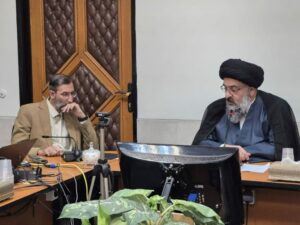

Ayatullah Sayyid Mujtaba Nur Mufidi: Today, profound questions are raised in the realm of film and cinema as primary instances of art, requiring specialized examination. Contemporary questions are no longer limited to whether a woman’s face or attire can be depicted in a manner inconsistent with religious standards, or whether a male makeup artist can apply makeup to a woman and vice versa. Questions extend far beyond these simple matters. These challenges must be thoroughly examined within the Jurisprudence of Art and the Philosophy of the Jurisprudence of Art.
Publisher’s Note: Emerging branches of jurisprudence appear to have experienced accelerated growth over the past two decades. Jurisprudence scholars have arrived at an unwritten consensus that modern human issues must be addressed through the discipline of jurisprudence (Fiqh). One of the most essential requirements for establishing an emerging branch of jurisprudence and enabling the resolution of its issues is formulating its specialized jurisprudential rules (Qawa’id Fiqhiyyah). We interviewed Ayatullah Sayyid Mujtaba Nur Mufidi—Professor of Advanced Jurisprudence and Principles of Fiqh at the Islamic Seminary of Qom and author of numerous books in contemporary jurisprudence—regarding the specialized rules of the Jurisprudence of Art. However, the President of the Research Institute of Contemporary Fiqh focused primarily on explaining art and establishing a precise definition of the Jurisprudence of Art. At the conclusion, he shared key observations regarding the specialized rules of the Jurisprudence of Art and the general approach to these rules in resolving art-related jurisprudential issues. The full text of the interview with this Professor of Advanced Jurisprudence at the Islamic Seminary of Qom follows below.
Question: What is the Jurisprudence of Art (Fiqh-e Honar), and in what respects does it differ from similar branches of jurisprudence, such as the Jurisprudence of Media, the Jurisprudence of Communications, and the Jurisprudence of Cyberspace?
Ayatullah Sayyid Mujtaba Nur Mufidi: To define the Jurisprudence of Art, we must first understand art itself. The definition of jurisprudence (Fiqh) is clear; however, art is a concept surrounding which vast disagreement exists—a concept whose definition is perhaps easy to perceive yet difficult to formally delineate (Sahl wa Mumtani’).
Perspectives vary widely: from those who define art as an internal state or quality, a body of knowledge, or a work produced by human beings, to those who view the core disagreement as lying in whether art is inherently purposeful or non-purposeful. That is, the category of art is disputed from several dimensions. Some consider art to be a science or form of knowledge; some perceive art as an internal psychological state (Halat-e Nafsani); and others regard art as an action or conduct originating from a human being.
Consequently, defining the Jurisprudence of Art based on differing definitions of art will yield distinct conclusions. If we assert that art belongs to the domain of knowledge and cognition, the question arises whether jurisprudence—as a discipline articulating the legal rulings governing the conduct of duty-bound individuals (Mukallafin) across various spheres—can even purport to express the ruling for a dimension of human existence that falls within the realm of cognition and knowledge. Thus, we must examine whether a normative position can fundamentally be adopted toward knowledge itself.
Or, for instance, if we consider art to be an internal state, can jurisprudence fundamentally maintain a position regarding internal, heart-based actions (A’mal-e Jawanih), or is it restricted solely to external, physical actions (A’mal-e Jawarih)? Therefore, given the existing disagreements in defining art, establishing a precise definition of the Jurisprudence of Art is difficult unless we extract a common denominator (Qadr-e Mushtarak) from these definitions, or focus and agree upon one of the necessary implications and effects of art, and subsequently define the Jurisprudence of Art.
Furthermore, modern art has become entirely distinct from traditional and authentic art. It is undeniable that art is innate to human nature; human beings naturally love beauty, a reality affirmed by Almighty God:
“إِنَّ اللَّهَ جَمِيلٌ يُحِبُّ الْجَمَالَ”
“Indeed, Allah is Beautiful and loves beauty.”
Therefore, we do not exaggerate if we state that art is innate to human existence, and humanity has continuously attempted to leave behind works characterized by the highest aesthetic quality—whether in the form of poetry, music, specific prose, painting, or sculpting. This is a phenomenon possessing an ancient historical precedent, making it innate to human history. Even today, when archaeologists discuss discoveries pertaining to ancient eras, there is scarcely an instance where, alongside discovering artifacts related to human life in the past, they do not uncover an artistic work—such as aesthetic dimensions in clothing, attire, utensils, and personal ornaments.
It can perhaps be stated that in the contemporary world, modern art has transformed, acquiring specialized branches and manifesting a distinct character. For instance, certain Western scholars during a specific period emphasized the notion that art must be entirely devoid of religious and moral objectives—namely, the theory of “art for art’s sake” advocated by some.
When this assertion is placed alongside the statement of Ibn Sina in Al-Isharat—where he asserts that the benefit of art is to transform the commanding self (Nafs-e Ammarah) into the reassured self (Nafs-e Mutma’innah), and that true art elevates human imagination toward sacred domains, liberating it from psychological illusions—the vast gap separating these two perspectives becomes manifest.
Among certain Islamic thinkers, we observe perspectives extending beyond even this: specific orientations that articulate a defining characteristic or attribute of art. The purpose of citing this point is to illustrate that in defining art, we face a broad spectrum of views and theories. If we intend to define the Jurisprudence of Art based on these differing opinions, we must formulate definitions for the Jurisprudence of Art parallel to each definition offered for art itself.
However, setting aside this point, and regardless of whether art should be recognized through articulating its conceptual components, through its necessary implications and effects, or through a synthesis of both—in any case, to determine the position of jurisprudence in this regard, we proceed on the premise that art is a manifestation of man’s internal states that expresses itself in the form of an action.
Given these preliminary points and existing disagreements, if we seek to present a general, nominal definition (Sharh al-Ism) that establishes a distinction between this branch of jurisprudence and other applied branches (Fiqh-e Madaf), we should state: The Jurisprudence of Art consists of the legal ruling (Hukm) pertaining to any act or behavior of duty-bound individuals (Mukallafin) that relates to a relatively extraordinary, beautiful, and perhaps unconventional work.
This is because art inherently possesses this aesthetic dimension, even if only by claim. It is an undeniable feature that an artistic work is one produced by a duty-bound individual in the form of speech or action, with or without tools. This stands distinct from ordinary human speech, behavior, and conduct. If an individual composes poetry, it naturally possesses beauty, even though beauty contains varying degrees. The creation of music, sculpture, and other branches of art established in the modern world all possess a form of beauty.
In any case, we seek to determine what legal ruling (Hukm) these works and actions hold across various dimensions from the perspective of jurisprudence and the Sharia, which articulates the legal rulings governing the conduct of duty-bound individuals.
With this definition, the Jurisprudence of Art becomes entirely distinct from the other applied branches of jurisprudence mentioned in your question. If we consider art in its broad sense, it may manifest even in how one wears clothing; that is, if someone exercises refined taste and discretion in dressing, we do not state that they have created an artistic work. In the Jurisprudence of Media, Communications, or Cyberspace, one may exercise refined taste and utilize these tools effectively; this represents art in its broad sense.
For instance, an individual in media may utilize refined taste to enhance impact—whether in advertising, news reporting, or introducing a book—naturally attracting a larger audience. A teacher instructing a class may possess an engaging teaching methodology, or a speaker’s delivery may captivate an audience. Thus, art can weave into the fabric of all dimensions of human life.
However, when we speak of “art” within the Jurisprudence of Art, we refer to art in its specialized, technical sense—that which leads to the creator of a work being recognized as its author and designated an “artist.” Thus, a teacher who manages a classroom engagingly is not termed an “artist,” even if one says they present material artistically. Therefore, the Jurisprudence of Art is completely distinct from the other applied branches of jurisprudence mentioned in the question. Art itself can naturally be present within all human activities and conduct.
While art in its broad sense can also serve as the subject of jurisprudential inquiry, the intention of this question is art in its specialized sense. The broad sense referenced, even if utilized in other domains, cannot be the intended subject of the question.
It is necessary to note that within the Jurisprudence of Art itself—even though I have attempted to present a general definition—numerous ambiguities persist regarding subject-matter identification (Mawdu’-shenasi). To properly address the category of art as an applied domain (Madaf-ilayh) of jurisprudence, our first step must be resolving many of the ambiguities surrounding this issue.
When the Jurisprudence of Art is raised, the first thing that comes to the mind of a jurisprudence researcher is to search for its background in jurisprudential treatises regarding subjects, questions, and issues. They examine the textual proofs (Adillah) and analyze subjects such as painting, depicting living versus non-living beings, vocal music (Ghena), instrumental music, and musical instruments. Then we arrive at the issue of performance/theatre, which was raised in a simple form in the past through topics such as men impersonating women and vice versa, or the mixing of genders (Ikhtilat).
However, the category of art—even within these topics with historical precedent—has become completely different from the past. For instance, music and vocal music (Ghena) have undergone genuine transformations. The questions raised on these matters today are entirely different. Relying merely on the simple questions raised in the past to structure the network of issues (Shabakeh-ye Masa’il) for the Jurisprudence of Art across various dimensions, expecting to answer modern issues through them alone, is not particularly fruitful.
Most writings and issues raised regarding art approach the topic through those simple historical questions. Conversely, if serious work is to be conducted in the Jurisprudence of Art, dispelling ambiguities surrounding art and its various branches, understanding its subject matters, and enumerating modern questions are essential first steps.
Today, profound questions are raised in the realm of film and cinema as primary instances of art, requiring specialized examination. Contemporary questions are no longer limited to whether a woman’s face or attire can be depicted in a manner inconsistent with religious standards, or whether a male makeup artist can apply makeup to a woman and vice versa. Questions extend far beyond these simple matters. These challenges must be thoroughly examined within the Jurisprudence of Art and the Philosophy of the Jurisprudence of Art.
Question: Could you cite a few examples of these new questions and challenges in the Jurisprudence of Art?
Ayatullah Sayyid Mujtaba Nur Mufidi: Cinematic art possesses immense importance, and the integrity of this art dictates that when depicting the life of a husband and wife inside a home, the wife would naturally not wear a hijab before her husband, or specific emotional interactions must exist between them. Or, to ensure that the conclusion of a performance, film, or story conveys its moral message effectively, we are compelled to portray certain dimensions of a negative character, some of which may be religiously or morally improper. Is such depiction permissible from a jurisprudential standpoint?
This question extends far beyond the simple questions of the past. Citing this example illustrates that the issues artists confront today are vastly broader than in the past, requiring greater dialogue, mutual understanding, and a shared comprehension of subject matters to prove fruitful.
My point is not that wherever human society drifts, we should passively follow in that same direction—for in that case, after a short period, no trace of jurisprudence or religious rulings would remain. Rather, my point is that mutual understanding and reciprocal comprehension must exist, specialized subjects must be fully understood, and these topics must not be approached through a simplistic lens.
In the Jurisprudence of Art, these subjects must be carefully addressed.
Question: What are the specialized rules of the Jurisprudence of Art? Could you name a few rules?
Ayatullah Sayyid Mujtaba Nur Mufidi: Within the realm of jurisprudential rules (Qawa’id Fiqhiyyah), our hands are by no means empty regarding the application of rules within the Jurisprudence of Art. My assertion is that if our proofs—the Quranic verses and traditions (Ahadith)—are re-read and re-examined, they will assist us immensely.
At times, I sense that some individuals insist in their statements and writings that we must rely exclusively on general rules. Indeed, rules are applicable in many instances. Rules such as the Prohibition of Assisting in Sin (Hormat-e I’anah ‘ala al-Ithm), the Rule of the Negation of Authority (Qa’idat Nafy-e Sabil), or the Rule of Enforcement (Qa’idat al-Ilzam), among others, possess prominent utility across all applied branches of jurisprudence. However, one must not overlook the generalities (‘Umumat), absolute textual proofs (Itlaqat), and specific proofs (Adillah Khassah) cited to establish the prohibition of certain artistic dimensions.
For example, in the debate on vocal music (Ghena), instrumental music, sculpting, or painting, the late Shaykh al-Ansari addresses certain opinions, such as that of Muhaqqiq Sabzawari, who notes regarding specific traditions addressing Ghena that it is not improbable to interpret them as applying to specific, context-bound practices existing at that time. Thus, those proofs were primarily directed at usages prevalent during that era.
Similarly, the late Imam Khomeini notes regarding sculpting that the prohibition on this matter was due to the fact that statues were worshiped as idols during that period. Attending to the fact that textual proofs were issued within a specific temporal context and directed at those specific conditions can prove highly illuminating for us.
I do not mean to claim that every proof prohibiting an artistic work was necessarily confined to its era; rather, we must re-examine and re-read textual proofs from this analytical perspective and evaluate subject matters under modern conditions. Ultimately, even if these subject matters have not changed in their outward appearance, they have been placed within complex modern equations.
Therefore, the influence of time and place (Zaman wa Makan) in the exercise of Ijtihad is a critical issue that some view only superficially. However, the matter is far deeper than that. In my view, the textual proofs (Adillah) we possess are fully capable of examination and, alongside jurisprudential rules, can assist us immensely.