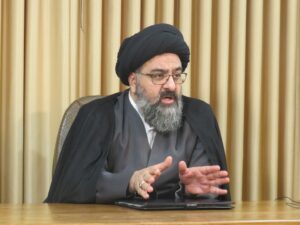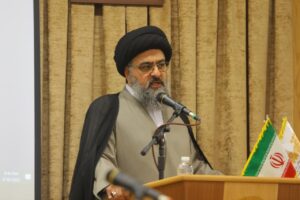

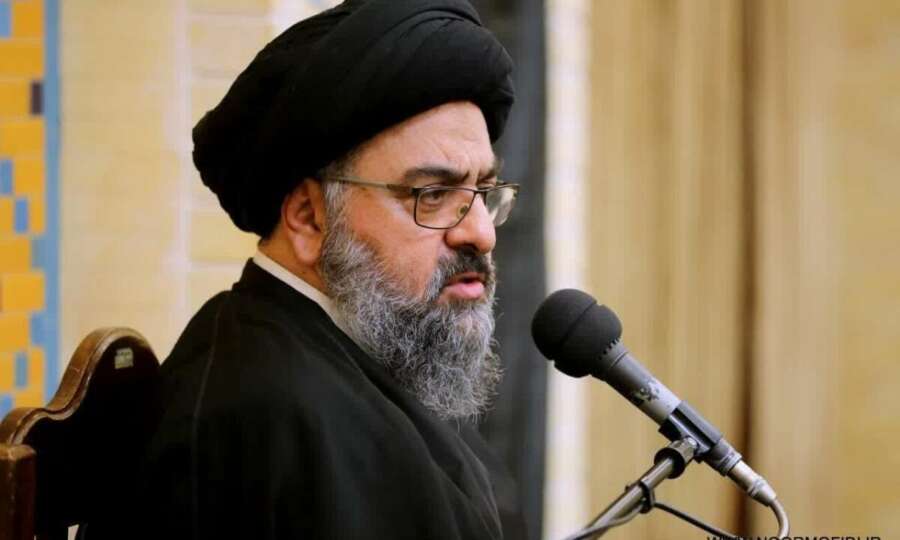
A delegation of seminary professors and preachers from Iraq visited the Research Institute of Contemporary Fiqh Studies on Monday morning, January 5th [15th of Dey], to familiarize themselves with the institute’s activities.
During this meeting, Ayatullah Sayyid Mujtaba Nur Mufidi, President of the Research Institute of Contemporary Fiqh, outlined the contemporary imperatives and needs of Islamic seminaries and preachers, stating: “The mission of preachers in contemporary society is exceedingly grave. The statement of Imam Hasan al-Askari (peace be upon him), who said:
“اتَّقُوا اللهَ وَكُونُوا زَيْنًا وَلا تَكُونُوا شَيْنًا، جُرُّوا إِلَيْنَا كُلَّ مَوَدَّةٍ، وَادْفَعُوا عَنَّا كُلَّ قَبِيحٍ، فَإِنَّهُ مَا قِيلَ فِينَا مِنْ حُسْنٍ فَنَحْنُ أَهْلُهُ، وَمَا قِيلَ فِينَا مِنْ سُوءٍ فَمَا نَحْنُ كَذَلِكَ”
“Fear Allah and be an adornment [for us], and do not be a disgrace. Draw every affection toward us, and ward off every ugly thing from us; for whatever good is said of us, we are worthy of it, and whatever evil is said of us, we are not as such.”
must continuously serve as the guiding principle for all our activities.”
He described the fulfillment of the mission resting upon the shoulders of scholars and preachers as contingent upon two dimensions: scientific and practical. He stated: “The first stage of the scientific dimension is attaining a correct understanding of religion and the school of the Ahl al-Bayt (peace be upon them). Although achieving this level of understanding is a difficult task, the people of the world expect religious teachings to be presented to them without deficiencies or unwarranted additions. Achieving this precise understanding requires dedication, referencing religious sources and foundations, and benefiting from the presence of scholars and prominent authorities.”
Ayatullah Nur Mufidi added: “The next stage of the scientific dimension of our mission is introducing this school of thought to the world without reduction or addition. Naturally, the preferences, tastes, and cultures of people across different corners of the globe vary significantly; however, we are not supposed to alter religion to fit these preferences. Rather, we must propagate religion based on its fundamental principles.”
The Professor of Advanced Jurisprudence (Kharij Fiqh) at the Islamic Seminary of Qom added: “The third aspect of our scientific mission is attending to the critical nature of the present era and maximizing its utilization. Praise be to Allah, with the victory of the Islamic Revolution in Iran and the leadership of the Shia Marja’iyyah in Iraq, a unique opportunity has been placed at the disposal of Islamic seminaries to articulate the school and tradition of the Ahl al-Bayt (peace be upon them) in the best possible manner.”
He enumerated Islamic unity and affection among the public and scholars as another scientific dimension of the seminary’s mission, stating: “Discord and enmity among Islamic schools of thought (Madhahib) and among internal Shia trends lead to loss, squandering opportunities, and draining the energies of religious preachers. As Imam Khomeini, the Supreme Leader, and the grand Marja’s of Iraq have repeatedly emphasized, unity among Islamic schools of thought and cohesion among internal Shia currents shatter the plans and schemes of the enemies.”
He added: “In this same line, recognizing the enemy and their schemes to create religious division among Muslims and within Shia ranks is an essential matter. Presently, we witness the activities of deviant sects within religious society and among believers, which must be identified and confronted in their proper context.”
In the second part of his address, Ayatullah Nur Mufidi examined the practical dimensions of the mission of scholars and preachers, stating: “The primary practical method for fulfilling the divine mission entrusted to us is understanding and practicing the lifestyle and practical conduct (Seerah) of the Ahl al-Bayt (peace be upon them). Today, the greatest struggle (Jihad) is explaining the Seerah and lifestyle of the Ahl al-Bayt in their living and interactions with people across various moral, devotional, social, economic, and other aspects of life. Naturally, the crucial point in this regard is for scholars and preachers to precede others in practicing the lifestyle and conduct of the Ahl al-Bayt, which ultimately leads to fulfilling their recommendation:
“كُونُوا لَنَا زَيْنًا وَلَا تَكُونُوا عَلَيْنَا شَيْنًا”
“Be an adornment for us and do not be a disgrace upon us.”
He added: “Unfortunately, on some pulpits (Manabir), we witness preachers searching for extraordinary miracles and supernatural deeds (Karamat) of the Ahl al-Bayt, whereas their most significant miracle is that very religious lifestyle, which has not yet been properly articulated and introduced.”
Ayatullah Nur Mufidi referenced contemporary events within the Islamic community, stating: “The Infallible Imams (peace be upon them) were defenders of truth and opponents of oppression. Today, we witness human tragedies in Gaza and Palestine and the support provided to the perpetrators by Western nations and the United States. The true Seerah of the Ahl al-Bayt in such matters was supporting the oppressed and unifying the Islamic community against the oppressor. We, too, must fulfill our grave historical mission and duty, demonstrating practical adherence to the school of the Ahl al-Bayt.”
Following his address, several guests raised questions regarding the topic and scope of Contemporary Fiqh and specific activities of the research institute, which Ayatullah Nur Mufidi answered.
It is worth noting that prior to this meeting, the guests toured various departments of the institute, including the scientific research groups, the library, and the Encyclopedia of Contemporary Fiqh, becoming acquainted with their activities.