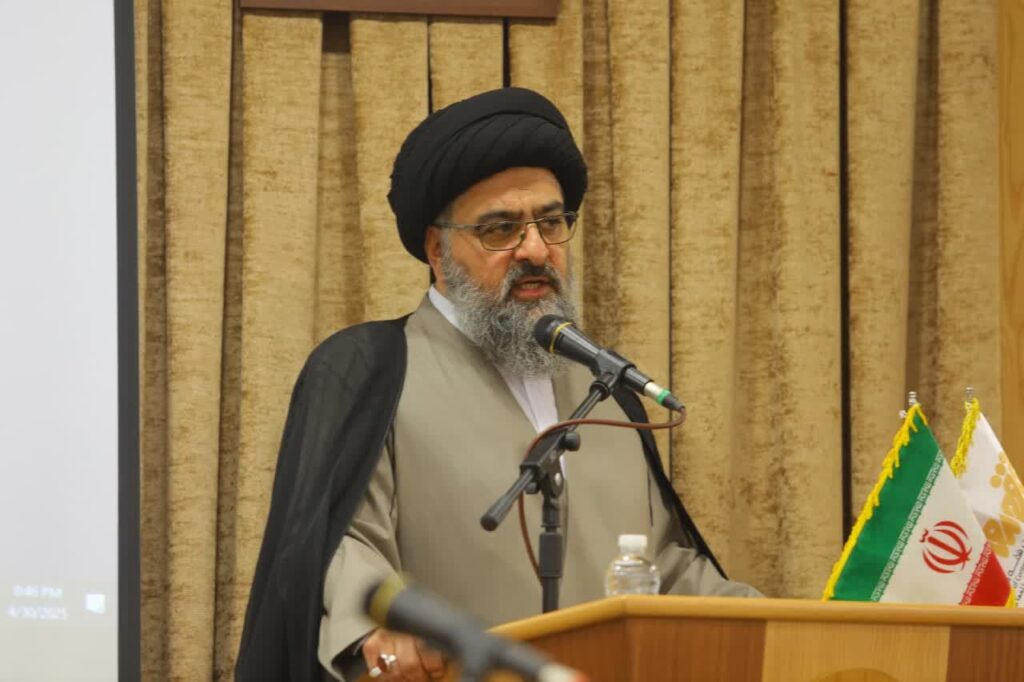
Pointing to the view of the martyred Leader of the Revolution regarding the importance of the unity of Islamic countries, the President of the Research Institute for Contemporary Jurisprudence noted: His emphasis was that Islamic countries must, by relying upon deep religious and cultural bonds, define new security arrangements without the intervention of extra-regional powers, so that the ominous shadow of arrogance is permanently lifted from this geography.
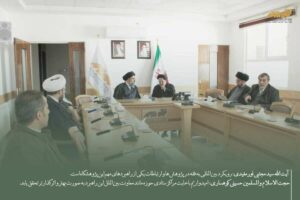
In a conversation with Shabestan News Agency in Qom Province, while offering condolences on the Arba’een [40th day] following the martyrdom of Grand Ayatullah Khamenei—whose blood breathed new life into the body of the Revolution, Iran, and the Resistance Front—Ayatullah Sayyid Mujtaba Nur Mufidi, prominent Professor of Advanced Classes (Dars-e Kharij) at the Islamic Seminary of Qom, engaged in re-reading the martyred Leader’s view regarding the importance of the unity of regional Islamic countries to expel America and the arrogant powers, stating: The martyred Leader consistently emphasized that “unity of word” (wahdat al-kalimah) is the key to victory over arrogant powers.
He continued: He believed that division among Islamic countries constitutes the greatest gift to enemies for continuing their colonial presence in the region. In the intellectual system of the martyred Leader, if the vast human, economic, and geographic capacities of the Islamic world are placed side by side, no power will possess the ability to stand against the will of Muslim nations, and this unity is an indispensable prerequisite (muqaddamah-ye wajib) for realizing the new Islamic civilization.
The President of the Research Institute for Contemporary Jurisprudence noted: In the view of the martyred Leader, America’s departure from the region was a “definitive and irreversible demand.” He viewed the presence of the United States as the primary root of insecurity, backwardness, and the creation of takfiri groups.
The prominent Professor of Advanced Classes at the Islamic Seminary of Qom continued: His emphasis was that Islamic countries must, relying upon deep religious and cultural bonds, define new security arrangements without intervention from extra-regional powers, so that the ominous shadow of arrogance is permanently lifted from this geography.
Stating that convergence between these two perspectives demonstrates that resistance and unity are two blades of a single pair of shears for severing the roots of foreign infiltration, Ayatullah Nur Mufidi said: The martyred Leader provided the platform for this coordination through his strivings, and today this path, under the wise guidance of the Supreme Leader, moves in a direction where the region advances toward sustainable, independent stability.
The Professor of Advanced Classes at the Islamic Seminary of Qom emphasized: This accompaniment and synergy heralds a new era wherein the will of regional nations will serve as the ultimate determinant of their political and social destiny.
Referring to the views of the martyred Imam regarding the usurping regime of Israel and the liberation of Noble Quds, he continued: The liberation of Noble Quds—derived from religious teachings and ideals of the late Imam, which he consistently emphasized throughout his leadership—demonstrates a profound intellectual system wherein the Palestinian ideal was viewed not as a political tactic, but as a “religious conviction” and “human obligation.” He believed the Palestinian issue is the first and immediate issue of the Islamic world, and no other matter should dim this priority in the mind of the Islamic Ummah.
Ayatullah Nur Mufidi continued: From the perspective of the martyred Leader, the geography of Palestine is indivisible. He emphasized the strategy of “From the Sea to the River” (from the Mediterranean Sea to the Jordan River), rejecting any plan seeking to divide this land or construct a micro-state in a corner of it. In his view, the entire soil of Palestine belongs to Palestinians, and Noble Quds will remain the eternal, unalterable capital of this Islamic country.
The Professor of Advanced Classes at the Islamic Seminary of Qom noted: He termed the Zionist regime a “cancerous tumor” and a “false, artificial appendage” planted in the heart of the Islamic world with the goal of creating division and arrogant dominance. One of his most famous positions was predicting the decline of this regime: he believed that based on divine customs (Sunnan) and owing to its countless oppressions, this regime will not endure and possesses no future in the region’s geography.
Stating that in explaining the solution, the martyred Leader emphasized the twin arms of “resistance” and “revolutionary diplomacy,” he said: He viewed the sole real path of salvation as field resistance and strengthening combatant groups, repeatedly declaring that negotiations with usurpers yield nothing but loss and retreat. Alongside resistance, he presented a democratic, logical initiative to the world: conducting a referendum among all original Palestinians (Muslim, Christian, and Jewish) to determine their political system, demonstrating Islam’s just vision regarding human rights.
The Professor of Advanced Classes at the Islamic Seminary of Qom added: Ultimately, faith in “divine assistance” (nusrat al-ilahiyyah) and the “inevitability of victory” formed the primary core of his words throughout all these decades. The martyred Leader consistently offered glad tidings with heartfelt conviction that Quds will be liberated, and offering prayer in Al-Aqsa Mosque is a dream realized through the strivings of the Islamic Ummah and awakening of nations. He viewed the liberation of Quds as the key to resolving the problems of the Islamic world and the beginning of a new era of Islamic civilizational glory.
The President of the Research Institute for Contemporary Jurisprudence also engaged in re-reading the Supreme Leader’s view regarding the importance of the Resistance Front and the role of resistance in advancing Islamic goals and regional security, adding: In my view, the new Supreme Leader—who was trained and nurtured by the martyred Leader—regards the Resistance Front not merely as a military alliance, but as an “intellectual school” and “defensive shield” for the entire Islamic world.
The Professor of Advanced Classes at the Islamic Seminary of Qom continued: From his perspective, resistance is the sole path to counter the excessive demands of arrogant powers seeking to plunder the identity and resources of Muslim nations. Relying upon faith and self-belief, this front succeeded in altering the regional balance of power, transforming the lofty goals of Islam from a theoretical state into a field-level, influential power.
He noted: In the discussion of regional security, his view rests upon “indigenous security.” The Supreme Leader believes the presence of foreign forces is itself the primary factor of insecurity and tension. The Resistance Front, by creating a synergistic network among free nations, erected a bulwark against terrorism and foreign interventions. From this viewpoint, genuine security is realized when regional nations themselves assume responsibility for protecting their borders and interests, which is precisely the role played successfully by the resistance.