

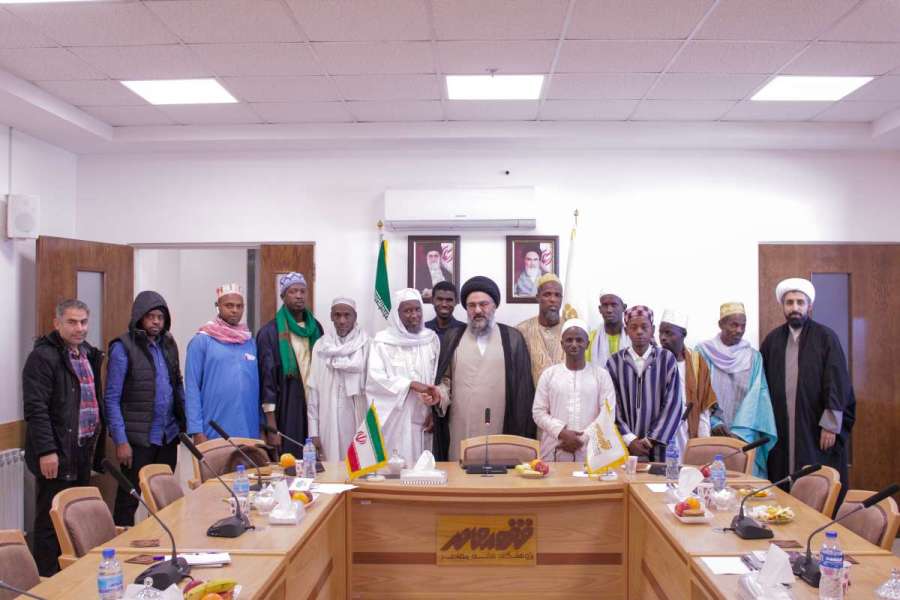
A group of Sunni religious scholars and missionaries from the country of Guinea-Bissau today, by attending the Contemporary Jurisprudence Research Institute, became acquainted with the activities of this institute and met and spoke with its high-ranking president.
In this meeting, which took place on Tuesday, Bahman 16th, Ayatollah Mojtaba Nourmofidi, while welcoming the guests during the blessed days of the Fajr Decade, said: “The Islamic Revolution of Iran, under the leadership of Imam Khomeini (may his soul be sanctified), opened a new window for the relationship between Iran and Africa, and he had a special view towards connecting with and supporting the people of Africa. Currently, the Supreme Leader also has a special attention towards the people of this region.”
Emphasizing the various commonalities between the Tijaniyya order and the Shia school of thought, he pointed to the issue of the relationship between jurisprudence and mysticism and said: “Imam Khomeini, as a great mystic, has rendered great services to mysticism. Mysticism and Sufism, from the perspective of Imam Khomeini, have a positive side and a negative side. He refers to positive Sufism and the positive Sufi as a ‘pure Sufi’ (Sufi-ye Safi).”
The professor of advanced seminary courses in Qom added: “From Imam Khomeini’s perspective, a pure Sufi is someone who has brought mysticism from the level of the intellect and heart to the level of action and is committed to the Sharia. A Sufi without purity is someone who is not committed to the outward form of the Sharia.”
Ayatollah Nourmofidi added: “In general, from the perspective of Imam Khomeini, who is a mystic of the highest order, both man and religion have two realms. One is the outward and the other is the inward. The outward in man is the starting point of the movement towards the inward, and actions and rituals cause the heart, soul, and inward of man to change.”
He said: “The mutual influence of the body on the soul and the outward on the inward is something that both human experience confirms and science and knowledge have confirmed. The acts of worship and rituals that have been presented to man in the form of the Sharia are the only way for man’s spiritual and soulful interaction. Likewise, heartfelt, spiritual, and soulful states cause the intensification of ritual acts of worship. The connection of these two forms the foundation of true mysticism and Sufism.”
The head of the Contemporary Jurisprudence Research Institute added: “Imam Khomeini, who is the foremost mystic of his time, in the mystical books he has written, emphasizes one matter greatly, and that is the ‘secrets of acts of worship’ (asrar al-ibadat). In his view, if someone is a person of worship but does not pay attention to the secrets of worship, they have not derived true benefit from the reality. In his view, if someone only pays attention to the secrets of worship and is heedless of the rituals, they fall into the trap of Satan.”
He noted: “Imam Khomeini’s attention to mysticism demonstrates the deep connection between jurisprudence and mysticism from the Shia perspective. If the historical conflicts between the people of jurisprudence and the people of mysticism and Sufism are understood and known, the importance of Imam Khomeini’s work becomes more apparent. This conflict is observable both among Shia mystics and jurists and among Sunni mystics and jurists. Some jurists accused the people of gnosis and mysticism of disbelief and immorality, and some people of mysticism accused the jurists of superficiality and literalism.”
Ayatollah Nourmofidi added: “These accusations and historical conflicts have multiple factors, the main reason being the mutual lack of understanding between jurists and mystics of each other’s views. This important issue, along with a lack of forbearance and low tolerance, would cause enemies to also fuel these conflicts. In such an atmosphere, Imam Khomeini (may his soul be sanctified) carried out several important tasks, which are considered a great service to Islam, Islamic knowledge, and scholars. First, Imam Khomeini strove so much in the pursuit of jurisprudence, mysticism, philosophy, and other sciences that he became the foremost scholar of his time. Imam Khomeini’s jurisprudential and mystical books are among the deepest books of this knowledge.”
He added: “In these books, he tried to present the concepts under dispute, understand them, and pay more attention to the depth of these matters. Imam Khomeini, along with some jurists and mystics, warns to avoid excommunication (takfir) and declaring others immoral (tafsiq), and if you see something that is unfamiliar to you…”
Ayatollah Nourmofidi proceeded to state several points and recommendations addressed to the religious missionaries and said: “We must know the time and the needs of the people of our time, and strive to present religious and divine teachings in an attractive format and with good literature appropriate to the needs of the audience. Recognize differences in taste and strive to reach a common understanding through dialogue. Endeavor to raise your scientific level and knowledge. But most importantly, be a teacher to the people through your actions.”
At the beginning of this meeting, he referred to his presence in some countries of North and South Africa and said: “The people of Africa, regardless of religious differences, have a pure nature (fitrah), and this nature is a very suitable ground for you missionaries to convey the message of Islam to them.”