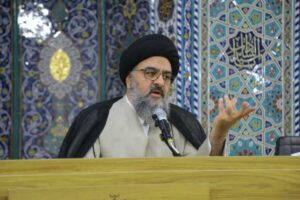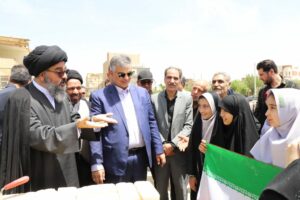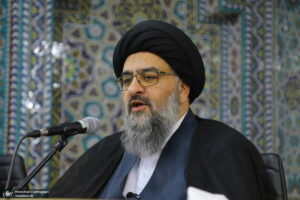
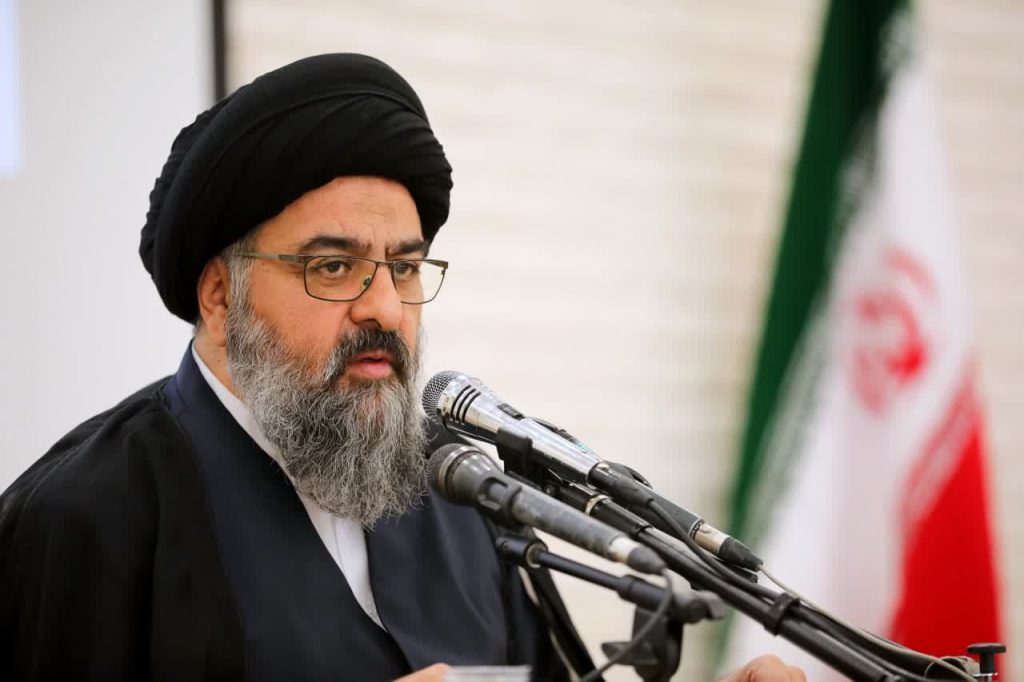
Statements of Ayatollah Sayyid Mojtaba Nourmofidi regarding the Fajr Decade in the advanced principles of jurisprudence class, Tuesday, Bahman 16, 1402
These days coincide with the Fajr Decade of the Islamic Revolution. Certainly and undoubtedly, the days of the victory of the Islamic Revolution are among the Days of God. Considering that in the year 57 (1979), great events occurred and both Islam, the people, and the country were saved from dangers, these days cannot be considered other than the Days of God. I am currently evaluating that event which occurred in the year 57, and the fact that no factor can remove the description of “Day of God” from that day. That is, even those who are apparently religious and oppose the Revolution or are indifferent to it cannot, under any pretext or reason, say that that day was not a Day of God. Ultimately, Imam Khomeini, with the accompaniment of the clergy and religious authorities and the empathy and support of the vast majority of the nation, with the slogan of “Independence, Freedom, Islamic Republic,” saved the country. Any day that cuts off the domination of foreigners over this country is a Day of God, any day that brings independence to this nation is a Day of God, any day that makes Islam sovereign over a country is a Day of God. This matter is not open to doubt. Sometimes, the repetition of phrases and slogans may cause a person to become heedless of the truth of a meaning and concept. All the criteria that can be mentioned for a Day of God apply to this event and these days. A country that was a playground for foreigners and whose rulers were the servants of foreigners, a country whose destinies were determined by others, a country whose people were humiliated, a country where the rulings of Islam were disregarded and whose people’s Islamic and Iranian identity had been destroyed—the day it is freed from these calamities, that day is a Day of God. Valuable assets were provided for this country and nation with the victory of the Islamic Revolution. This value will neither diminish nor be deniable forever. As for those who say, with all these troubles, issues, and livelihood problems, how can it be said that that day was a Day of God? I say with certainty that that day was a Day of God and will remain so. God forbid that at some point certain issues cause a person to conceal matters. Some want to discredit the very foundation of the Islamic Revolution. This truth is fundamentally not open to discrediting. The motivations, ideals, and goals that the nation envisioned for this Revolution were and are so sacred and legitimate that nothing can strip those motivations, ideals, and goals of their legitimacy.
Today, after more than forty years since the victory of the Islamic Revolution, with a fair and realistic view, it can be said that we have had both successes and failures, both victories and disappointments, both strengths and weaknesses. To consider everything entirely as success is not correct; this is self-deception. To see no weakness whatsoever—neither sound reason rules this, nor does the Sharia permit us to do so. To consider everything entirely as failure is undoubtedly also false. We must, by looking at the past and evaluating it, and with hope for the future, advance the Revolution. Fundamentally, the basis of the Supreme Leader’s “Second Step Statement” is precisely this. It has a look at the past, at the strengths and weaknesses, and it is a design for the future. It was named the “Second Step” for this very reason. In the first step, there were weaknesses and strengths. Now we must eliminate the weaknesses and turn them into strengths, and continue the path towards the future. Sometimes during these days, we encounter some statements and speeches that, perhaps due to existing problems, seek to deny the past and call the foundation of the Revolution into question. This is unfairness and, in a sense, ignoring realities, and it is certainly not compatible with religious teachings. Today we have many strengths. These must be seen and paid attention to. The authority of the country, Iran’s influence in regional and international equations—this is no simple matter. At the same time, we also have problems. Scientific advancements in various fields are undeniable, but truly, the people’s livelihood has problems—unemployment, inflation, and economic issues. All of you perceive this. Everyone knows the pressure on the people in this regard in society. The officials must think of a solution for this issue. These people have been on the scene in all the years after the Revolution. They gave their lives, they gave their wealth, they defended, they did not fall short. Wherever needed, they came to the field—in the war, in the Sacred Defense, in the defense of the shrines, in the marches, in the elections, in all arenas they were present, and truly they sacrificed their very existence in the way of the Revolution. These people deserve the best, and there must truly be planning to solve these problems. Now, the discussion is extensive, the criticisms are many. Part of these criticisms goes back to global issues, sanctions, and pressures brought by foreigners, and another part is the result of our own mismanagement and problems that we have created with our own hands.
We must strive as much as we can to solve these problems. The satisfaction of the people must be obtained. Defending the people should not be just a slogan; this must happen practically. All officials must truly consider this as a principle in their work. Honoring the Revolution involves both explaining the achievements and analyzing the weaknesses. If these weaknesses and flaws are not treated, they can create more problems. We must both give hope and warn, both give glad tidings and give admonition. These are two important principles in the call of the saints and prophets. Admonition and giving glad tidings are not only related to the Hereafter; admonition and giving glad tidings also relate to the worldly consequences of actions. This is a matter that, God willing, should be taken into consideration.
It is also necessary to pay attention to the fact that the march on Bahman 22nd is a symbol of attachment and connection with the Revolution and its lofty ideals. Everyone, with any thought and taste, must express this attachment and connection with all their might. We also honor the memory of the martyrs of the Revolution, the martyrs of the Sacred Defense, and the martyrs of the defense of the shrines. We honor the memory of the dear, great Imam Khomeini. We honor the memory of the great figures from the seminary and the clergy who labored in this path, including Martyr Motahhari and Martyr Beheshti, and the martyrs from the seminary who were martyred on the fronts and in the defense of the shrines. Martyr Soleimani, who was the master of the martyrs of the resistance, and whose name and memory are still inspiring. We honor the memory of all of them and ask God Almighty for elevated stations for them all. We hope that those who labored and strove in the way of this Revolution and its preservation are rewarded in the sight of God. May God grant success to all of us so that we can always place the defense of Islam, the school of the Ahl al-Bayt, this Revolution, and this country at the core of our work. May we make our morals kinder towards one another and face each other with good opinion and goodwill. May we preserve our unity, join hands, and strive to resolve the country’s problems and the people’s concerns. And may we pray, God willing, that the banner of this Revolution be entrusted to the blessed hands of the Imam of the Age (may God hasten his noble reappearance).