Ayatullah Nur Mufidi: Reviving the Conduct of Hazrat Zahra (PBUH) Requires a Scholarly Re-reading
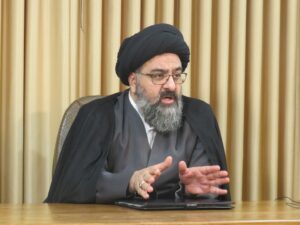
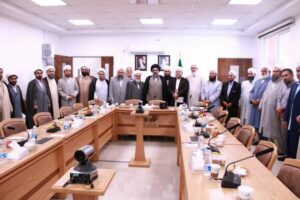
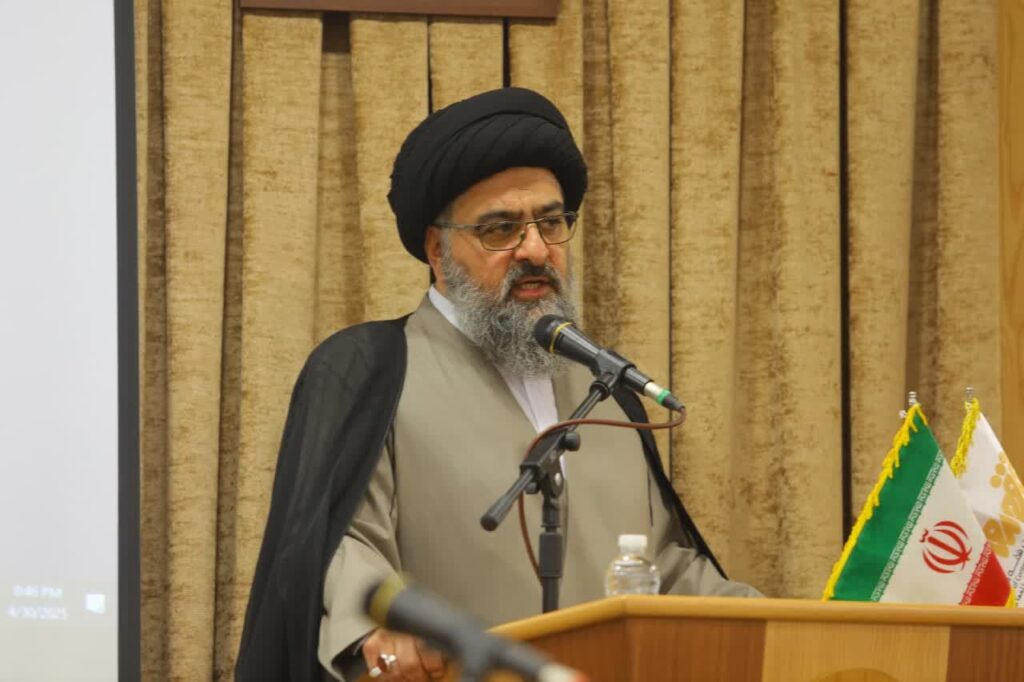
On the eve of the anniversary of the martyrdom of Hazrat Zahra (peace be upon her), addressing a gathering of Fatimiyyah preachers held on Friday afternoon, November 21, in the holy city of Qom, Ayatullah Sayyid Mujtaba Nur Mufidi stated that while the name of Hazrat Zahra (peace be upon her) is frequently heard in society, her virtues flow less in the text of people’s lives, emphasizing: “Today more than ever, we need knowledge of and modeling upon the Fatimi conduct (sirah).”
Enumerating the monotheistic, social, moral, and familial dimensions of the personality of Hazrat Siddiqah Tahirah (peace be upon her), he considered re-reading and reinterpreting these virtues for the new generation as one of the fundamental necessities of the contemporary era.
In this speech, he enumerated Tawhidi identity-building, sense of responsibility against deviation, conscious asceticism, and family ethics of Hazrat Zahra (peace be upon her) as four crucial axes in the Fatimi conduct, emphasizing: These virtues must be re-explained using understandable and practical language for today’s generation so that Islamic society may benefit from its educational, social, and spiritual effects.
The Necessity of Re-reading the Virtues of Fatima al-Zahra (PBUH) in the Contemporary Era
During these days, it is appropriate to speak a few words regarding Fatimiyyah and the precious, peerless personality of Fatima al-Zahra (peace be upon her).
The point upon which I wish to rely today—and which is exceedingly vital—is: How can we make the virtues of Siddiqah Tahirah Fatima al-Zahra (peace be upon her) an exemplar in this era and for this generation? This requires re-reading her virtues. One of the primary problems and obstacles to modeling in present times is the disconnect between the mental atmosphere of this generation and its own honors and role models. This is the product of multiple factors contributing to this rupture and discontinuity. Fatima al-Zahra (peace be upon her) is the Master of Women (Sayyidat al-Nisa’), the Veracious Lady (Siddiqah) of the Ummah: an exemplar in defending truth, in asceticism (zuhd), courage, modesty and humility, spousal companionship, child-rearing, attending to the needy and indigent, and striving to elevate awareness and raise the knowledge of people—especially women. Yet this personality has not received due attention in the text of Islamic society’s life as it ought to. Today, more than ever, we are in need of this personality; our society today needs cognition and modeling upon the life of Fatima al-Zahra (peace be upon her) more than in the past. I believe many of our problems stem from distancing ourselves from this reality and personality. Her name may flow upon tongues and her banner fly everywhere, but she is not present in the text of our lives as she ought to be. I present to you several examples of vital points in the life of Hazrat Zahra (peace be upon her) by observing which we must reform our life trajectory today and cultivate the new generation along this path:
1. Tawhidi Identity-Building
One vital accomplishment of Siddiqah Tahirah Fatima al-Zahra (peace be upon her)—like her honorable father, the Noble Messenger of Islam (PBUH), and her revered husband, the Commander of the Faithful (peace be upon him)—was Tawhidi identity-building against virtual/counterfeit identities: ensuring human beings are monotheists (muwahhid) in belief, thought, action, and conduct. The framework of the summons of all Prophets and the Prophet of Islam (PBUH) was the call to Tawhid. This point is prominent in the life of Fatima al-Zahra (peace be upon her): striving to distance society’s mind from polytheism (shirk). Polytheism was not limited merely to idol-worship and manifestations present in Arabian society at that time; following the advent of Islam and the Prophet’s mission, polytheism wore a different garb. Time does not permit explaining how polytheism re-emerged in society; one of the primary actions of the Master of the Women of the Worlds, Siddiqah Tahirah Fatima al-Zahra (peace be upon her)—standing in continuation of the Prophet’s mission and in line with the Imamate of the Commander of the Faithful (peace be upon him)—was Tawhidi identity-building. Pay attention to her statements and conduct: the beginning of every word, measure, and movement was God’s remembrance, praise, and gratitude. At the opening of the Fadakiyyah Sermon, she states: “Praise be to Allah for that which He bestowed,” subsequently pointing to the creation of this universe and how God created this world by His will. This means reinforcing Tawhid foundations and directing society’s attention away from modern manifestations of polytheism. Even in politics and defending Guardianship (Wilayah), this pillar is consistently maintained. That is, Fatima al-Zahra (peace be upon her) paid attention to both positive/affirmative and negative aspects: the positive aspect being the summons to Tawhid and recalling this belief, and on the negative side, warning that polytheism can manifest in various forms, and people must remain vigilant not to fall into polytheism.
This axis is acutely needed today; numerous virtual/counterfeit identities have formed, shaping a new human being for this generation. Desires, needs, interests, and tastes have strayed from the Origin of the universe toward another direction: material manifestations and “being seen” have transformed into a principle. This is a false need and a virtual identity. The desire to be seen has been reinforced in this generation to an extent perhaps absent in the past. The desire to be seen always exists within man—selfishness, egocentrism—seeking in various forms to place oneself as the axis. If someone lacks power, he does so in his home, exercising egocentrism, selfishness, and prioritizing himself over family. If someone holds greater power, he does so in a larger group. Many of us have not yet seen water, otherwise we are skilled swimmers! Hence you see that uncultivated individuals, when placed in public arenas, display those vices. The more self-cultivated a person is, the more value-based, moral, and religious he acts in interactions with others. In this era, we acutely need this element and utilizing this dimension of Fatima al-Zahra’s (peace be upon her) personality.
2. Sense of Responsibility Facing Deviation
The second point we can draw from the blessed existence of Siddiqah Tahirah (peace be upon her) in this era is a sense of political and social responsibility facing deviation. Fatima al-Zahra (peace be upon her), despite all constraints, spared no effort in defending truth and the Guardianship (Wilayah) of the Commander of the Faithful (peace be upon him)—not merely as his wife, but as the Guardian of God (Wali Allah). She went to the doors of the Muhajirun and Ansar, recalling truths. She did not sit idly by saying “I am a woman, a conflict has arisen, and they will resolve it themselves.” Her Eminence felt responsible before the deviation that emerged at that time: defending truth against deviation is a cornerstone of Siddiqah Tahirah’s (peace be upon her) personality. Look at what she accomplished to this end: if this axis is examined and its evidence noted one by one, we comprehend how a grief-stricken lady aged eighteen—or at most 27 or 28 according to some reports—acted. It is astonishing to man that a lady who performed maternal and wifely duties in the best manner moved dynamically in the social sphere against deviation without tiring. This holds lessons for all, man and woman alike; today’s generation must learn this lesson from Siddiqah Tahirah Fatima al-Zahra (peace be upon her)—from delivering her sermon in the mosque to approaching the doors of Muhajirun and Ansar and engaging in dialogue with companions.
3. Conscious and Honorable Asceticism (Zuhd)
The third axis is that Her Eminence, despite being the daughter of the Messenger of God (PBUH), made asceticism (zuhd) the axis of her life—a conscious and honorable asceticism. Asceticism, cited from Fatimi conduct, does not mean denying the world or rejecting world blessings, but liberation from emotional attachment and dependency. The story of her wedding incorporates both: Fatima al-Zahra’s (peace be upon her) wedding took shape with noted preparations. Naturally, a bride desires a wedding dress; a simple wedding gown was prepared. Someone might say “I do not want a wedding dress” and go to extremes. Yet when confronted with the request of a needy woman, she gave that very dress to her and wore an ordinary dress herself. This is neither world-denial nor attachment: she prepared a conventional wedding dress to wear, but when encountering someone poorer than herself, bestowed it with complete willingness rather than reluctance. After this act, women came to Fatima al-Zahra (peace be upon her) asking what happened to the wedding shirt; she stated a woman arrived with no one to attend to her, so I spent it upon her. Doing so, she expected no reward from anyone: “We feed you only for the face of Allah. We wish not from you reward or thankfulness” [Quran 76:9]. Speaking for myself, I perform nothing, and if I do, it is uncertain whether it stems from heartfelt willingness; even if willing, we expect praise and gratitude. In today’s world, this is a precious pearl needed by humanity and this generation: conscious, honorable asceticism containing neither world-denial nor attachment.
4. Family Ethics
Another axis is the family life of Hazrat Zahra (peace be upon her). In terms of social ethics and home life, she is rare or peerless: with all those heavy responsibilities and tasks performed, inside the home in motherhood and wifely companionship she is peerless; in domestic work she is peerless; in terms of ethics, bestowing character upon children, respecting her husband, respecting guests, and everything contributing to family firmness and placing a family gathering in optimal conditions, Hazrat Zahra (peace be upon her) is the model and exemplar.
These are some virtues requiring attention in the contemporary era—a generation needing them despite being surrounded by various manifestations of polytheism, materialism, and immersion in pleasures. We bear a duty to state these virtues not only for Shia, but for all Muslims and humanity.
Of course, the literature used to express these points is also vital: how we express these virtues to the current generation and era is crucial because humanity requires it. In this era, we must accurately introduce Siddiqah Tahirah (peace be upon her) to this generation, retelling and re-reading these virtues so that under their light, our lives acquire a different hue and scent. One of our paramount responsibilities and missions is stating these virtues in a manner holding educational, moral, political, and social applications in society so all may be utilized. God willing, through the blessing of this sacred existence, may Almighty God grant us the success (tawfiq) to state these virtues and enable all to apply them.