
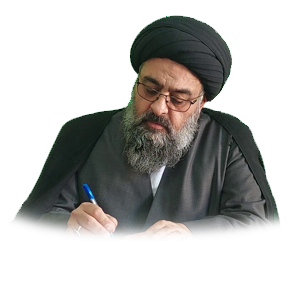
Session Twenty-Six
Preliminaries, Preliminary Nine: The Precedence of Presumptive Proofs over the Practical Principles, The Criterion for Prioritizing Presumptive Proofs, The Third View: Government, The Incorrect Attribution of al-Muhaqqiq al-Na’ini to Sheikh al-Ansari, Critique of the Third View, First Objection, Second Objection, Critique of the Second Objection
October 19, 2025
The Incorrect Attribution of al-Muhaqqiq al-Na’ini to Sheikh al-Ansari
We noted that the third view regarding the prioritization of presumptive proofs (amarat) over the practical principles (al-usul al-amaliyyah) is government (hukumah). Two formulations of government were outlined: the formulation of the late Sheikh [al-Ansari] and that of al-Muhaqqiq al-Na’ini. We briefly highlighted their common ground and their differences.
However, it is remarkable that al-Muhaqqiq al-Na’ini has attributed to the late Sheikh the view that he pursued a path other than government to explain the reconciliation between presumptive proofs and practical principles. Al-Muhaqqiq al-Na’ini, in this very section and in the chapter on equal balance and prioritization (al-ta’adul wa-l-tarjih), has attributed to the late Sheikh the view that the Sheikh considers the nature of the incompatibility between presumptive proofs and practical principles to be identical to the incompatibility between actual and apparent rulings, reconciling them through the same path used to reconcile actual and apparent rulings.
Subsequently, objecting to the Sheikh, al-Na’ini states: the criterion and basis in the case of the actual and apparent rulings differ from the criterion and basis here. This is because the reconciliation between presumptive proofs and practical principles is possible only through the path of government, not through the path proposed by the Sheikh.
Yet, the late Sheikh explicitly states in the Rasa’il that the rationale for prioritizing presumptive proofs over the practical principles is government. Yesterday, we cited the late Sheikh’s own phrasing. He explicitly states that presumptive proofs govern the practical principles. Nonetheless, al-Muhaqqiq al-Na’ini asks why the late Sheikh did not proceed through the path of government, but instead placed the issue on the scale of the incompatibility between actual and apparent rulings, proposing here the same reconciliation he stated for actual and apparent rulings.
This was a point that was necessary to highlight prior to analyzing these two formulations.
Critique of the Third View (Government)
Regarding government, as we noted, whether we proceed according to the first formulation proposed by the late Sheikh, or according to the second formulation proposed by al-Muhaqqiq al-Na’ini, the concept of legal assimilation (tanzil) is present in both. According to the Sheikh’s view, it is legal assimilation to the status of the eliminator (tanzil manzilat al-rafi’). According to al-Na’ini’s formulation, it is legal assimilation to the status of knowledge (tanzil manzilat al-‘ilm) or legal assimilation to the status of a complete revelation (tanzil manzilat kashif tamm). In both, ultimately, the concept of legal assimilation is present. On this basis, the following objection is raised:
The primary objection is that when we refer to the phrasing of the proofs of presumptive proofs, we find that the concept of legal assimilation is absent in most of them. If the concept of legal assimilation were present—whether to the status of the eliminator, as the Sheikh maintained, or to the status of knowledge, certainty, and a complete revelation, as al-Na’ini maintained, it would require proof. Ultimately, to legally assimilate one thing to the status of another requires proof.
How can this legal assimilation be established? If, for example, regarding the authority of the solitary report, we refer to the practice of rational people (sirat al-‘uqala’), their practice of acting upon the solitary report is not based on legally assimilating the solitary report to the status of certainty. Rational people act upon the solitary report because they possess no substitute. If they were to act only upon certainty and conviction, their lives would be disrupted. Therefore, they are compelled to act upon the solitary report, which yields only conjecture. Yes, they consider the solitary report and its like to be a path to actual reality, despite the fact that a possibility of error exists, but they possess no other path. Consequently, they act upon the solitary report and consider it authoritative.
Thus, if our proof for the authority of a presumptive proof (such as the solitary report) is the practice of rational people, how can it be argued that presumptive proofs govern the practical principles? Is the concept of legal assimilation really derived from this, and do rational people legally assimilate the solitary report to the status of knowledge and certainty? Or, for example, according to al-Na’ini’s view, are presumptive proofs, conjectures, or the solitary report considered legally assimilated to the status of knowledge, certainty, and a complete revelation? Do rational people really consider the solitary report to be legally assimilated to the status of certainty? We possess no proof regarding the legal assimilation of conjectural presumptive proofs to the status of knowledge, certainty, and the eliminator.
The status of rational practical principles is clear. Regarding rational exemption, for instance, we can say that presumptive proofs enter (warid) the rational practical principles. However, regarding textual practical principles (such as textual exemption or istishab), how can we argue that the presumptive proof governs them? Especially since the concept of legal assimilation is fundamentally absent in most proofs of presumptive proofs. What do we mean by legal assimilation? It means that the Lawgiver, devotionally, places one thing in the stead of another. When no such thing is present, can we argue that there is government?
Therefore, the late Sheikh’s and al-Na’ini’s view that presumptive proofs govern the practical principles—in the sense that they consider presumptive proofs legally assimilated to the status of the eliminator, knowledge, certainty, and a complete revelation—is unacceptable. This is because (even if we cannot say this is true of all proofs, as we will shortly mention that this aspect is present in some proofs, and legal assimilation may be derived from them) the proofs are generally not of this nature. When, for example, the import of the proof of the solitary report’s authority is that the solitary report is authoritative, how can it be derived from this that He is legally assimilating the solitary report to the status of knowledge and certainty?
I noted that if we commit to a detailed distinction, we must establish, in that specific section where government is raised, how government is realized there. We will address this subsequently.
The late Shahid Sadr [Ayatollah Muhammad Baqir al-Sadr] raised an objection here. He also inclines toward conflict, representing the same view we outlined from the author of al-Riyad, albeit with a difference. He states that conflict exists between presumptive proofs and practical principles. Why? What is the objection to government?
This objection is, in truth, formulated under the assumption of conceding the previous objection. That is, even if we concede (sallamna) that legal assimilation is unobjectionable and accept that the Lawgiver, for example, has legally assimilated the solitary report to the status of the eliminator, or to the status of knowledge, certainty, and conviction, the objection is that the apparent meaning of those proofs (khilaf-e-zahir) contradicts this.
For in “Every thing is permissible until you know it is forbidden,” “until you know it is forbidden” is the limit. We previously noted that the very difference between the proofs of the principles and those of the presumptive proofs is that a limit is mentioned in the proofs of the principles, whereas generally no limit is mentioned in the proofs of the presumptive proofs. The limit mentioned in the proofs of the practical principles is knowledge of prohibition—meaning that which you doubt, you must acquire knowledge of. What was it that we doubted? Did we doubt the actual ruling or the apparent ruling? We doubted the actual ruling. Therefore, now that knowledge is acquired, it must be knowledge of that same actual ruling.
Thus, his objection is that we cannot interpret “forbidden” to encompass both apparent and actual prohibition; because under this proof, we can only set aside the principle of permissibility or “Every thing is permissible for you” when we acquire knowledge of the ruling. But which ruling? “until you know it is forbidden” means until you acquire knowledge of the actual ruling of this thing; meaning that you actually understand that it is forbidden. To assert that this also includes apparent prohibition is incompatible with the apparent meaning of the proof.
Student Inquiry: If we did not possess the principle of permissibility, we would also doubt the apparent state; “Every thing is permissible for you” is not only regarding the actual reality, if there were no principle of permissibility we would not know the apparent duty either, so it also encompasses the apparent ruling.
Teacher Response: We wish to examine what the import of this proof requires…
The proof of the principle of permissibility states: “Every thing is permissible for you until you know it is forbidden.” Subsequently, they interpreted “forbidden” to encompass both actual prohibition and apparent prohibition. Now, what is the limit here? We are not concerned with actual and apparent prohibition in a certain sense. We now possess knowledge and certainty, for example, regarding the apparent ruling.
However, the problem is that we doubt its validity and authority. We are certain that we must act upon this, and its import is authoritative in our regard. But is the knowledge of the validity and authority of presumptive proofs mentioned as a limit in the proofs of the practical principles or not? If knowledge of the authority of presumptive proofs were mentioned as a limit in the practical principles, we could assert that “forbidden” means authority and validity.
However, the problem and difficulty is that knowledge of authority is not taken as a condition for the limit of devotional submission to the practical principles. That which is taken as a condition for the limit of the practical principle is the knowledge of the contradiction of the principle’s content; meaning that if something is found contrary to the content of the practical principles, we set the practical principles aside. But does knowledge of the contradiction of the practical principles’ content suffice for entry? No, what is required for entry is precisely the issue of knowledge and certainty regarding the validity and authority of the presumptive proof.
Therefore, the second objection is that what is mentioned as a limit in the practical principles differs from what you are discussing. This limit is incompatible with your formulation.
The third objection, to which al-Muhaqqiq al-Na’ini referred, is that if we possess knowledge of the validity of the presumptive proof, we also possess knowledge of the validity and authority of the principles. What is the difference between them? At any rate, knowledge of authority and validity is present both in the case of the practical principles and in the case of the presumptive proofs.
Student Inquiry: …
Teacher Response: Behind this, we are currently analyzing this… No, we are currently discussing based on the first formulation… in the second formulation, they interpret certainty and knowledge as that very customary certainty… the reason why al-Muhaqqiq al-Na’ini has outlined three formulations here is precisely due to these differences.
According to the first formulation, knowledge and certainty are interpreted as “proof” (hujjah). You also agree that interpreting it as “proof” is contrary to the apparent meaning of the proofs. To say that “Every thing is permissible for you until you know” means “until a proof is established” (hatta taqum al-hujjah) is difficult. To interpret them in this manner is indeed difficult and unacceptable.
We wish to say that the same is true in the practical principles; there is no difference. This cannot serve as a rationale for the precedence of the presumptive proof over the principle, or the entry of the presumptive proof over the principle… that is another objection. The third objection, in reality, wishes to say that you have attempted to distinguish between the presumptive proof and the practical principle from this perspective, but no such distinction exists… We are, after all, comparing them. We are not examining them in isolation.
Critique of the Second Objection
It appears that this objection is invalid. This is because, while it is true that our discussion is predicated upon the assumption that the proofs of the solitary report’s authority indicate legal assimilation, why should the proofs of the practical principles (such as istishab and exemption) conflict with this and negate legal assimilation? In some instances, or in relation to certain principles, the negation of legal assimilation may be conceivable, but to assert that the phrasing of all practical principles represents the negation of legal assimilation is unestablished.
“Every thing is permissible for you until you know it is forbidden” states that this thing is permissible for you until you acquire knowledge of its prohibition. Now, let us assume that this knowledge encompasses both real knowledge and assimilated knowledge. Where does this negate legal assimilation, so as to produce conflict and subsequently raise the issue of exception? Therefore, we can perhaps resolve the second objection.
At any rate, it appears that the issue of government absolutely and as a universal affirmative proposition (al-mujabah al-kulliyyah) cannot be established. What, then, must we do? We have explained conflict and exception, entry with three formulations, and government with two formulations. That is, we have practically outlined six views thus far: conflict and exception, three formulations for entry, and two formulations for government—amounting to six rationales for prioritizing presumptive proofs over the practical principles.
All of these faced complications. Now we must see what path we must commit to here. Must we commit to a detailed distinction? Several types of distinctions have been outlined. Consider the view of Imam Khomeini (may Allah have mercy on him). We will examine this view tomorrow, God willing.