Key Quotes
-
Hujjat al-Islam wa al-Muslimin Dr. Alizadeh Mousavi: The Research Institute for Contemporary Jurisprudence must acquire international authority. This Institute possesses the capacity to become a civilizational authority in the Islamic world.
-
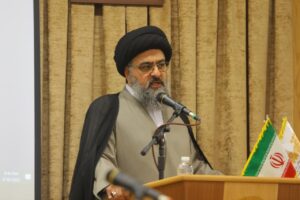
Ayatullah Sayyid Mujtaba Nur Mufidi: Presenting the teachings of the Ahl al-Bayt (peace be upon them) in today’s global intellectual space has acquired redoubled necessity, and the Research Institute will earnestly pursue its academic mission on this path.
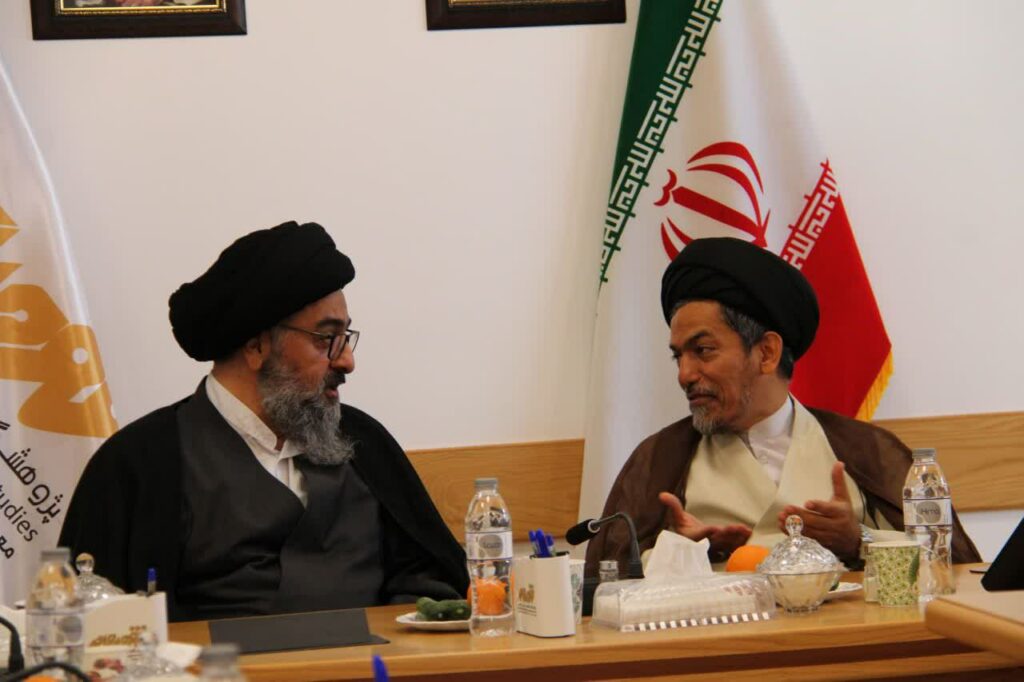
Hujjat al-Islam wa al-Muslimin Sayyid Mahdi Alizadeh Mousavi, esteemed Representative of the Supreme Leader in Bangladesh, visited the Research Institute for Contemporary Jurisprudence and became closely acquainted with the academic, international, and managerial activities of this research center.
According to the news portal of the Research Institute for Contemporary Jurisprudence, in this meeting, Hujjat al-Islam wa al-Muslimin Dorri, Vice President of the Institute, outlining the establishment process and six years of academic activities of this center, presented a report on 10 active specialized departments—including the Jurisprudence of Economics, Health, Art, Environment, and Family. Emphasizing an approach avoiding symbolic actions, he detailed the “Encyclopedia of Contemporary Jurisprudence” project, announcing that 700 entries have been formulated and 360 jurisprudential subjects with gathered sources placed at the disposal of researchers thus far.
Point to critical-analytical reports on over 290 jurisprudential books, the Vice President of the Institute referenced research gaps present in research sources, deeming these vacuums requiring earnest engagement by researchers. He also announced the Institute’s “Wiki” platform, which provides all data intelligently and continuously to the academic community.
Hujjat al-Islam Dorri further added: Compiling 37 specialized journals in contemporary jurisprudence published in Iran, alongside producing and publishing 28 electronic journals by the media department, this Research Institute covers updated findings and discussions of contemporary jurisprudence. The technology department of the Institute also utilizes artificial intelligence capacities in text translation, audio transcription, and conducting preliminary research.
Referring to the Institute’s book publication activities, he stated: Currently, we have approximately 40 book titles ready for print, among which six to seven titles have been published, six titles submitted for licensing, and eight titles undergoing typesetting. He also announced the Institute’s new decision regarding immediate translation and publication of all published books into Arabic and English, adding that this translation process recently commenced.
Hujjat al-Islam Dorri announced the preparation of a comprehensive chatbot intended to incorporate valuable information available on the Institute’s portal—including classes, books, professors, research topics, and advisors. He stated: Following information completion in cooperation with the technology department, this chatbot will be prepared to offer services to researchers and interested parties for convenient access to required information.
Expanding International Interactions and Pioneering the Use of Modern Technologies
Dr. Moblaghi, Director of International Affairs at the Institute, enumerated four fundamental strategies of this department: First, drafting the “Comprehensive Map of International Islamic and Jurisprudential Studies Centers”—a database identifying nearly 120 reputable global centers that will soon become publicly accessible as an online reference. Second, “Referencing International Academic Events”—encompassing monthly monitoring of 9 to 10 reputable global conferences and academic seminars, providing direct links for participation by Iranian researchers. Third, “Organizing Specialized Seminars and Jurisprudential Symposia”—having organized 16 specialized seminars and 4 international symposia featuring prominent academic figures from countries such as Iraq, including a recent seminar titled “Methodology of Argumentation using the Holy Quran in Sunni Jurisprudential Works” with professors from the University of Kufa. Fourth, “Expanding Exchanges”—including reinforcing virtual communications as well as in-person diplomacy via hosting and dispatching researchers. Pointing to extensive interactions with Arab countries and Lebanon, Dr. Moblaghi described the Institute’s future vision as expanding this communication network to Eastern Islamic nations (Pakistan, Bangladesh, and India) to establish “Contemporary Jurisprudential Studies” as an all-encompassing scientific movement across the Islamic world.
Digital and Print Library: Comprehensiveness in Resources and Innovation in Access
Subsequently, Mr. Rostami, Director of the Institute’s Library, presented the unit’s activities since 2020 [1399 Solar Hijri]. He announced that this digital library gathered over 25,000 data records across Persian, Arabic, and English languages, with over 18,000 documents (articles, dissertations, and books) containing full text files. He also referenced uploading detailed tables of contents of Persian books to acquaint researchers with their contents.
Mr. Rostami also added: The Institute’s library has transformed into a primary resource cited by active artificial intelligence engines in this field, logging approximately 7,000 to 8,000 unique visits monthly from artificial intelligence bots prior to internet disruptions.
The Director of the Institute’s Library reminded: Alongside the digital library, the Institute’s print resources—by purchasing and collecting over 5,000 specialized book volumes—have sought to fill resource vacuums in fields such as Medical Jurisprudence, Art Jurisprudence, and Economic Jurisprudence, while procuring resources aligned with Sunni research perspectives as well.
Continuing, Hujjat al-Islam Mousavi, Administrator of the Advanced Contemporary Jurisprudence Classes Website, announced the uploading of 390 contemporary jurisprudence classes across various years from over 111 professors, stating: These classes are categorized across 40 distinct subjects, and we are currently updating approximately 80 percent of these classes for the current year.
He added: In addition to dedicated classes, references by sources of emulation (Marja’s) addressing contemporary jurisprudential subjects in other classes were compiled and included on this site. Over 12,000 files have been uploaded thus far, which, including the media collection (Resanash), brings this figure to nearly 14,000 files.
Referring to the Institute’s policies in expanding activities internationally, Hujjat al-Islam Mousavi stated: Pursuant to directives from officials, entry into classes of Arabic-speaking professors from Karbala, Najaf, Qatar, Saudi Arabia, and the UAE has commenced. He added: Classes of professors from Saudi Arabia and Bahrain have also been gathered under the categories of “Jurisprudence of Emerging Events” (Fiqh al-Nawazil) and “Emerging Issues” (Mustahdasat).
Subsequently, Hujjat al-Islam wa al-Muslimin Sayyid Mahdi Alizadeh Mousavi, Representative of the Supreme Leader in Bangladesh, commending the founder of the Research Institute for Contemporary Jurisprudence, Ayatullah Sayyid Kazim Nur Mufidi, Representative of the Supreme Leader in Golestan Province, described his role in consolidating unity and disseminating the teachings of the Ahl al-Bayt (peace be upon them) in this province as most prominent, emphasizing the necessity of international academic branding centered around prominent jurisprudential figures and requesting research activities transcend limited domestic confines.
The Representative of the Supreme Leader in Bangladesh added: “The points presented were exceedingly valuable and illuminating, showing that the Institute organization benefits from faithful, dedicated human resources stepping along the path of academic and religious development by divine grace.” He further emphasized: “The Research Institute for Contemporary Jurisprudence must achieve international authority (Marja’iyyah).”
Outlining the capacities of the institution under his management, he stated: We operate across three strategic areas: first, extracting a model for “dialogue” (inter-school of thought, interfaith, and even with non-believers) based on “Etiquette of Disagreement” (Adab al-Khilaf), which focuses on jurisprudential discussions beyond theological ones; second, the realm of doctrines and movement-mapping addressing intellectual foundations; and third, the civilizational realm responding to challenges of the decline of Islamic civilization.
Pointing to the specific context of Bangladesh and the Subcontinent region, the Representative of the Supreme Leader in Bangladesh noted: We face a population of 170 million holding immense receptivity toward our jurisprudential sources. Unlike the Arab world—which is sometimes accompanied by diplomatic and religious challenges—the Subcontinent region is thirsty for the teachings of the Ahl al-Bayt (peace be upon them), and universities in this region strongly demand jurisprudential sources and exchanges. He added: Even among Ahl al-Hadith and Wahhabi currents, changing approaches and demand for scholarly dialogues are visible, representing a precious opportunity.
Hujjat al-Islam wa al-Muslimin Alizadeh Mousavi also proposed that given the excellent reception in understanding Shia academic centers, readiness exists to introduce the Research Institute for Contemporary Jurisprudence as a landmark center for holding joint seminars and information exchange.
Criticizing weakness in introducing prominent Shia figures to the world, the Representative of the Supreme Leader in Bangladesh stated: Unfortunately, we maintain weak branding in the international arena. While certain movements centered around a single figure maintain presence in 110 countries worldwide, many of our great jurists remain unknown even among Shia in neighboring nations.
He added: We must abandon “localism” (bumi-nagari) and, relying upon the capacity of prominent, top-tier figures, build a focal core to introduce Shia contemporary jurisprudence to the world.
In conclusion, stating that “all our academic assets must not remain confined domestically,” Hujjat al-Islam wa al-Muslimin Alizadeh Mousavi declared full readiness for hosting specialized seminars, dispatching professors to the Subcontinent, and translating and promoting the Institute’s achievements in this region, emphasizing that accumulated capacities in this Research Institute possess the necessary potential to transform into a civilizational authority in the Islamic world.
At the conclusion of this meeting, Ayatullah Sayyid Mujtaba Nur Mufidi, President of the Research Institute for Contemporary Jurisprudence, in his remarks, while expressing gratitude for the presence of Hujjat al-Islam wa al-Muslimin Sayyid Mahdi Alizadeh Mousavi and his presentation of valuable, illuminating topics, emphasized: This meeting is a precious opportunity for exchanging views and strengthening synergy, and I appreciate his goodwill and positive perspective.
Referring to the formation process of the Institute’s activities, he stated: “In recent years, remarkable movements occurred in the realm of jurisprudential research, rooted in scientific planning and sincere efforts of every member of this organization. We consider this an auspicious sign and hope that by divine grace, the future horizon will be even brighter than the past.”
Ayatullah Nur Mufidi concluded by emphasizing: Presenting and explaining the teachings of the Ahl al-Bayt (peace be upon them) in today’s global intellectual space has acquired redoubled necessity, and the Research Institute will earnestly pursue its academic mission along this path.