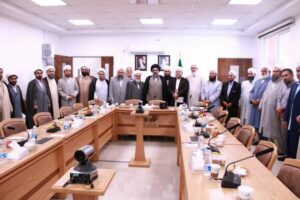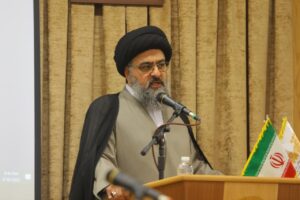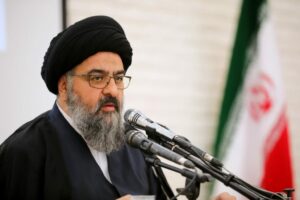
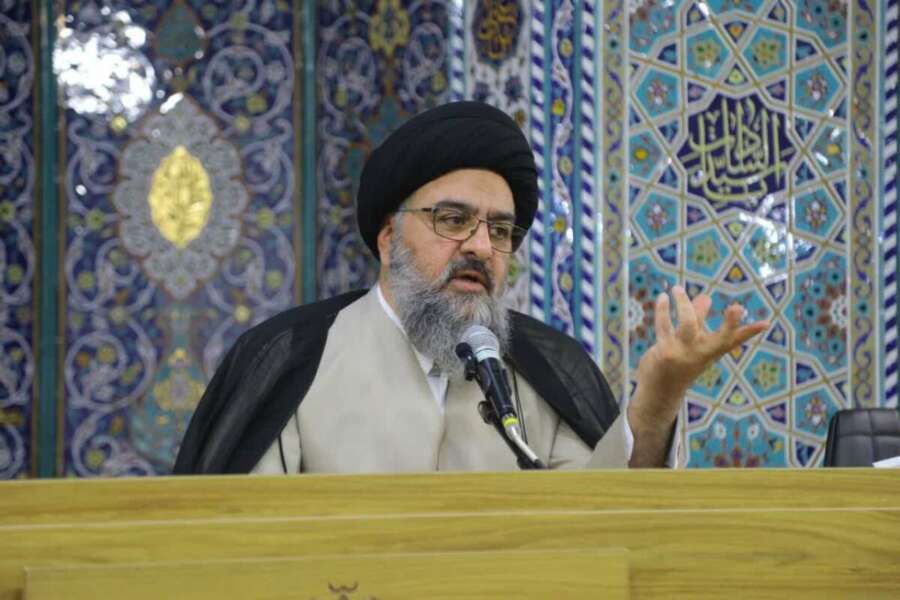
Ayatullah Sayyid Mujtaba Nur Mufidi, during a speech at the academic seminar explaining the school of Imam Khomeini (peace be upon him) on the topic “Imam Khomeini’s Critical Engagements with the Science of Usul in the Contemporary Era,” stated: A critic and evaluator must possess the maximum level of scholarly qualifications and capabilities. Many critics do not possess such qualifications, and we can clearly see this inability in their works and words. The Imam stood at the apex of scholarly capability and competence, entering every field of knowledge as a great specialist and authority.
First, it is necessary to commemorate the birth anniversary of Fatima al-Zahra (peace be upon her), which passed a few days ago, as well as the birth anniversary of the Imam (may his soul be sanctified), and to express joy at the establishment of such a center and extend appreciation to those involved in this organization, those who strove to organize this meeting, the esteemed director of the Institute for the Preservation and Publication of the Works [of Imam Khomeini] in Qom, his esteemed colleagues, and above all, the respected Custodian of the Shrine of the Imam (may his soul be sanctified) and the Institute for Preservation and Publication, His Eminence Ayatullah Aqa Haj Sayyid Hassan Khomeini, who truly and fairly has striven and continues to strive for promoting the thoughts of the Imam, organizing beneficial and effective measures.
Given the limited time available in this session, I do not have ample opportunity to present a detailed account of what I wish to deliver; however, I am obliged in this brief opportunity to concisely address the critical engagements of the Imam (may his soul be sanctified) with the science of Usul in the contemporary era.
The Four Approaches of the Imam (may his soul be sanctified) in His Scholarly Works
The Imam (may his soul be sanctified) adopted four approaches and engagements toward the sciences in which he taught or authored works, especially the science of Usul (‘Ilm al-Usul). If we wish to categorize his entry into the various fields of knowledge in which he authored works or delivered lectures, one approach is the explanatory/explicatory approach (ruykard-e idhah’i); second, the critical approach (ruykard-e intiqadi); third, the reformative approach (ruykard-e islahi); and fourth, the innovative approach (ruykard-e ibda’i).
Clarification, explanation, and interpretation of the views of predecessors and theorists is a task that everyone seeks to undertake; now, to what extent they succeed in fulfilling this vital task is another discussion. The critical approach, of course, has various levels; the type of critique, its depth, and its scope vary. The critical approach usually serves as the basis for reform and innovation. Some stop at the surface in their critical approach; some examine to an extent the underlying layers of a theory or opinion; while others dive deep to capture the foundations and assess their validity or invalidity. However, rarely does reform emerge from the heart of this engagement and approach, and even less frequently, innovation. The Imam (may his soul be sanctified) possessed all four of these approaches in most of his works and writings, and this is clearly observable and traceable.
My address in this session is focused on the second engagement, namely the critical engagement; I will not deal with the explanatory engagement. Of course, the Imam’s reforms and innovations arising from this engagement demand an independent session of their own. Therefore, the axis of my speech is solely this approach and engagement, specifically regarding the science of Usul.
The Most Important Characteristics of the Imam’s (may his soul be sanctified) Critical Approach
Before entering the main axes of this critical engagement, I deem it necessary to address the most prominent and important characteristics of the Imam’s critical approach toward a discipline or the issues of a discipline. These characteristics are not unique to the science of Usul; you observe these features in jurisprudence (fiqh) as well, and where he embarks upon Quranic exegesis (tafsir), it is observable. When he enters the ocean of philosophy and gnosis (‘irfan), we can again clearly see these prominent features.
Five characteristics and prominent features in the Imam’s critical engagement and approach can be mentioned, setting aside his scholarly and ethical qualifications. For the first condition of criticism and critique (regardless of the subtle differences between the two, which we may pass over) is scholarly and ethical qualification. A critic must possess maximum scholarly competence and capacity. Many critics do not possess such competence, and we can clearly see this inability in their works and words. The Imam stood at the pinnacle of scholarly capability and competence (which time does not permit addressing now) and entered every field of knowledge as a great specialist and authority. Therefore, setting aside this point regarding the critic, which is a crucial condition, five prominent features can be noted in Imam Khomeini’s critical engagement:
1. Macro-View (Kalan-nagari), Not Micro-View
Each of these axes is independently open to discussion, elaboration, and citation of evidence; we could provide evidence for them, but I must pass through these points in a listed manner because they serve as an introduction to my main address. This macro-view never distanced the Imam from micro-details; we do not see this macro-view in many scholars.
2. Active Processing, Not Passive
Many, when engaging in critique, owe their thoughts to others; they borrow their questions from others, and ultimately through piecing together—or as some say, like a typist placing letters side by side—by placing others’ data, they criticize and draw a conclusion. This is passive processing. However, the Imam, in engaging with sciences, exercises active processing: he thinks independently, formulates questions independently, and draws conclusions independently. Many present others’ data with altered forms. Of course, this does not mean the Imam never did so; the Imam also in certain cases adopted others’ data, stating points whose core substance was borrowed. But for instance, in Kitab al-Bay’ (The Book of Sale), we clearly see that he thought independently, designed a structure independently, posed questions, and drew conclusions. This work is active processing.
3. Discipline and Coherence
Many critical approaches not only lack necessary discipline and coherence, but sometimes fall into contradiction and inconsistency. Regarding the Imam, however, discipline and coherence can be observed throughout his thought and views, especially in the dimension of critique.
4. Addressing Foundations and Fundamentals
Many critics pay attention primarily to the superstructure (bina) and neglect the foundations (mabani). The Imam pays full attention to the underlying fundamentals: sometimes he dismantles the foundation of an opinion, and sometimes he lays new foundations and builds a new structure upon them. In the science of Usul—in the discussions of Sahih and A’amm, the derivative noun (Mushtaqq), the preliminary of an obligatory act (Muqaddamat al-Wajib), and the intersection of command and prohibition (Ijtima’ al-Amr wa al-Nahy)—you can witness evidence of my statement.
5. Focus on Beneficial Discussions
In every science, taking into account the ultimate objective and goal of that science, the Imam evaluates issues. When he encounters issues far removed from the goal and destination of that science, he distances himself from them and holds authors and works accountable for over-engaging in what should not be pursued. These five items constitute the most important characteristics of the Imam’s critical approach.
Axes of the Imam’s (may his soul be sanctified) Critical Engagement with the Science of Usul
In this session, I intend to outline the Imam’s critical engagements regarding the existing state of the science of Usul across several axes, to see how much time we have and how many axes we can present.
Axis One: Redundancies (Zawa’id) in the Science of Usul
Some of the Imam’s critiques are structural, while others are methodological. The most important critical engagement of the Imam (may his soul be sanctified) with the science of Usul in its current state is that Usul has become entangled in issues and discussions far removed from the ultimate goal of Usul. Esteemed professors are aware that the Imam, in numerous places—in his treatise on Ijtihad and Taqlid and on occasions in other discussions—emphasizes that the science of the Principles of Jurisprudence (‘Ilm Usul al-Fiqh) is a prelude to jurisprudence and an instrumental science (‘ilm-e ali), not an independent science (istiqlali). Its objective is discovering the rules of deduction (istinbat) and understanding religious rulings (ahkam). This is the trajectory of Usul. Therefore, if someone distances themselves from this instrumental perspective, adopts an independent view, and becomes submerged in it, in his view it is a waste of life and a departure from this goal. Jurisprudence, which in his view is the law of worldly and otherworldly life, must be the destination for discovering these principles and rules. Hence, the Imam explicitly states that if discussions in Usul are not practical and exert no effect on jurisprudential deduction, engaging in them is futile. In the early parts of the discussion on Certainty (Qat’) and Speculation (Zann), various divisions are mentioned—subjective certainty/speculation (qat’ wa zann-e mawdu’i) and path-based certainty/speculation (qat’ wa zann-e tariqi)—and sub-divisions are stated for each. The Imam states that many of these classifications are “mere imaginations with no reality behind them” (mujarrad tasawwurat la waqi’a laha). Of course, despite holding this critique, in certain places he himself enters the discussion, stating that out of deference to masters (mashayikh), we present these discussions, yet he refrains from entering many such debates.
Regarding one of the bitter consequences of the inflation (tawarrum) of the science of Usul, the Imam states: Perhaps one factor that caused the Akhbaris to adopt a stance of rejection toward Usul—which he describes as an extremist view—was these prolixities and redundancies. His expression is: “And it is possible that this prolixity was the source of the Akhbaris’ attack on the codification of issues in Usul al-Fiqh.” Elsewhere he states: Had it not been for fear of verbosity, I would have delineated all such issues that play no role in deduction and have been discussed past and present. These issues are mentioned throughout Usul, and examples are abundant.
Why is this approach important, and why can it be strengthened to serve as a beginning for returning and reconstructing this discipline in line with its duty? What is rejected and criticized by the Imam is the entry of these redundancies into Usul when they play no role in deduction; no one is opposed to expanding Usul in line with its intended objective. I will cite a few examples: Is it not truly time for some of these issues to enter Usul, whereas this has not occurred and time is spent on matters that, in the Imam’s words, play no role in deduction? We face serious challenges today—challenges not only in responding to modern dilemmas, but even in deriving from sacred texts and religious sources to answer past questions. Our primary sources of deduction are the Quran and Sunnah. Today, one of the primary challenges in understanding religious texts is what has gained fame under the title of hermeneutics: methods of textual interpretation have varied greatly; there is talk of the historical nature of textual interpretation, and the impact of historical rules on religious texts. Where should these be discussed? Part of these may possess a theological (kalami) dimension, but prominent aspects belong to Usul. We have set these aside and debate matters that are, in the Imam’s words, “mere imaginations with no reality.” This is a major dilemma that organizing such meetings and clarifying this perspective can help resolve. Of course, to reassure concerned hearts in the seminary so they do not worry about disrupting scholarly pillars and intellectual foundations, I must state that the Imam was not unique in this regard; prior to him, figures such as the late Mr. Boroujerdi (whose jurisprudential mastery was beyond doubt), the late ‘Allamah Tabataba’i, and Martyr Sadr harbored these concerns. Ultimately, when critical movements become a culture and are promoted, they serve as the foundation for reformative and innovative movements.
For instance, the discussion of the Objectives of Shari’ah (Maqasid al-Shari’ah) is currently raised. I do not wish to pass judgment on this topic now. For some time, Maqasid al-Shari’ah has been discussed in the seminary, with proponents and opponents. But if we are to adopt an approach of rejection or affirmation, it must be discussed somewhere. I state merely as a matter of possibility: Is there any issue if, just as Consensus (Ijma’) was localized, Objectives (Maqasid) are also localized? In the expression of the late Sheikh [Ansari], “They are the foundation for it, and it is the foundation for them.” According to Sharif al-Murtada as quoted by ‘Allamah al-Hilli, Sunnis were the innovators of Consensus due to the historical narrative you know. The late Sheikh in Al-Rasa’il states that Sunnis are the foundation of Consensus, and Consensus is the foundation for them. Yet this very Consensus, viewed by Sunnis as an independent source alongside the Quran and Sunnah for deducing religious rulings, entered Shia jurisprudence and became a source of deduction—not alongside the Quran and Sunnah, but localized. My question is: Is localization of Maqasid possible or not? Of course, Maqasid with the vast scope emphasized by some Sunni scholars is certainly incorrect; as scholars say, it creates chaos and leaves no trace of jurisprudence, causing its erosion. But the same conditions that led to localizing Consensus might provide the possibility of localizing Maqasid. I do not say it is definitive, but its possibility warrants examination.
Or, for instance, some of the Imam’s theories possess the capacity to enter the science of Usul and be discussed. When these fields and openings lie before us, should we engage in issues playing no role in deduction? For example, the theory of time and space (Zaman va Makan) is one of the most vital and novel theories, which I believe has neither been discussed well nor acquired coherence and discipline. A congress was held, articles written, and speeches delivered, but it was abandoned. Many writings published in those days—though presented to interpret this theory—are interpretations displeasing to their author (tafsir bi-ma la yardha sahibuhu). Truly, my impression is that many of them distance themselves from the Imam’s great thought. The theory of time and space itself possesses the capability of transforming into multiple rules of Usul. The desirable expansion of Usul consists of formulating rules suited to new conditions for deducing rulings facing us in the modern world. At one time, jurisprudential rules (qawa’id al-fiqhiyyah) did not exceed the fingers on one’s hands, but today how many rules do we have? Rules of Usul are the same: as we advanced, rules of Usul expanded, and this expansion is not only not censured, but a necessity.
Or the theory of Public Interest (Maslahah), which is truly a critical issue. Regarding Maslahah, vast capacity for scholarly effort exists. I personally held about 70 sessions discussing the Rule of Public Interest (Qa’idah-ye Maslahah). From the Imam’s statements, it emerges that he considered Maslahah involved not only in discovering/deducing secondary rulings or executing secondary rulings, but even in deducing primary rulings (ahkam-e awwaliyyah) within a defined framework. How much room for work exists here! The science of Usul must expand proportionally to these needs. This was the first axis.
These are all important and macro dimensions of this axis in engagement; otherwise, micro-engagements in this regard are also mentionable.
Axis Two: Confusing Reality (Haqiqah) and Convention (I’tibar)
The second axis of the Imam’s critical engagement with Usul—which is a methodological critique you have heard—is confusing reality (haqiqah) and convention (i’tibar), or genesis (takwin) and legislation (tashri’), described in various terms: extending philosophical methodology based on rational proofs into Usul, which is built upon conventional (‘urfi) and rational (‘uqala’i) methods. Significant confusion between the two (reality and convention) has occurred. One of the main axes criticized by the Imam across various issues of Usul is precisely this. From preliminary discussions to the end, examples can be cited throughout Usul where the Imam criticized arguments and conclusions of scholars like the late Akhund [Khorasani], Na’ini, Muhaqqiq Isfahani, and at times Muhaqqiq ‘Iraqi. The foundation of this statement is clear: because Usul seeks to discover rules of deduction and understand religious rulings from religious texts, we face divine addresses (khitabat) and seek to discover religious rulings from them. Naturally, in the Imam’s view, this science is conventional knowledge (danesh-e i’tibari). The propositions arranged in this science and its issues belong to conventional matters—meaning conceptual and assentive meanings that possess no reality outside the vessel of human action and perception (wa’a’ al-idrak). This is why he emphasizes that a jurist must be accustomed to conventional conversations (muhawarat-e ‘urfiyyah). Someone not accustomed to conventional conversations cannot be a good jurist. We have examples among jurists: between those with stronger conventional understanding and those distant from it, we clearly see differences and effects of these two approaches.
I noted several examples here, but time does not permit addressing all of them as each requires explanation. For this axis, perhaps the most examples can be cited, as Akhund Khorasani used this method extensively in arguments, as did Na’ini and Isfahani. For example, in the discussion of contradiction between rulings in Ijtima’ al-Amr wa al-Nahy (Intersection of Command and Prohibition), those asserting the impossibility (imtina’) of intersection cited several premises, one of which leading to impossibility is that the five obligation rulings (ahkam khamsah) contradict one another—stating that two rulings, being two existential matters, cannot coalesce. Many accepted this. The Imam states: In conventional matters (umur-e i’tibari), contradiction (tadhadd) carries no meaning, and everything is subject to the convention of the enacting authority (i’tibar-e mu’tabir). Likewise in cause and effect (asbab wa musabbabat), and in Presumption of Continuity (Istishab). For instance, in Istishab, the survival of the subject (baqa’ al-mawdu’) is required. Sheikh [Ansari], explaining why the subject must survive, states: Because the relation of the presumed item (mustashab) to the subject is that of accident (‘aradh) to substrate (ma’rud). The Imam objects here: Why do you state that the relation between the presumed item and subject is that of accident? This belongs to real matters (umur-e waqi’i); in conventional matters, no such relation exists.
Or regarding abstract concepts (umur-e intiza’iyyah), they say that the removal or enactment of abstract matters in ontology (takwin) is possible only through the source of abstraction (mansha’-e intiza’). This has been used extensively. Coincidentally, today in jurisprudence class, regarding currency depreciation and liability (dhaman), proofs of proponents of liability were discussed. Some proponents hold the purchasing power theory, regarding the essence of money as purchasing power, arguing that one borrowing money assumes liability for purchasing power. An objection raised by some is that purchasing power is an abstract matter, not external wealth (mal-e khariji), and only external wealth comes under liability. In response, under the Imam’s foundation, money today is conventional (i’tibari), whether banknotes or electronic numbers; even if abstract, its enactment and removal are not confined solely to the source of abstraction—everything in conventional matters depends on the manner of convention and enactment (kayfiyyat-e i’tibar wa ja’l). This has significant effects in Usul and Fiqh.
I noted 7 or 8 examples for this axis, but unfortunately time does not permit mentioning all of them.
Axis Three: Restricting Conventional Understanding (‘Urf)
The third axis, to which I must limit myself to conclude, concerns restricting the involvement of conventional understanding (‘urf) in understanding divine addresses (khitabat-e shar’iyyah). This critique served as the basis for some reforms and innovations by the Imam. No one doubts the involvement of ‘urf in understanding divine addresses; no one says we should set ‘urf aside and rely solely on intellect. This differs from Axis Two (where philosophical precision infiltrated textual understanding). Everyone attributes a role to ‘urf, but its domain is crucial. The Imam expanded the domain of ‘urf in understanding divine addresses. I will cite two or three examples.
The late Akhund, Na’ini, and other prominent scholars claimed that rational people (‘uqala) treat the content of legal indicators (amarat) as standing in place of reality (nazil-manzilah-ye waqi’), or speculation standing in place of certainty (qat’). They argued that although when one gains speculation one permits possibility of error (imperfect disclosure), reasoners complete disclosure (tatmim-e kashf), treating it as full disclosure. The Imam completely rejects this notion of placement/imputation (tanzil), stating: What does this mean? Reasoners and custom do not perform such mental operations! Which custom or reasoner in transactions, governance, or wherever speculation is relied upon thinks they are completing imperfect disclosure? These are unnecessary academic discussions that entered our inquiries. He believed reasoners possess reliable paths (turuq mu’tabarah) upon which they act. In solitary reports (khabar wahid), it is not a matter of imputation (tanzil); reasoners realize that if they do not act on solitary reports and seek absolute certainty for everything, their lives would fall into disruption (ikhlal-e nidham). Thus, imputation is not the issue.
Another example where the Imam assigns a role to ‘urf is applying concepts to instances (tatbiq al-mafhum ‘ala al-misdaq). Akhund, Na’ini, and the Imam agree that in concepts, conventional understanding (‘urf) is authoritative—such as the meaning of ghina or puberty (bulugh)—unless the Lawgiver intervened to delimit or qualify it. However, regarding applying concepts to instances, both Akhund and Na’ini stated that ‘urf is not authoritative. The Imam asserts that in applying concepts to instances, ‘urf is indeed authoritative—not careless custom (‘urf-e mutasamih), but precise custom (‘urf-e daqiq) that neither reaches philosophical precision nor tolerates carelessness.
One of the most important instances where the Imam paid attention to ‘urf concerns divine legal addresses (khitabat-e shar’iyyah). The majority view holds that divine addresses dissolve (yanhal) into the number of duty-bound individuals (mukallafin)—the well-known Theory of Dissolution (Nazariyyah al-Inhilal). That is, “Establish prayer” as a general address dissolves into individual addresses equal to the number of humans: Establish prayer, establish prayer, establish prayer. This theory created numerous problems, including addressing the incapable (‘ajiz), the sinner known by God to disobey, or the disbeliever. Most importantly, in the debate on opposing duties (didd) and combining two duties—one more important (aham) and one important (mushimm)—how can the second address apply if the primary is disobeyed? Scholars sought resolution through Step-by-Step Precedence (Tarattub). Criticizing the Theory of Dissolution, the Imam innovated the Theory of Legal Addresses (Nazariyyah al-Khitabat al-Qanuniyyah). He posited two types of addresses: personal address and legal address. A legal address is directed by the legislator at society at large. When legislators enact a law, the objective is establishing legislation; as long as a significant portion possesses capacity for compliance, the address is valid, even if the incapable, disobedient, or disbelieving cannot comply personally. The Imam derived this theory from conventional legislative practice (‘urf). Consider how many problems this resolves—addressing the incapable, sinner, disbeliever, and complex debates on Tarattub. In Enjoining Good and Forbidding Evil (Amr bi al-Ma’ruf wa Nahy ‘an al-Munkar), regarding whether obligation depends on knowledge of capacity, the Imam held that doubt regarding capacity does not waive the obligation through the Principle of Exemption (Bara’ah). Examples like these are abundant.
There were other axes and instances, but I believe this suffices. I truly believe—and I state this without bias or purely emotional attachment that we and your generation hold toward the Imam—that the Imam is a thinker whose views are like pearls in the deep sea of his knowledge, requiring harvesting, processing, and presentation. A thinker whose revolution and socio-political dimensions overshadowed his scholarly dimension. However, one must remain hopeful. These sessions in the seminary are not few, especially over the past year or two. Mr. Asadpour and the Institute itself harbor this concern for promoting the Imam’s thoughts. One must remain hopeful and not despair, although factors have combined to make these scholarly views less prominent. We must tirelessly continue these efforts, especially so that these thoughts are embedded as rules within the science of Usul, providing solutions and hope to society. God willing, this will occur, and the efforts of young scholars, authors, professors, and thinkers must continue with greater strength. If I spoke at length, I apologize to everyone. May Allah make the noble soul of the Imam pleased with this gathering. May its blessings benefit us in the Purgatory (Barzakh) and Resurrection. May Allah ward off the evil of enemies of Islam and the Revolution from the people, and protect the servants of Islam and the system, the Supreme Leader, and the Grand Marja’s under His care.